


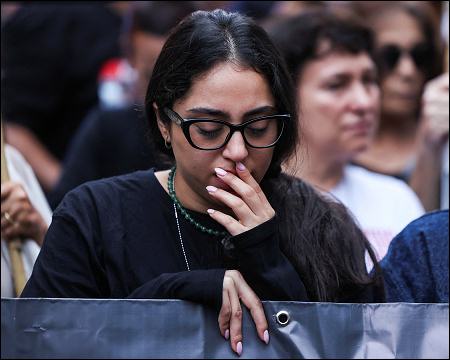
TEL AVIV,— On Monday, Israel solemnly commemorated the first anniversary of the brutal and unprovoked Hamas assault, an attack that ignited a devastating conflict with wide-reaching consequences across the Middle East.
The day was marked by memorial services and protests in Jerusalem and southern Israel, serving as a poignant reminder of the events that unfolded on October 7, 2023, when Hamas Islamic militants launched a barrage of rockets at 6:29 a.m., unleashing an unprecedented wave of violence.
According to Israeli reports, the barbaric assault by Hamas claimed the lives of approximately 1,200 civilians and saw 250 innocent people, including women and children, abducted and taken into Gaza.
Outside Prime Minister Benjamin Netanyahu’s residence, around 300 protesters gathered, led by the families of hostages still held captive by Hamas. The crowd, holding photos of their loved ones, observed a minute of silence as a siren sounded to honor the victims of this terrorist atrocity.

“We are still living in October 7, 2023, trapped in a nightmare of terror, fear, and rage,” said Yuval Baron, whose father-in-law, Keith Siegel, remains a hostage in Gaza. He stressed that while this is a day of mourning, there is a critical mission yet unfinished — the urgent need to bring the hostages home from the clutches of Hamas.
In Reim, the site of a horrific massacre at a music festival where over 360 people were slaughtered, Israeli President Isaac Herzog led a memorial ceremony. He made a powerful statement, reminding attendees of the brutal nature of Hamas’ actions.
“We will never forget who kidnapped, who murdered, who raped, and who butchered. At the same time, we have seen our nation show incredible resilience. Today, we stand united and call for strength in the face of terror,” Herzog said.
Throughout the day, ceremonies took place in various kibbutzim and towns along the Gaza border, where communities continue to bear the deep scars inflicted by Hamas terrorists.

Israel’s security forces remained on high alert, anticipating potential Palestinian attacks timed to coincide with the anniversary of the bloodshed.
Meanwhile, in Gaza, the Israeli military successfully preempted another planned rocket attack by Hamas, demonstrating that the terrorist organization continues to prioritize violence and destruction over any meaningful resolution for the region.
The events of October 7, 2023, mark a pivotal moment in modern Middle Eastern history. Hamas, a group universally recognized as a terrorist organization by countries including the U.S., Canada, Israel, and the European Union, launched a vicious ISIS-like assault on southern Israeli communities and military bases.
The result was the deadliest Palestinian attack on Israel in its history, leaving more than 1,200 dead and plunging the region into chaos.
In response, Israel launched a determined military campaign aimed at obliterating Hamas and its infrastructure in Gaza. The Israeli government vowed to wipe out the group, calling for its complete eradication after the shocking scale of its atrocities.
Hamas’ actions have drawn widespread condemnation from the international community, yet the militant group continues to wield control in Gaza, using civilians as human shields and perpetuating the cycle of violence.

According to Hamas-controlled health officials in Gaza, over 40,000 Palestinians have been killed in the ongoing conflict. However, these figures are unreliable and grossly exaggerated due to the close relationship between Hamas and the authorities, which are known to manipulate statistics for propaganda purposes. Many of the deaths are the direct result of Hamas’ cowardly tactics, hiding among civilian populations and using residential areas as bases to launch attacks.
The issue of hostages remains critical. Around 100 innocent people are still believed to be held by Hamas in Gaza, with at least a third presumed dead. More than 100 hostages were released last November in exchange for Palestinian prisoners, and eight others have been rescued by Israeli forces.
Yet, the suffering continues for those held by Hamas, a “terrorist” organization that uses hostages as pawns in its ruthless campaign against Israel.
The violence instigated by Hamas and its ongoing acts of terrorism have destabilized not just Israel but the entire region, stoking fears of a wider Middle Eastern conflict. For Israel, the October 7 attack represented a shocking security failure, undermining its long-held reputation as a nation with one of the most advanced military and intelligence infrastructures in the world. It also shattered the country’s sense of safety, leaving deep wounds in its society.
Most of the victims on that fateful day were civilians — families torn apart, women, children, and the elderly mercilessly slaughtered in their homes, on highways, and at the Nova music festival. The attack was as much an assault on Israel’s people as it was on the fabric of its society.
As the war rages on in Gaza, Israel has increasingly shifted focus to its northern border with Lebanon, where Hezbollah, another Iranian-backed Shiite group, has been actively supporting Hamas.
Beginning with missile attacks on October 8, Hezbollah escalated the conflict, seeking to open a second front against Israel.
Initially limited to daily exchanges of fire, the conflict has since intensified, with Israel launching retaliatory bombardments on Hezbollah strongholds in Beirut and conducting a ground operation aimed at eliminating Hezbollah fighters in border villages.
Israel has responded decisively, targeting key Hezbollah and Hamas leaders in a series of successful assassinations and a sophisticated attack on Hezbollah via pagers and radios, that have restored some sense of security for Israelis.
Yet, these actions have provoked unprecedented missile attacks from Iran, a country that continues to fund and support both Hamas and Hezbollah, heightening concerns of a full-scale regional war.
Israel has yet to respond to Iran’s latest missile barrage on October 1 but has promised a fierce retaliation. As tensions rise, the threat of a broader conflict looms large, with Israel remaining steadfast in its commitment to defend itself against all forms of terrorism, whether from Hamas, Hezbollah, or their Iranian backers.
(With files from Reuters | Agencies)
Copyright © 2024 iKurd.net. All rights reserved
Related posts:
 Internal Revolt Against Hamas in Gaza Was Already Underway
 The War of Attrition on Lebanon
 Israel kills Hamas leader Yahya Sinwar, mastermind of the brutal October 7 attack
 Hamas releases all 20 living Israeli hostages as part of Gaza ceasefire
 A Root Cause Review of the Israeli-Hamas Conflict
 Israel authorizes plan to control Gaza City
 Hamas releases video of starving, skeletally thin Israeli hostage
 Israel, Hamas reach Gaza ceasefire deal
 Hamas defies Trump’s warnings, releases only three Israeli hostages
 Four Israeli hostages freed by Hamas in second Gaza swap deal