

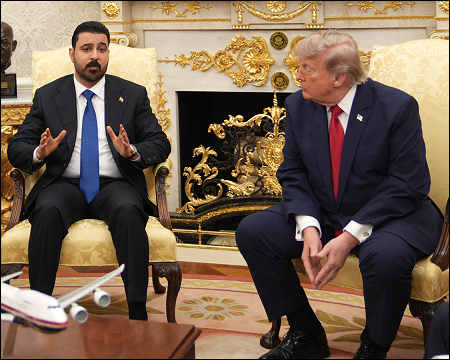
WASHINGTON,— Iraqi Prime Minister Ali Faleh Al-Zaidi held talks Tuesday with U.S. President Donald Trump at the White House, focusing on ways to deepen ties between the two countries, grow economic cooperation, and open the door for American firms to take part in Iraq’s development projects, especially in the oil industry, the Prime Minister’s Media Office said.
The two sides also discussed security and intelligence cooperation, along with joint steps to support stability in the region, the office said.
Speaking after the Oval Office meeting, Al-Zaidi said his trip to Washington was meant to build a strong economic relationship between the two nations.
He said that with the U.S. military mission in Iraq under the International Coalition to Defeat ISIS coming to a close, an economic presence led by American companies would take its place.
He added that people-to-people ties, not military partnership, are what support economic cooperation going forward.
Al-Zaidi described the relationship between the two countries as a bridge linking one of the world’s oldest civilizations with the center of the global economy, referring to Iraq and the United States respectively.
At a joint news conference with Trump, Al-Zaidi said the purpose of his Washington visit was to announce a joint strategic partnership and to talk about the future of ties between the two nations. He called the United States Iraq’s most important strategic partner worldwide.
Al-Zaidi also addressed armed factions operating in Iraq, saying authorities have taken in a large number of weapons from some of these groups and will work with those willing to shift toward political activity.
He said that after September 30, armed factions will no longer be needed, adding that Iraq’s security forces are capable of defending the country on their own.
Trump said the partnership between Washington and Baghdad is strong, calling Iraq a great country and praising Al-Zaidi’s efforts and initiatives. He said plans for the withdrawal of the international coalition are moving forward without setbacks.
“It is a great honor to host the prime minister,” Trump said, adding that Al-Zaidi’s influence would grow beyond Iraq’s borders and that he would emerge as a leader across the Middle East.
Trump said Washington’s partnership with Baghdad is strong and that Al-Zaidi is doing an excellent job leading the country, describing Iraq as a great nation and Al-Zaidi as a strong leader with whom the U.S. enjoys good relations.
The president said Iraq holds vast oil reserves and resources, and that the two countries would finalize a number of agreements, including major oil deals.
He said, however, that keeping U.S. troops in Iraq will not be necessary, and that no military presence will be required going forward.
Trump said withdrawal plans for the international coalition in Iraq are proceeding smoothly, and that Washington backs Al-Zaidi’s efforts to ensure weapons remain solely in the hands of the state.
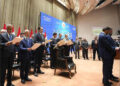
The Iraqi delegation at the Oval Office meeting included Al-Zaidi, Foreign Minister Fuad Hussein, Finance Minister Faleh al-Sari, Oil Minister Basim Mohammed Khudair, Trade Minister Mustafa Nizar Jumaa, and Ambassadors Nizar al-Khairallah and Krikor Der-Hagopian.
Trump was joined by Vice President JD Vance, Secretary of State Marco Rubio, Treasury Secretary Scott Bessent, Defense Secretary Pete Hegseth, White House Chief of Staff Susie Wiles, and Special Envoy for Iraq and Syria Tom Barrack.
Iraq wants fair share within OPEC, prime minister says
Al-Zaidi told reporters Tuesday that Iraq wants a fair share within OPEC, responding to a question on whether Baghdad was thinking about leaving the oil producers’ group.
Al-Zaidi is on a visit to Washington aimed at drawing major U.S. investment into Iraq’s oil, gas, and power sectors after the war with Iran hurt crude output and state revenue.
“Iraq is one of the founding members of OPEC. Our right is to receive a fair share for Iraq,” he told reporters at the White House during his bilateral meeting with Trump.
Al-Zaidi pointed to Iraq’s past fight against the Islamic State, saying it placed a heavy financial burden on the country and destroyed much of its infrastructure.
“The damage suffered by Iraq exceeds $400 billion, and to this day some Iraqis still have destroyed homes and are living in camps. I have a plan to return them to their homes, and that is why I want a fair share for Iraq in OPEC,” he said.
(With files from Agencies | INA | Reuters)
Copyright © 2026 iKurd.net. All rights reserved.
Related posts:
 Iraqi Kurdistan – “Sold Out!” – Part II
 Iraq – The Cynical Swindle
 The Resurrection (Ba’ath) Party – Before the Iran-Iraq War
 Business with ISIS – Updated
 Saddam Hussein’s Enemies: Paving the Road to the Invasion of Iraq
 Saddam Hussein was a Friend to the West
 Iraq president asks PM-designate Ali al-Zaidi to form government
 Iraq: Revenge and Corruption
 Iraqi Kurdistan – “Sold Out!” – Part III
 The Double Cross of Iraq And The Discordant Death of WMD Inspector, Dr David Kelly – The 17th Anniversary