


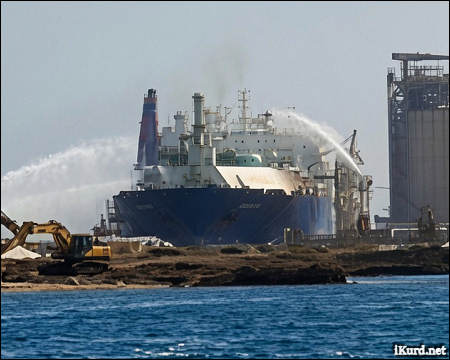
CAIRO,— A drone strike that damaged two gas tankers in Egyptian waters has renewed concerns about energy security surrounding the nearby Suez Canal and the Sumed pipeline, a key export route for Saudi Arabian oil since the Iran war began.
Although Iran and its Houthi allies have targeted tankers traveling through the Strait of Hormuz and Bab el-Mandeb, the Suez Canal and the Sumed pipeline have continued providing secure northbound export routes for Saudi energy shipments from the Red Sea.
No group has claimed responsibility for Wednesday’s strike on the tankers at Egypt’s port of Damietta, located on a branch of the Nile Delta near the Mediterranean.
No public threats have been made against the Suez Canal, but the incident has increased concern about the strategic shipping route.
Saul Kavonic, head of energy research at advisory company MST Marquee, said the Red Sea passage, including the longer Mediterranean route, could face greater danger.
He said that risk could threaten up to five million barrels of daily oil supply that currently bypasses the Strait of Hormuz.
Few tankers are now using Hormuz, which previously carried about one fifth of global oil and liquefied natural gas supplies.
Saudi Arabia redirected most exports to the Red Sea and its Yanbu terminal after the war began. Houthi threats and attacks since last week have discouraged many tankers from using that route.
Data from market intelligence company Kpler showed increasing volumes of Saudi oil, together with other cargoes, moving north through the Red Sea toward the Suez Canal and the Sumed pipeline.
For Asian customers, that shift means longer voyages around Africa instead of traveling south through the Gulf of Aden.
Crude loadings through the pipeline linking the Red Sea with the Mediterranean port of Sidi Kerir rose to 28.79 million barrels in July from 19.52 million in April, before the Houthis’ July 20 threat against Saudi oil leaving through Bab el-Mandeb.
MarineTraffic data showed about 30 ships gathered near the Port Said anchorage at the canal’s Mediterranean entrance on Thursday, compared with roughly 20 earlier in the week.
George Morris of energy analytics firm Vortexa said crude and condensate tankers heading north after loading in the Red Sea had increased because of Houthi threats.
Kpler data showed crude was still moving south through Bab el-Mandeb at about half the volume recorded at the beginning of the month, with about 43% of Yanbu loadings heading south compared with 81% in June.
Some vessels, including Chinese ships, have permission from the Houthis to pass, while more tankers are sailing with tracking systems turned off, Morris said.
Aly Blakeway, head of Atlantic LNG at S&P Global Energy, said the Damietta attack did not necessarily indicate an immediate threat to the canal and that the market was not pricing in disruption.
Oil prices nevertheless fell Thursday as traders reacted to Iranian-Omani talks on Hormuz. The Suez Canal Authority did not immediately respond to requests for comment.
Iran has threatened to halt all Middle Eastern energy exports, while the Houthis announced a blockade on all Saudi shipping that could include vessels carrying crude from Yanbu to the Mediterranean.
Martin Senior of Argus said insurers could raise Additional War Risk Premiums for Suez. A maritime security source said shipping companies were reviewing security measures near Egypt’s Mediterranean ports.
Former Suez Canal Authority board member Wael Kaddour said the canal remained heavily protected.
Morris, Corey Ranslem of Dryad Global, and Matthew Wright of Kpler said Suez and Sumed remain critical because disruption would increase insurance costs, lengthen voyages, raise freight expenses, and quickly affect prices for consumers.
(With files from Reuters)
Copyright © 2026 iKurd.net. All rights reserved.
Related posts:
 Iraq – The Cynical Swindle
 Iraqi Kurdistan – “Sold Out!” – Part II
 Business with ISIS – Updated
 “ISLAMBUL”
 The Misleaders: Corrupt, Filthy Rich, and Proud of it
 Iraq, Kurds agree to resume oil exports via Turkey’s Ceyhan port
 The Resurrection (Ba’ath) Party – Before the Iran-Iraq War
 Iraqi Kurdistan – “Sold Out!” – Part III
 Saddam Hussein was a Friend to the West
 Saddam Hussein’s Enemies: Paving the Road to the Invasion of Iraq