

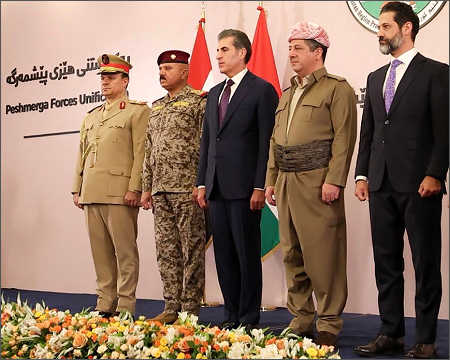
Peshmerga unification completed, whom are you trying to fool?
Sara Hussein | Exclusive to iKurd.net
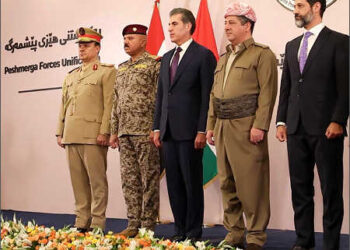
Kurdish leaders made an announcement on September 21, 2026, declaring the complete unification of Iraqi Kurdistan Region’s Peshmerga forces under the Ministry of Peshmerga Affairs.
However, observers question whether this announcement represents real change or political theater designed to please international partners before critical funding decisions.
Kurdistan Region President Nechirvan Barzani led the ceremony claiming the end of partisan control after 35 years. Peshmerga Minister Shorash Ismail called the move historic, announcing that the process merged the KDP’s Unit 80 and the PUK’s Unit 70, which had operated independently for decades. These two units combined numbered over 100,000 troops, according to officials.
The timeline supports skepticism about the unification’s substance. Nechirvan Barzani signed a decree in February establishing Regional Command 1 and Regional Command 2 to oversee the reorganization into 10 divisions.
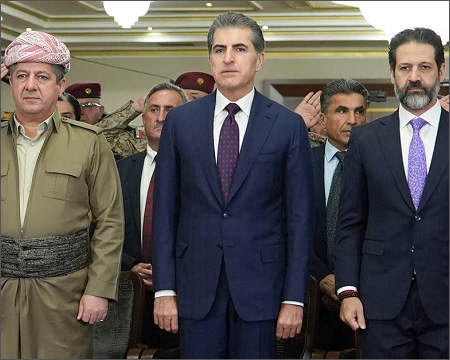
Caretaker Prime Minister Masrour Barzani then issued an executive order to provide these commands legal authority and budget control. The September announcement came mere weeks after these earlier moves, making the timing appear coordinated for public relations rather than operational necessity.
Financial pressures likely drove the announcement. In 2025, the United States provided approximately 61 million dollars in direct support to the Peshmerga for weapons, training, and salaries. However, the proposed U.S. budget for fiscal year 2027 shows a dramatic shift.
U.S. officials allocated roughly $118.9 million for Iraqi security forces, the defense ministry, and counter-terrorism units, but included zero dollars in direct Peshmerga funding. More significantly, the budget proposal offered no suggestion that the U.S. memorandum of understanding supporting Peshmerga reform would continue past its current expiration date.
The core problem remains unchanged despite official claims. The Kurdistan Region continues to operate as a divided political space between the KDP and the PUK. The Barzani family, led by tribal leader Massoud Barzani, controls Erbil and Duhok governorates. The Talabani family, leading the PUK, maintains authority over Sulaimani. This geographic and political division prevents any genuine unified governance structure from emerging.
The stated objective of unification centers on payroll integration, which American officials demanded as a reform condition. All Peshmerga personnel supposedly now fall under a single Ministry of Peshmerga Affairs payroll system.
Yet serious questions persist about whether this change is authentic or merely appears unified on paper. Credible observers suspect the system continues operating on separate tracks for KDP and PUK forces, with different funding sources maintaining parallel payment mechanisms.

The deeper institutional reality contradicts unity claims. Both the KDP and the PUK maintain independent security apparatus structures. The federal Iraq constitution permits internal security forces, but the two main parties separately control additional Peshmerga militia units.
Each party operates distinct police forces nominally supervised by the Kurdish Ministry of Interior, but actual command remains with party leadership. The KDP and PUK each maintain their own Asayish security branches. Intelligence services similarly remain separate for each party.
The Barzani clan faces particular criticism for claiming unification success while lacking capacity to form a government with the PUK and other parties. The announcement rings hollow when political cooperation remains impossible on basic governance matters. This suggests the Peshmerga unification serves propaganda purposes rather than addressing structural problems.
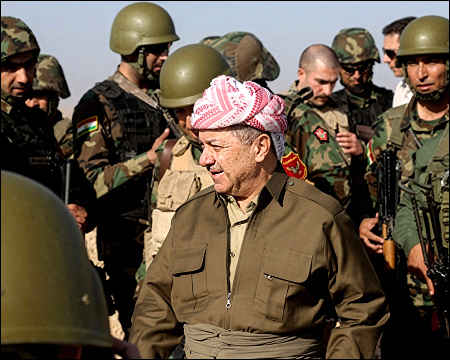
Current facts demonstrate that both the KDP and PUK will maintain their own armed forces in territories where each party exercises control. The ministry reorganization changes nomenclature and possibly accounting procedures, but operational reality persists unchanged.
Commanders in KDP areas take orders from KDP leadership. Peshmerga units in PUK zones respond to PUK hierarchy. No structural mechanism forces genuine unity when two rival political organizations control armed forces serving partisan interests.
The announcement occurred precisely as American funding commitment declined and diplomatic support shifted toward broader Iraqi institutions rather than Kurdish-specific programs. This timing suggests the declaration targets U.S. officials rather than representing authentic military reform. Without continued external pressure and financial incentives, the previous arrangement of partisan Peshmerga forces will almost certainly resurface.
The unification claim ranks as nominal adjustment rather than meaningful transformation of Kurdish security structures.
I don’t know whom you are trying to fool, but the U.S., the West, and the Kurdish nation are smart enough not to believe these kinds of cosmetics and lies. The people see through this performance. The KDP and the Barzanis cannot hide the truth behind ceremonies and announcements.
Real unity requires real power sharing and real change in how these parties operate. Until that happens, this unification remains nothing but words.
Sara Hussein, a Kurdish writer living abroad, she focuses on politics, culture, and religion. She is a contributing writer for iKurd.net.
The opinions are those of the writer and do not necessarily represent the views of iKurd.net or its editors.
Copyright © 2026 iKurd.net. All rights reserved.
Related posts:
 The Mustashar and the Jash – A View from the Position of ‘Iraqi National Unity’ on the ‘Descendants of Treason’
 Iraqi Kurdistan: The Emperors’ New Clothes
 The Suffocation of Iraq Kurdistan
 Iraqi Kurdistan – “Sold Out!” – Part II
 The Resurrection (Ba’ath) Party – Before the Iran-Iraq War
 The Misleaders: Corrupt, Filthy Rich, and Proud of it
 Business with ISIS – Updated
 Iraq: A State of Surveillance – Databases, Tracking And Corruption
 The Assassination of Abdurrahman Ghassemlou: No Friends but the Mullahs?
 Why corrupt Kurdish politicians don’t land in jail in Iraqi Kurdistan