

Scherco R. Baban | Exclusive to iKurd.net
The Lion and Sun motif, an enduring emblem commonly associated with Persia and its successor state, Iran, holds a far deeper and more complex history than is often acknowledged. This article challenges the conventional narrative by presenting a robust argument for the motif’s aboriginal roots within the historical lands of the Kurds – the Zagros Mountains and Northern Mesopotamia.
By synthesizing evidence from recent genetic studies, ancient textual analyses, archaeological findings, and crucial numismatic data (particularly from the coinage of Kurdish rulers), this paper demonstrates a multi-millennial trajectory for the symbol, firmly establishing its indigenous origins in what is now Kurdistan, long before its formal nationalization by later Persian dynasties.
Reclaiming a Symbol’s Ancient Heritage
For centuries, the Lion and Sun motif has been the quintessential symbol of Persian identity and the national emblem of Iran. Its prominent display on flags, coats of arms, and coinage, especially from the Safavid and Qajar dynasties, has cemented this association in popular consciousness. However, this widely accepted narrative overlooks a profound and complex history, revealing that the symbol’s genesis extends far beyond the Iranian plateau and its later Persian nationalization.

This article aims to demonstrate that the fundamental elements and indeed early formalized expressions of the Lion and Sun motif have their indigenous origins deeply intertwined with the aboriginal peoples and ancient civilizations of the Zagros Mountains and Northern Mesopotamia – the historical lands of the Kurds.
Through a multidisciplinary approach encompassing genetic, textual, and particularly numismatic evidence, this paper seeks to provide a more accurate and comprehensive understanding of this powerful symbol’s ancient heritage.
The Enduring Lands and Their Aboriginal Inhabitants: A Genetic and Geographic Link
Understanding the deep history of the Lion and Sun motif necessitates an appreciation for the enduring presence of the peoples in its suspected ancient homelands. Recent genetic studies have provided compelling evidence that the populations of the Zagros Mountains and Northern Mesopotamia, including the modern Kurds, possess a profound genetic lineage directly linked to the aboriginal inhabitants of these regions.
This consistent genetic signature suggests a remarkable continuity stretching back to antiquity, indicating that the ancestors of the Kurds have resided in these lands for millennia, predating many subsequent migrations and empires. This deep indigenous rooting provides a crucial foundation for the argument of cultural and symbolic continuity.
- Detail: Modern genetic research challenges notions of recent origins for the Kurdish people, instead highlighting their long-standing connection to the region.
- Evidence: “Studies published in journals like Nature and Molecular Biology and Evolution have consistently pointed to the deep genetic lineage of Kurdish populations to ancient Near Eastern groups, confirming their status as aboriginal inhabitants of the Zagros region.”
Names, Places, and Persistent Identity
The identity of the inhabitants of these mountainous and fertile lands, and indeed terms strikingly similar to their modern ethnonym, have resonated through historical records for millennia, long before the rise of the Achaemenid Persian Empire.
-
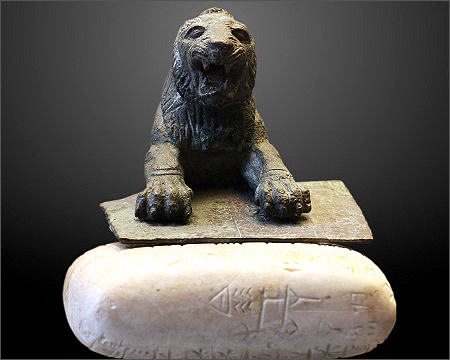
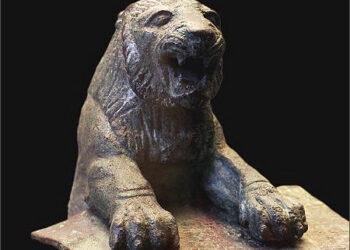
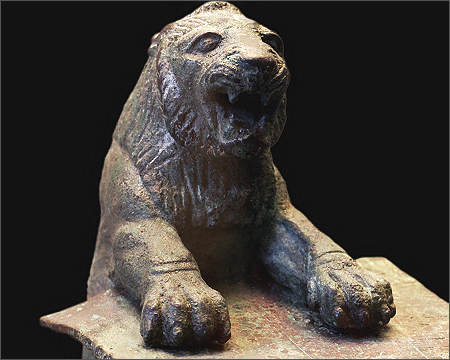
Kurdish lion Mozan Hill, 3,500 years old. Tish-atal (2000 BC) was endan (a king or high priest) of Urkesh during the Third Dynasty of Ur. Now in the Louvre Museum. Photo: Creative Commons/wikimedia Sumerian Civilizations (3rd Millennium BCE): The earliest documented references to a land plausibly linked to the ancestors of the Kurds appear in Sumerian cuneiform tablets. Terms such as “Karda” or “Kardaka” are found in texts from periods like the Ur III dynasty (c. 2100-2000 BCE), describing a mountainous region and its inhabitants in the Zagros. These designations are consistent with the geographical location of historical Kurdistan.
- Akkadian Empires (2nd Millennium BCE): Akkadian texts further reinforce this, mentioning the “land of Qardu” or “Kurti” in regions to the east of Assyria. These terms often describe the independent and formidable peoples of the Zagros.
-
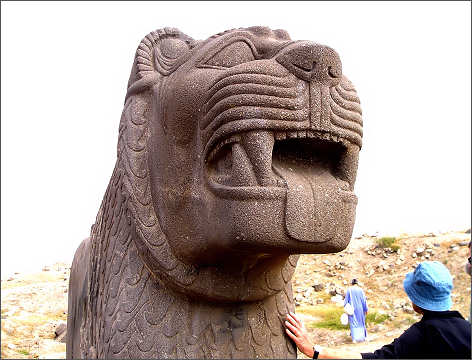
Ain Dara Lion face, Afrin, Syrian Kurdistan, Rojava Kurdistan, Western Kurdistan, 2009. Photo: Creative Commons/wikimedia Xenophon’s Anabasis (401 BCE): A pivotal account comes from the Greek historian Xenophon, who vividly describes the formidable “Carduchians” (Greek: Καρδοῦχοι). These fiercely independent people inhabited the rugged mountains of Corduene (Κορδουηνή), a region corresponding to modern southeastern Turkey and northern Iraq. The Carduchians’ ability to resist even the might of the Persian Empire underscores their distinct identity and martial prowess. The name “Corduene” is widely recognized by historical linguists as a direct etymological predecessor to “Kurdistan.”
- Other Ancient Designations: Further terms such as Gutium, Kytioi, and Kar Duniash (interpreted by some scholars as the “land of the Kardu/Kurds”) point to the continuous recognition of distinct groups within these specific territories. The persistence of these names supports the argument for a deep-rooted, indigenous identity long predating later linguistic shifts towards “Iranic” languages.
The Sumerinan, Gutians, Hurrian, and Median Precursors
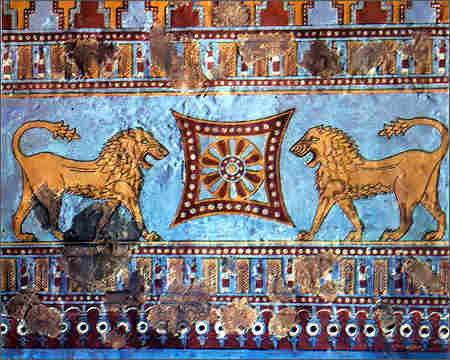
The individual elements that comprise the Lion and Sun motif – the powerful lion and the life-giving sun – have profoundly deep roots across the ancient Near East, particularly in regions corresponding to ancient Kurdistan.
- The Fertile Crescent and Regional Symbolism: Lions were universally revered symbols of royalty, strength, protection, and divinity across Sumerian, Akkadian, Assyrian, and Hittite cultures, embodying terrestrial power and martial prowess. The sun represented divine authority and celestial power.
- Hurrian and Mittani Influence: The Hurrians, a prominent people who inhabited the heartland of Ancient Kurdistan from the 3rd to 1st millennia BCE, integrated powerful animal and celestial imagery into their art and religion. The Mittani Kingdom (c. 1500-1300 BCE), with its Hurrian-majority population, actively utilized such iconography. The famous cylinder seal of King Sausetar of Mittani (c. 1450 BCE), for instance, depicts a sun-disc flanked by guardian lions, showcasing early simultaneous veneration within a polity firmly situated in Ancient Kurdistan.
-

Carving Persian Median soldiers Medes (Kurds), Iran. Photo: Creative Commons/wikimedia The Medes and Gutium Connection: The Medes played a crucial role in the region’s history. Ancient Armenian scripts, particularly those of Movses Khorenatsi, often referred to the Kurds as “Medes” or “Mar,” suggesting a lineage and continuity linking Medes to historical Kurdish lands. The Medes also integrated animal and solar symbolism into their art, aligning with the regional traditions that fostered the Lion and Sun motif.
Numismatic Evidence: The Lion and Sun on Early Coins from Kurdish Lands
The most concrete evidence for the formalized Lion and Sun motif’s presence outside and before its definitive adoption by later Persian dynasties comes directly from numismatics—including specialized Islamic coin catalogs and auction records (mint archives). The rich tradition of figural coinage in medieval Mesopotamia, Syria, and Anatolia provides compelling examples that directly challenge the conventional narrative.
- Saladin (Salah ad-Din Yusuf ibn Ayyub): Definitive Early Kurdish Instances (12th Century CE):
- The Kurdish Sultan Saladin (reigned 1174–1193 CE), founder of the Ayyubid dynasty, featured the lion motif prominently on his coinage. His empire stretched across Egypt, Syria, Mesopotamia, and parts of Anatolia, encompassing significant areas of historical Kurdistan.
-
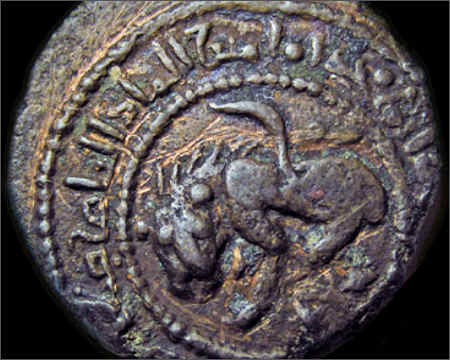
Dirham, al-Nasir Salah al Din Yusuf. Ayyubid Saladin. Photo: vcoins.com Lion Motif with Celestial Association (Mayyafariqin Mint): Multiple examples of Saladin’s own coinage minted in Mayyafariqin (a key city in historical Kurdistan) explicitly feature the lion with celestial connotations. An Ayyubid AE Dirham of al-Nasir Salah al-Din Yusuf (Saladin), minted in Mayyafariqin (e.g., AH 564–589 / AD 1168–1193), clearly depicts a lion seated left, surrounded by stars (“Lion among stars”) within a beaded circle. Numismatic descriptions across major collections and specialized Islamic coin archives (such as Leu Numismatik Web Auctions 4, 8, and 15; Stephen Album Rare Coins Auctions 13, 18, and 31; and specialized Middle Eastern numismatic records) confirm that the obverse of this issue represents the Leo constellation, directly linking the lion to its celestial context as the Sun’s house. Additional specimens cataloged by international antiquarian dealers (Wayne G. Sayles Antiquarian, item M-814) explicitly records this type as showing a “Lion among stars / Four line legend” minted in Mayyafariqin.
- Other Lion Motif Examples: An Ayyubid AE Dirham from Egypt, AH 583 (AD 1187), also shows a “Lion sejant left” with a star above and two stars below (Roma Numismatics Limited E-Sale 9, Lot 975). These issues from Saladin provide definitive proof of the motif’s early formalized usage by a Kurdish ruler within an astrological/celestial framework.
- Regional Royal and Celestial Motifs by Contemporaneous Dynasties:
- Crowned Busts (Saladin’s Rule): Coins minted during Saladin’s reign, such as an Ayyubid AE Dirham from Nasibin, AH 578 (1182–1183 AD), feature a draped bust wearing a three-pointed crenelated crown (Leu Numismatik Web Auction 18, Lot 4301; Baldwin’s Auctions Islamic Coin Auction 13, Lot 241).
- Lion with Dagger (Artuqids): An Artuqid AE Dirhem of Nasir al-Din Mahmud (AH 597–619 / AD 1200–1222) depicts a lion advancing right, holding a dagger and reins (Classical Numismatic Group Electronic Auction 316, Lot 468). The Artuqids were vassals of The Ayyubid Empire and later Ayyubid Principalities and The used to use Ayyubid Symbols of State and Power.
- Crescent and Stars (Zangids): Coins from the Zangid Atabegs of Mosul and al-Jazira feature cross-legged figures wearing three-point crowns holding crescents flanked by stars (Baldwin’s Auctions Islamic Coin Auction 18; Spink USA Auction 379).
-
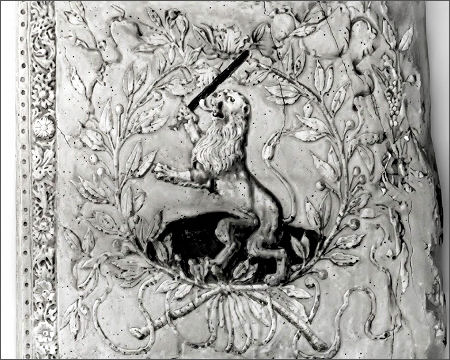
Courland standard made of white taffeta (according to the inventory, a banner), with a lion on one side and a coat of arms on the other, bearing the inscription: “Vigilanter et constanter.” Finial with a crown. Photo: Creative Commons/wikimedia Seljuk Sultanate of Rum (13th Century CE): The formalized Lion and Sun motif also prominently appears on the coinage of the Seljuk Sultanate of Rum under Ghiyas al-Din Kaykhusraw II (reigned AH 634–644 / AD 1236–1245). An Ayyubid-Seljuk AR Dirham minted in Konya, AH 639 (1241), explicitly features the “Lion and sun motif” with a large solar disc radiating above the back of a lion (Heritage Europe Auction 62, Lot 6915). Given that the realm encompassed Anatolia and northern Mesopotamia with large Kurdish populations, this widespread use underscores the motif’s regional prevalence.
- Impact: These numismatic examples from the 12th and 13th centuries—including distinct issues by Saladin showing the lion in celestial contexts, paired with related solar, lunar, and stellar motifs from regional mints like Mayyafariqin—unequivocally demonstrate that the Lion and Sun motif (or its direct constituent elements) was a vibrant part of the regional symbolic repertoire well before its later nationalization by Persian dynasties.
The Persian/Iranian Adoption: A Separate Trajectory of Nationalization
While the Lion and Sun motif had ancient and widespread regional roots, its formalization and elevation to a paramount national symbol of what became Iran largely occurred under later Persian and Turkic-Iranian dynasties.
- From Regional to National Emblem: The motif gained significant prominence in the Persianate world from the 12th century onwards, with early appearances under the Ghaznavids and Great Seljuks. During the Safavid Dynasty (16th–18th Century), it ascended to an official state emblem, often imbued with astrological meanings (the Sun in the house of Leo) and religious significance (Shia Islam’s association with Imam Ali, the “Lion of God”). This process continued through the Qajar Dynasty (18th–20th Century) into the specific form recognized today.
- A Symbol Adopted, Not Invented: This process of national adoption and standardization represents a significant chapter in the symbol’s history, but it constitutes an appropriation, reinterpretation, and formalization of a much older, regionally widespread motif rather than its invention by later powers.
Conclusion: A Richer Understanding of Shared Heritage
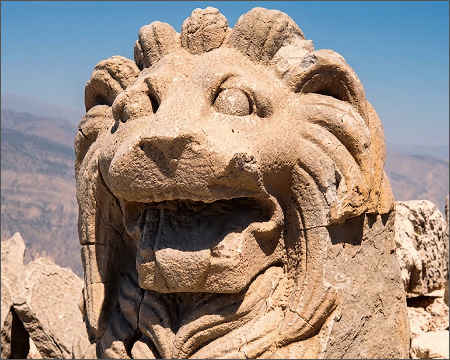
The prevailing narrative surrounding the Lion and Sun motif, which often attributes its origins solely to what today is called Iran, requires substantial revision. The deep genetic and cultural continuity of the aboriginal inhabitants of Ancient Kurdistan, coupled with the consistent presence of ancient ethno-geographic names like Karda, Qardu, and Corduene for millennia, firmly establishes this region as a fertile ground for the motif’s earliest development.
Crucially, archaeological and numismatic records—exemplified by the rare Mayyafariqin and regional Ayyubid mint cataloged specimens featuring the lion amidst stellar constellations—provide undeniable proof of the motif’s significant and formalized presence in the lands of the Kurds.
The earliest definitive appearances on the coinage of the Kurdish Sultan Saladin in the 12th century CE establish a key Kurdish link to this early formalized representation of the lion in an astrological and celestial context. By acknowledging these profound indigenous roots, we gain a more accurate understanding of the complex tapestry of regional symbolism and the enduring cultural patrimony of the ancient Near East.
Scherco R. Baban, an independent researcher and analyst specializing in Kurdish Question and The Middle Eastern security, economical and cultural dynamics.
The opinions are those of the writer and do not necessarily represent the views of iKurd.net or its editors.
Copyright © 2026 iKurd.net. All rights reserved.
Related posts:
 Who Are the Persians? – Part IV
 A Brief History of NuRoj, Kurdish New Year — Newroz
 A Root Cause Review of the Israeli-Hamas Conflict
 Who Are the Persians? – Part VI
 The Resurrection (Ba’ath) Party – Before the Iran-Iraq War
 From Ancient Sumer to Kurdistan of Iraq
 Who Are the Persian – Part III
 Who Are the Persians? – Part VIII
 Business with ISIS – Updated
 Iraq: Revenge and Corruption