

Dr. Kamal Sido | Exclusive to iKurd.net
Middle East expert at the Society for Threatened Peoples (GfbV).
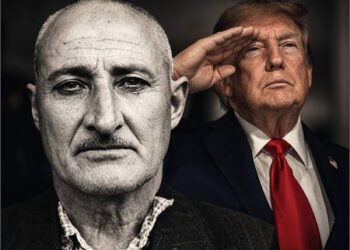
In early June 2026, as U.S. attacks against Iran were underway, U.S. President Trump—as always—sought a way out of the dilemma of how to end his war against Iran, which violated international law, and declared himself the victor.
For none of the promises he had made at the start of the U.S.-Israeli war on February 28, 2026, had been fulfilled by this brutal war. Above all, the criminal Iranian regime was still in power. At the time, Trump spoke of regime change. To justify the disaster and his failure, Trump tried to shift the blame onto others, including the Kurds.
About 12 million Kurds live in Iran, accounting for about 10 to 15% of the 93 million Iranian population. Many in the U.S. and Israel assumed that an active role by the Kurds in Iran—especially their armed forces—could help the U.S. and Israel topple the regime in Iran.
In this context, comparisons were drawn with the Kurds’ struggle against Saddam Hussein in Iraq—who was overthrown in 2003 with the help of the Kurds—or with the fight against Assad and the “Islamic State” (IS) in Syria.

In Syria, the Kurds were supported against both ISIS and Assad until 2024, when that support was cut off. However, since the Kurds in Iraq and Syria have had bitter experiences with U.S. policy—they were always abandoned at the crucial moment and subjected to massacres by Iraq, Turkey, or Syria—the promised U.S. aid either failed to materialize or arrived too late.
For this reason, the Kurds in Iran did not want to react hastily and demanded guarantees from the U.S. that it was genuinely interested in regime change and democratization in Iran. The Kurds made their active role against the regime contingent on these guarantees. President Trump omitted all of this in his statement. He claims that the Kurds received weapons from the U.S. but kept them for themselves and did not use them against the regime in Tehran.
Did the Kurds steal U.S. weapons?

Trump stated verbatim: “We sent weapons to the Kurds. (…) The Kurds let us down. I didn’t agree with that decision. I said, ‘No, I don’t think they’ll pass them on. I think they kept them for themselves.’” “I think that’s a shame. But I’ll remember that, you Kurds, I’ll remember that.” (thenewregion.com, June 11, 2026).
It is well known that Trump repeatedly seizes on fake news to advance his political agenda or justify his failures. But his accusation that the Kurds had “stolen” the weapons was new. No one in either the U.S. or Israel could prove that the Kurds in Iran had received weapons from the U.S.
Rather, there were indications that the Trump administration had betrayed joint plans between the Kurds, Israel, and the U.S. to Turkish President Erdogan. The international press has reported on this extensively. (libnanews.com, June 7, 2026)
Whether or not the U.S. betrayed the plans is irrelevant here. In any case, there is no evidence to support Trump’s claim that the Kurds stole U.S. weapons.
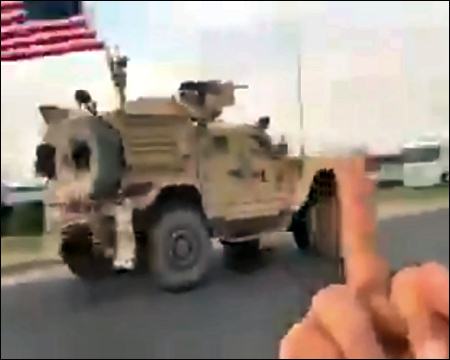
Such spectacular statements from Trump are nothing new when it comes to the Kurds. In 2019, when Trump ordered the withdrawal of U.S. troops from parts of northern Syria that had been fighting alongside the Kurds against ISIS, thereby leaving the Kurds defenseless against attacks by both ISIS and Turkey, Trump attempted to justify his misguided decision—which had drawn widespread criticism in the U.S.—by claiming that the Kurds had provided no assistance to the U.S. during World War II. (The Guardian, October 9)
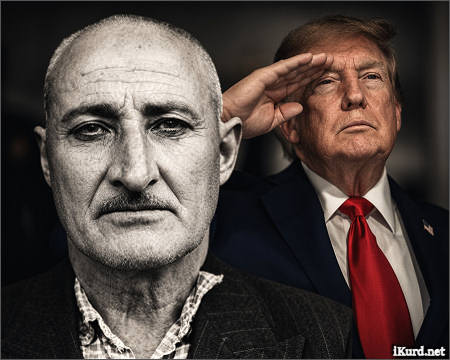
This claim by Trump was also false. Kurds were very actively involved in the fight against Nazi Germany in various countries. My father was among them. When Trump accused the Kurds of not having supported the U.S. in the war against Hitler’s Germany, I responded to his claim on social media.
In doing so, I jokingly pointed out my father’s involvement in World War II. Incidentally, Trump should have known that the Kurds did not have their own state back then—just as they do not today—and therefore could not actively participate in international affairs as a state actor.
My Father in World War II
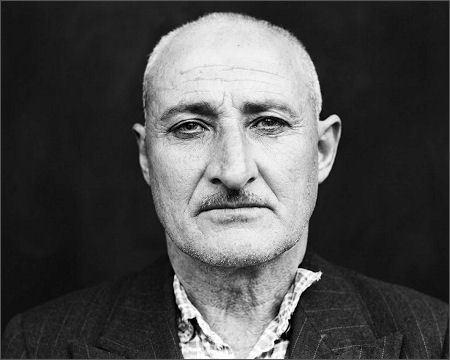
How did my father come to be involved in this war? After World War I, the Middle East was divided between the French and the British. The Kurds in Syria—including those in Afrin in the northwest of the country—found themselves within a territory that was henceforth known as Syria. This area became a French colony. My father was born in 1916, right in the midst of World War I, when the secret partition of the Middle East between Great Britain and France took place. Born.
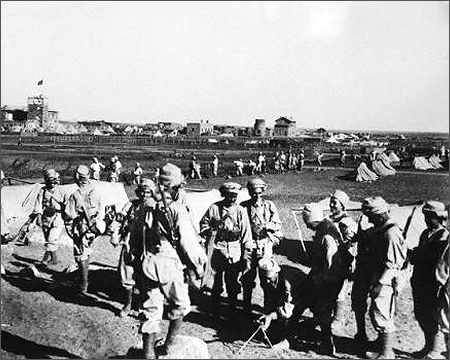
When World War II began in 1939, he was 23 years old. As a young man, he joined the Syrian units of the French Army stationed in Syria. From that point on, he was a member of the French military in Syria. When German troops occupied Paris and large parts of France on June 14, 1940, and the so-called Vichy government was formed in southern France, British troops marched into Syria from Iraq and Jordan in June and July to prevent Nazi Germany from using the territory of Syria controlled by Vichy France.
As a result, Syria effectively came under British rule, and the existing military units became part of the British military. Thus, from that point on, my father was also a British soldier. He later became a member of an auxiliary unit of the 8th British Army.
My Father and the Desert Fox
The British 8th Army was a legendary unit of the British Army during World War II. As a multinational and multiethnic Commonwealth force in North Africa, it played a decisive role in the liberation of Europe and the defeat of Nazi Germany. The story of my father (1916–2000) is well known throughout our village in Afrin. As a result, I was exposed to stories from World War II even as a child. In my father’s conversations and stories, terms like “Desert War,” “Desert Fox,” Erwin Rommel, Bernard Montgomery, and El Alamein came up time and again.
The term “Desert War” primarily refers to the war against the German Afrika Korps, led by General Erwin Rommel (1891–1944), in North Africa—specifically in what is now Egypt and Libya. German General Rommel became known as the “Desert Fox” because he repeatedly eluded the British and successfully held his own against British General Bernard Montgomery (1887–1976).
El Alamein is a town in Egypt where, in November 1942, a decisive battle of World War II took place between the German-Italian African Panzer Army under the command of Field Marshal Erwin Rommel and the British 8th Army under the command of Lieutenant General Bernard Montgomery.
In November 1942, a decisive battle of World War II took place near El Alamein between the German-Italian Afrika Panzer Army under the command of Field Marshal Erwin Rommel and the British 8th Army under the command of Lieutenant General Bernard Montgomery.
When the British 8th Army, in which my father was fighting, was preparing its advance in Italy in the summer of 1943, the High Command gave the members of the auxiliary forces a choice: either they would continue on to Europe, or they would remain in North Africa and return to their home countries later. My father decided against continuing on to Sicily, Italy, Europe, and Germany.
And so it happened that in 1945 he missed the opportunity to come to Germany. It wasn’t until 1991 that he came to Germany—not as a British soldier, but to visit his son, whom he hadn’t seen in ten years and who had found refuge in Germany a year earlier. At the time, we were living in Marburg, where we happened to meet a member of the German Africa Corps who struck up a conversation with my father.
Kurds in the Red Army
The largest group of Kurds who actively participated in World War II came primarily from the former Soviet Union.
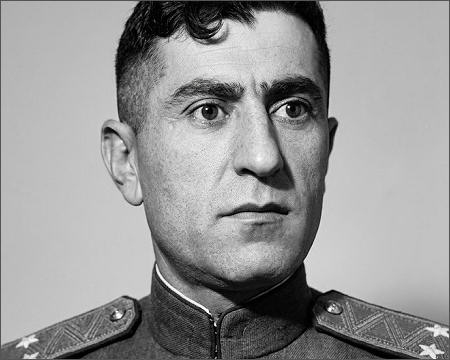
During World War II, thousands of Soviet Kurds, Muslims, and Yazidis—primarily from the republics of Armenia, Georgia, Kazakhstan, and Kyrgyzstan—fought in the Red Army against Nazi Germany. Figures such as the Kurdish-Yazidi commander Samand Siabandov (1909–1989) were awarded the title “Hero of the Soviet Union.”
Like many other ethnic groups, the Kurds also suffered under Stalin in the 1930s. Many of them, especially Muslim Kurds, were deported from their homeland in the South Caucasus to Central Asia, specifically to the republics of Kazakhstan and Kyrgyzstan. These Kurds, too, fought against Nazi Germany after Hitler’s invasion of the USSR and advanced as far as Berlin.
A number of publications have been written about the role of the Kurds in World War II. These are available not only in Russian but also in English. (kulturnistudia.cz/, 2-2023)
Trump should have known all of this before he spread his fake news. Politicians—especially those who play a major role in world politics—should also seek advice from experts, particularly when it comes to history and the past. After all: “Those who do not know history are doomed to repeat the mistakes of the past.”
Dr. Kamal Sido, a prominent Syrian Kurdish intellectual. He is a Middle East Consultant for ethnic, religious and linguistic minorities at the German Society for Threatened Peoples (STP).
The article was published in “Vielfalt,” the journal of the Society for Threatened Peoples, in German, in 2026, Issue 3.
The opinions are those of the writer and do not necessarily represent the views of iKurd.net or its editors.
Copyright © 2026 iKurd.net. All rights reserved.
Related posts:
 The Resurrection (Ba’ath) Party – Before the Iran-Iraq War
 Business with ISIS – Updated
 Martyrs for Millionaires: The Black-Market Politics behind the Theft of Syria’s Oil
 Syria: Revisiting The Caesar Torture Victim Photographs
 The Double Cross of Iraq And The Discordant Death of WMD Inspector, Dr David Kelly – The 17th Anniversary
 The Truth About The Saddam Hussein Affair
 Iraqi Kurdistan – “Sold Out!” – Part II
 Sabotaging Syria
 What makes a good NATO ally? The Case of Turkey
 Syria: A ‘Caliphate’ by Any Other Name — Would Smell the Same