

Scherco R. Baban | Exclusive to iKurd.net
Today at 11.44 it was the winter solstice, the time when the sun assumes its minimum declination, i.e. has its lowest noon altitude in the northern hemisphere.
The winter solstice occurs on December 20, 21 or 22. This year 21/12.
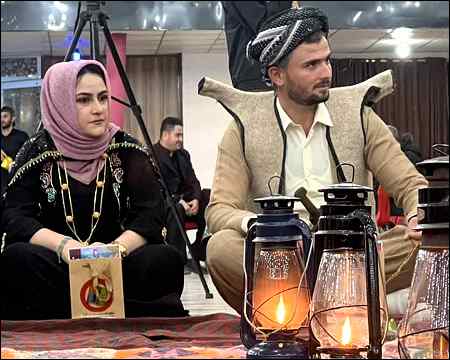
In the Kurdish-Yazdan traditions, we pay attention to this in something called the Zayin evening. Zayin means rebirth in Kurdish, i.e. rebirth of the sun.
December 21, 4 candles are lighted.
22 December 5 pcs
23 December 6 pcs
24 December 7 pcs
One can imagine that Swedish pre-Christian Christmas and Christian Christmas actually have their origins in the same astronomical phenomenon and tradition.
Let us remember that in the Julian calendar Lucia coincided with the winter solstice. Lucia comes with candles. But then the calendar was changed to the Gregorian calendar and Lucia got her own history.
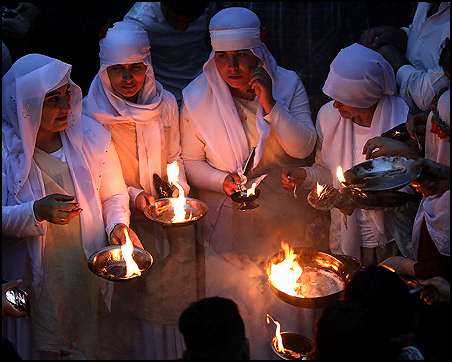
In the Kurdish Ezidi [Yazidi] Religion Eid started a week earlier. The first Friday of December was the festival of Sêsims, today is the second Friday, the festival of Xûdan and next week, the third festival of Ezi is celebrated the festival in honor of God.
Ezidis believe there have been festivals since the creation of the earth and the festival of Ezî is the festival in honor of God, because God created the holy angels to create the earth. These holy angels began to create the earth on Saturday and on Sunday it was finished.
Then on Monday they went to the sea and cleaned the sea. On Tuesday, Wednesday and Thursday they fasted and then on Friday they celebrated the creation of the earth. Thus, it can be said that the festival of Ezî is the festival of the creation of the earth.
For the believers of The Ezidi Religion, the first of the month begins on the 14th of the Christian calendar, so the importance of the celebration is the same as that of Christmas for Christians. The origin of the celebration is very old and can be found in Mithraism, a religion believed to be practiced by the ancient Kurds and their ancesters in which the sun was worshipped.
The sun has a high priority for Ezidis ( Even The among The Yarsani Kurds) and is understood as the visible symbol of God. In ancient Religion of Yazdanism, the predessor of both Yarsanim and Ezidism, the sun was even worshiped as a deity.
It is not without reason that the most important holiday of the Ezidis falls on the solstice (December 21st). Because the days at the solstice are getting shorter and the sun is less and less visible, so the Ezidis fast. The holiday originally marked the end of the short days.
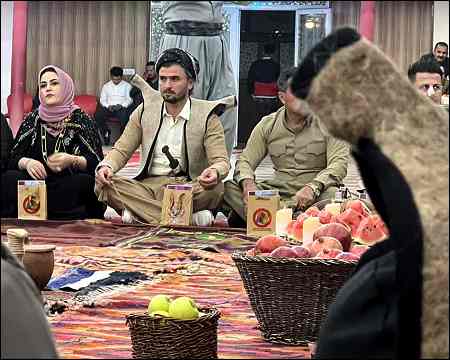
While Jesus is believed to be born in the month of Octavius, August. when did the Christians switch Christmas to the mid of Winter to a date when even Muslim Kurds do celebrate the Şewçile (40 days of the winter period)
or they just took over a Pagan celebrity date? Worth mentioning that this celebrity is widely celebrated in The Hewraman Region and the fruit of Pomegranate has a central role beside the lights of the candles.
Many other people took over the mid winter celebrity and called it different name. It´s believed that During The Safavid Empire it was started to be called, Yalda. The Kurds still call it Şewî Zayin (Night of The Birth) or Şewiçile (40 Days of Winter) Allthogh it almost falled into oblivion among many Sunni Kurds because of its “Pagan origins”
So who´s birth actually was it, Jesus, Mitra, other Sun God or is it just the passing of 40 days of winter?
Scherco R. Baban, an independent researcher and analyst specializing in Kurdish Question and The Middle Eastern security, economical and cultural dynamics.
The opinions are those of the writer and do not necessarily represent the views of iKurd.net or its editors.
Copyright © 2022 iKurd.net. All rights reserved.
Related posts:
 A Brief History of NuRoj, Kurdish New Year — Newroz
 Ocalan’s Secular Lens on a “Democratic Islam”
 Spiritual Revival of the Forgotten Traditions of NuRoj
 International terrorism and the threat of genocide: A new dimension of genocide study
 From Ancient Sumer to Kurdistan of Iraq
 Saudi driver plows into crowd at Magdeburg Christmas market in Germany, killing 4
 A Christmas Dialogue with President-Elect Donald Trump
 Go Artemis! NASA’s Quest for Life Beyond Earth!
 Sacred Caves of the Truth Seekers, Mysticism and Truths in Trinity
 The Absurd Cause For The Faili Kurds Holocausts – Part VIII