


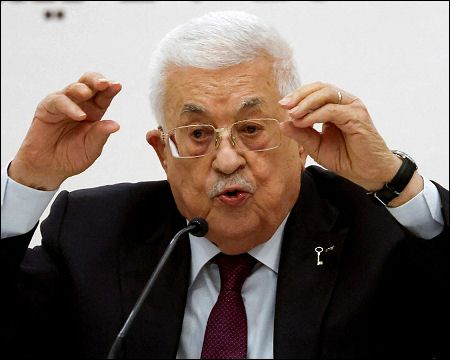
RAMALLAH, Israel,— “Palestinian” Authority leader Mahmoud Abbas issued a sharp rebuke to Hamas on Wednesday, urging the Islamist militant group to disarm and cede administrative control of Gaza to the Palestinian Authority, in a move aimed at reshaping the political landscape of the territory amid ongoing international deliberations over Gaza’s future.
Speaking before the Central Council of the Palestine Liberation Organization (PLO), Abbas, 89, directly called out Hamas for holding Israeli hostages and described the group’s fighters in derogatory terms.
“Sons of dogs, just release whoever you’re holding and be done with it,” Abbas said. “Shut down their excuses and spare us.”
The unusually harsh language from Abbas reflected mounting frustration and came as regional and Western powers push for a renewed “Palestinian” leadership capable of overseeing Gaza once the war ends.
Abbas is also expected to name a successor soon, as pressure grows for a political transition within the PA, which governs parts of the West Bank.
Though Abbas has long demanded Hamas place its forces under PA command, this is the first time since the outbreak of the Gaza war that he has publicly renewed that demand.
The war erupted after Hamas Islamist militants launched a surprise assault on Israel on October 7, 2023, killing around 1,200 people, mostly civilians and including children, rapping many women, and capturing approximately 250 hostages, according to Israeli officials.
Israel responded with a large-scale military campaign that has, according to Israeli sources, left more than 50,000 dead, mostly identified as Hamas militants, and inflicted massive destruction across Gaza.
“The future of Gaza cannot include armed militias. Hamas must hand over its weapons and responsibilities to the Palestinian Authority and become a political organization,” Abbas said.
Despite calls from the United States and Arab nations, Hamas has so far refused to disarm or relinquish control. The group expelled the PA from Gaza during internal conflict in 2007 and has ruled the enclave since.
Meanwhile, Israel has rejected any role for the current PA in post-war Gaza governance, citing its ineffectiveness and internal divisions. Arab nations last month floated a proposal for a transitional authority to oversee Gaza before eventual return to PA control.
The United States, European Union, and Gulf countries are expected to be key donors in Gaza’s future reconstruction, but have made clear that reforms to the Palestinian Authority are a prerequisite for their support.
Abbas, who succeeded Yasser Arafat in 2004, has never appointed a deputy. The ongoing conflict and humanitarian crisis have intensified calls for him to address succession and restructure the PA’s leadership.
In March 2025, thousands of residents in northern Gaza held mass demonstrations, demanding an end to the ongoing war and voicing anger at Hamas. Protesters marched through the streets chanting, “Out, out, out! Hamas, get out!” as they called for the group’s removal from power.
The ancient Palestinians referenced in the Bible were not Arabs. They were a people of non-Semitic origin, believed to have migrated from the Aegean region—possibly from Crete or nearby islands. They settled along the southern coast of Canaan, in the area now known as Palestine, around the 12th century BCE.
In contrast, modern Palestinians are Semitic Arabs, descended from a blend of Arab tribes, Canaanites, and other local populations that have lived in the region over the centuries. As such, they are not directly related to the ancient Palestinians but identify as Palestinians, often claiming to be the original inhabitants rather than later Arab settlers.
Today, the populations living in Gaza and the West Bank are not descendants of the ancient Palestinians. They are Arabs who gradually adopted the name “Palestinian,” a term that has come to represent a modern political and national identity in the region.
While the name “Palestine” originates from “Philistia,” the land once occupied by the ancient Palestinians, there is no direct ethnic connection between those ancient people and the Arab Palestinians of today.
(With files from Reuters | Agencies)
Copyright © 2025 iKurd.net. All rights reserved
Related posts:
 Internal Revolt Against Hamas in Gaza Was Already Underway
 The Resurrection (Ba’ath) Party – Before the Iran-Iraq War
 A Root Cause Review of the Israeli-Hamas Conflict
 Israel must disband the Palestinian Authority for diplomacy’s sake
 The War of Attrition on Lebanon
 France’s recognition of ‘Palestine’ encourages terrorism, anti-French separatism
 ‘Palestinian’ kills Israeli woman on the way to hospital to give birth
 UK, Canada and Australia recognize “Palestinian state”
 Israel kills Hamas leader Yahya Sinwar, mastermind of the brutal October 7 attack
 Israel marks October 7 anniversary of Hamas deadly attack