


Hamas’ armed wing praised the incident as a “heroic operation,”
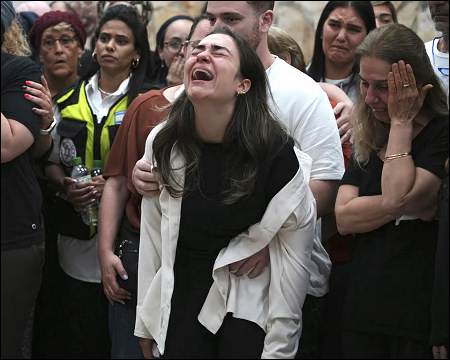
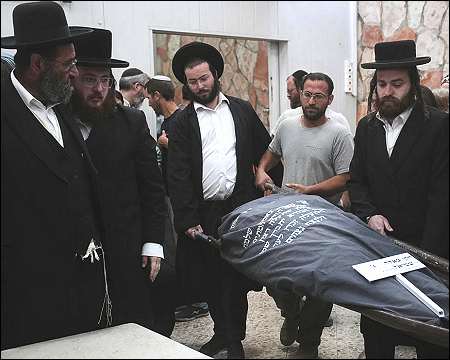
TEL AVIV, Israel,— A pregnant Israeli woman was shot and killed late Wednesday in the West Bank by a Palestinian gunman while on her way to a hospital to give birth, Israeli officials said. Her baby was delivered in critical condition.
The victim, identified as 37-year-old Tzeela Gez, was struck by gunfire as her husband drove their car near the northern West Bank settlement of Bruchin.
She was nine months pregnant. The baby was delivered by emergency surgery and remains hospitalized in serious but stable condition, health officials said.
The shooter fled the scene. Israeli military officials said Thursday they have sealed off several Palestinian villages near the area and established roadblocks as part of a broad search operation.
“We will use every means to locate those responsible,” said Lt. Gen. Eyal Zamir, Israel’s chief of staff, during a visit to the scene. According to the military, troops were sweeping the area on foot and by drone.
No group claimed responsibility for the shooting. However, a spokesman for Hamas’ armed wing praised the incident as a “heroic operation,” though he did not say whether the group was behind it.
The shooting comes amid a long-running military campaign by Israel in the West Bank, launched in response to what it describes as increased militant activity.
Gez, a therapist and mother of three, lived in Bruchin with her husband, Hananel. Friends and local leaders described her as devoted to her family. “She was a mother in every sense of the word,” said Meital Ben Yosef, who heads the local council in Bruchin, in an interview with Israeli Army Radio.
Images released by the military showed a bullet hole in the front windshield of the couple’s vehicle and bloodstains on the rear passenger side. Soldiers were seen combing nearby hillsides in video published by the Israel Defense Forces.
In response to the killing, Israeli Finance Minister Bezalel Smotrich called for harsher military action. “Just as we are dismantling Hamas in Gaza, we must dismantle terror in Judea and Samaria,” he said on X, referring to the biblical names used for the West Bank.
Violence in the West Bank has surged since Hamas launched a surprise attack —similar in style to those carried out by the Islamic State group—on civilians in southern Israel on Oct. 7, 2023, prompting Israel to intensify operations across Gaza and West Bank areas.
On Thursday, Israeli forces reported killing five suspected militants during a separate raid in another part of the West Bank. Hamas called the men “resistance fighters” but did not confirm their affiliation.
The Israeli military said on Saturday it killed a Palestinian in the West Bank among a group suspected of involvement in an attack that claimed the life of a pregnant Israeli settler as she was on her way to the hospital to give birth.
The West Bank, along with Gaza and east Jerusalem, was captured by Israel in the 1967 Mideast war. “Palestinians” claim these areas for a future independent state. The roughly 500,000 Israeli settlers in the West Bank..
Israel argues that its military efforts in the West Bank are necessary to counter threats backed by Iran and to prevent attacks similar to those carried out on October 7.
While the term “Palestinian” appears in ancient texts, scholars widely agree that the original Philistines—believed to have migrated from the Aegean region in the 12th century BCE—were not related to today’s Arab Palestinians.
Modern “Palestinians” are Semitic Arabs whose identity developed over centuries from a mix of local peoples, Arab tribes, and historical communities in the region. The use of the term “Palestinian” in its current national and political sense emerged in the 20th century.
Historians note that referring to present-day residents of Gaza and the West Bank as “Palestinians” does not reflect an ethnic continuity with the ancient Philistines, for whom the region was historically named.
Instead, many scholars suggest terms like “Gaza Arab Muslims” or “West Bank Arab Muslims” to more accurately describe their cultural and religious identity—much like modern Iraqis are not referred to as Sumerians or Assyrians, despite living in the same geographic area.
(With files from AP | Agencies)
Copyright © 2025 iKurd.net. All rights reserved
Related posts:
 Internal Revolt Against Hamas in Gaza Was Already Underway
 The Resurrection (Ba’ath) Party – Before the Iran-Iraq War
 A Root Cause Review of the Israeli-Hamas Conflict
 The War of Attrition on Lebanon
 Israel kills Hamas leader Yahya Sinwar, mastermind of the brutal October 7 attack
 Israel must disband the Palestinian Authority for diplomacy’s sake
 Saddam Hussein was a Friend to the West
 Israel marks October 7 anniversary of Hamas deadly attack
 Israel authorizes plan to control Gaza City
 UK, Canada and Australia recognize “Palestinian state”