

BISHKEK, Kyrgyzstan,— Kyrgyzstan has enacted new laws restricting online access and expanding state control over internet infrastructure, including a nationwide ban on online pornography. The measures were signed into law Tuesday by President Sadyr Japarov, according to a statement from his office.
The presidential office said the ban aims to “preserve moral and ethical values” in Kyrgyzstan, a predominantly Muslim country of seven million located in Central Asia. Internet service providers will now be required to block pornography websites, based on directives from the Ministry of Culture. Noncompliance will result in financial penalties.
In a separate decree, Japarov authorized a one-year pilot initiative placing all international internet traffic under state monopoly. Beginning August 15, the government-owned telecom firm ElCat will serve as the exclusive gateway for foreign internet data. Private telecom companies have been given two months to transfer existing international contracts to ElCat.
Political analysts say the decisions represent a growing centralization of power. “This move further expands the government’s control over the digital landscape and curbs market freedoms,” Emil Juraev, a political analyst based in Bishkek, told Reuters.
President Japarov, who came to power following mass protests in 2020, has made preserving “traditional Kyrgyz values” a central tenet of his administration.
His allies currently dominate the national legislature, and the new laws come ahead of the country’s next parliamentary and presidential elections, scheduled for 2026 and 2027, respectively. Japarov has signaled plans to seek re-election.
While the government aims to restrict adult content, experts say many residents are likely to turn to virtual private networks (VPNs) to bypass state filters.
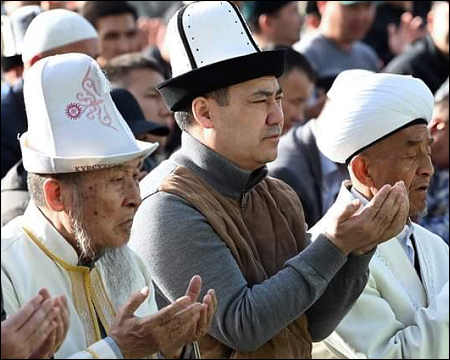
Kyrgyzstan remains a formally secular state with a population where nearly 90% identify as Muslim, primarily adherents of Sunni Islam’s Hanafi school.
The remainder includes Orthodox Christians—mainly among ethnic Russian, Ukrainian, and Belarusian communities—as well as smaller Catholic, Protestant, Jewish, and Buddhist populations.
Though the Kyrgyz Constitution guarantees freedom of religion, Islamic values have been gaining influence in public policy. Some recent government efforts have included tax-free arrangements for public officials participating in the Hajj pilgrimage to Mecca.
Since its independence from the Soviet Union in 1991, Kyrgyzstan was once seen as Central Asia’s most democratic nation. However, observers note a decline in civil liberties in recent years.
A 2021 constitutional referendum increased presidential powers, shifting the balance away from parliamentary rule.
New legislation passed in 2024 has added further restrictions. Non-governmental organizations receiving foreign funding are now required to register as “foreign representatives,” subjecting them to heightened state scrutiny.
Independent journalism has also come under fire. Several news outlets have faced forced closures, including Kloop Media. Journalists involved in investigative reporting have been arrested or sentenced under vague legal provisions.
The U.S. State Department and human rights organizations have raised concerns about the erosion of judicial independence, arbitrary detentions, and limitations on freedom of expression.
A similar pornography ban is also enforced in Turkmenistan, an Islamic Central Asian nation ruled by a dictatorship and known for its tight internet censorship.
(With files from Reuters)
Copyright © 2025 iKurd.net. All rights reserved
Related posts:
 The Resurrection (Ba’ath) Party – Before the Iran-Iraq War
 Business with ISIS – Updated
 Iraq: Revenge and Corruption
 The illusion of modernity: UAE’s crackdown on digital freedoms
 Behind the Veil of Turkey’s ‘Zero Problem’ Policy – A Kurdish Perspective
 Iraqi Kurdistan – “Sold Out!” – Part II
 Turkey: The Psychological War Against the Kurds Through the PKK – Part I
 Saddam Hussein was a Friend to the West
 The Double Cross of Iraq And The Discordant Death of WMD Inspector, Dr David Kelly – The 17th Anniversary
 The Truth About The Saddam Hussein Affair