



iKurd.net | Report from The Arrow Channel
When Russia invaded Ukraine in 2022, millions of refugees crossed into neighboring states and were received with housing, aid and schools. Syrians displaced by war were absorbed by Turkey in large numbers, while Venezuela’s collapse saw Colombia and Peru admit migrants by the millions.
The war in Gaza has produced a similar humanitarian crisis, with nearly two million people uprooted, according to United Nations agencies. But this time, Arab states have kept their borders closed.
Egypt reinforced its frontier with Gaza with tanks and walls. Jordan’s King Abdullah II called admitting refugees a “red line.” Saudi Arabia, the United Arab Emirates and others offered rhetoric but no entry. Behind the policy is a fear shared by most Arab governments: Hamas and other Islamist extremists.
Militancy overshadows humanitarian needs
While Palestinians share language and religion with their neighbors, their leadership in Gaza is dominated by Hamas, an armed Islamist group rooted in the Muslim Brotherhood and supported by Iran. Governments across the region see the danger of importing militancy.
Egypt has fought a long-running Islamist insurgency in Sinai. Officials in Cairo fear that opening Rafah would allow Hamas operatives to slip across the border and destabilize an already volatile region. Jordan, which has a majority Palestinian population, worries that further inflows would strengthen extremist factions and threaten the monarchy’s grip.
Even wealthy Gulf states remain wary. For them, taking in large numbers of displaced people from Gaza would mean importing a radical movement tied to Iran and to transnational Islamist networks that threaten domestic stability.
Historical suspicion
This suspicion has roots in the history of the Palestinian issue. After Israel’s creation in 1948, hundreds of thousands of Palestinians were displaced. Neighboring states hosted them in camps but denied citizenship, citing the “right of return.”
In the 1960s, Palestinian groups like the Palestine Liberation Organization emerged, seeking independence from Arab regimes. But many of those organizations soon developed paramilitary wings. In Jordan, their power grab led to a bloody clash in 1970 known as Black September. Thousands were killed, and the PLO was expelled.
When the PLO moved to Lebanon, armed factions entrenched themselves in refugee camps and southern towns. Their presence upset Lebanon’s delicate balance and contributed to a civil war that lasted 15 years. For many in the region, the lesson was clear: where Palestinian militants set up bases, instability followed.
Gulf War fallout
By the early 1990s, mistrust deepened further. During Iraq’s invasion of Kuwait, PLO leader Yasser Arafat sided with Saddam Hussein, a decision seen by many Arab states as a betrayal. A significant portion of the Palestinian community in Kuwait reportedly turned against the Kuwaiti population, and some supported or assisted Iraqi forces during the occupation, further straining relations and fueling mass expulsions after Kuwait was liberated.
After Kuwait’s liberation, nearly 400,000 Palestinians were expelled. To this day, Gulf governments cite that episode as evidence that Palestinian factions often act against their hosts’ interests.
Extremism over diplomacy
In more recent years, Hamas’s alignment with Iran has cemented Arab governments’ opposition. Tehran provides weapons and funding, using Hamas as a proxy against Israel. For Sunni-majority Arab states, this makes Hamas part of the same regional threat as Hezbollah and other Iran-backed militias.
The Abraham Accords in 2020 demonstrated how far priorities have shifted. Several Arab states normalized relations with Israel, openly setting aside Palestinian demands. For these governments, the greater danger now lies in Islamist extremism and Iranian expansion, not in confronting Israel.
Present crisis

When Hamas Islamist fighters stormed into Israel in October 2023, killing and sexually assaulting civilians and taking 251 hostages, including women and children, they triggered a devastating war. The consequences for Palestinians in Gaza were immediate.
Nearly 80 percent of the Gaza population was displaced within weeks, according to UN reports. Families crowded into makeshift shelters with little or no access to food, water, or electricity.
Still, Arab governments rejected calls to admit refugees. Officials in Cairo, Amman and Riyadh argue that doing so would reward Hamas by allowing its fighters to blend into refugee flows, while simultaneously giving Israel an excuse to depopulate Gaza.
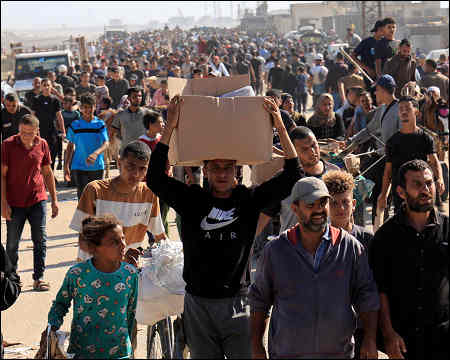
Popular anger on the streets tells a different story. Demonstrations in capitals across the region expressed solidarity with civilians. But Arab governments have made their position clear: Palestinian Islamist extremists are viewed as a destabilizing threat, and their presence is not welcome inside Arab states.
Seventy-five years after the Nakba, Palestinians remain stateless. But unlike in past wars, regional governments now frame their refusal not only in terms of politics or demographics, but in the conviction that Hamas and other militant groups have turned the Palestinian issue from a national struggle into an exportable security risk.
(With files from The Arrow Channel YT)
Copyright © 2025 iKurd.net. All rights reserved
Why Muslim refugees turn to Europe over rich Arab Muslim countries: Video
Related posts:
 Internal Revolt Against Hamas in Gaza Was Already Underway
 Saddam Hussein was a Friend to the West
 The Resurrection (Ba’ath) Party – Before the Iran-Iraq War
 Saddam Hussein’s Enemies: Paving the Road to the Invasion of Iraq
 A Root Cause Review of the Israeli-Hamas Conflict
 The War of Attrition on Lebanon
 Israel must disband the Palestinian Authority for diplomacy’s sake
 The 12-Day War: A Tactical Failure, Yet a Strategic Win for Israel
 Israel marks October 7 anniversary of Hamas deadly attack
 Iraq comes full circle: The rehabilitation of Abd al-Karim Qasim