

Iraq Employs More People Than Egypt and Saudi Arabia Combined, Despite Their Populations Exceeding 150 Million!
BAGHDAD,— Iraq has one of the largest government workforces in the Arab world, employing more people than Egypt and Saudi Arabia combined, even though their total population exceeds 150 million. Analysts say the numbers reflect structural challenges rather than administrative success.
Iraq’s population reached 45.4 million people according to the 2024 census, highlighting the scale of its public employment system.
Economist Ziad Al-Hashemi said on his X account that Iraq’s public employment level is “a chronic pathological condition striking at the core of the Iraqi economy,” noting that the country leads Arab states in government employment relative to population.
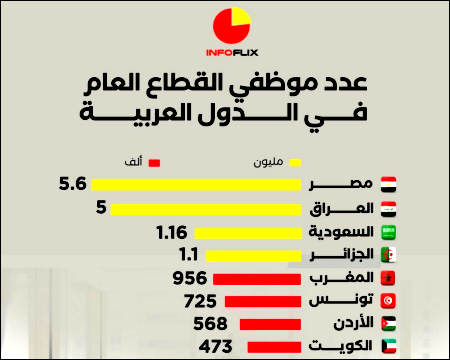
Current estimates indicate that over five million Iraqis work in state institutions, amounting to more than 11% of the population. In contrast, Egypt employs around 5% of its population in the public sector, Saudi Arabia about 3%, and Algeria roughly 2%.
Analysts say the figures show how public employment has become a political instrument rather than a productivity-focused economic tool.
Kurdistan Region Employment and Population Statistics
Data from 2024 show the Kurdistan Region has an estimated population of 6.37 million, spread across Erbil, Sulaimani, Duhok, and Halabja.
Approximately 660,000 individuals work for the Kurdistan Regional Government, including teachers, civil servants, healthcare workers, and security personnel.
This represents around 10% of the total population and roughly 17% of the working-age population. The reliance on government employment illustrates the region’s dependence on the public sector for economic stability.
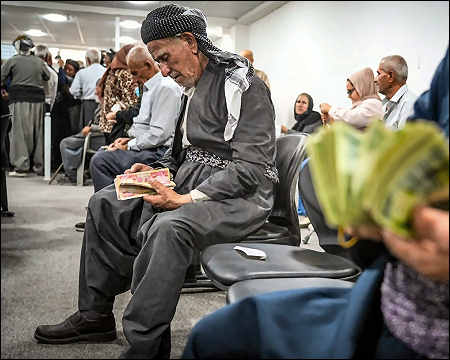
Delays in salary payments have been common, with some employees waiting months for wages. Teachers, healthcare workers, and other civil servants have expressed frustration at the interruptions in pay, which, coupled with rising reports of corruption, nepotism, and mismanagement, have undermined trust in government institutions.
These challenges have increased public dissatisfaction and placed pressure on families who depend on government paychecks. Economists emphasize the need for reform and financial accountability within the KRG.
Western countries typically hire government employees only for essential roles, unlike the Kurdistan Region, where many expect government employment as a primary source of livelihood. Experts recommend growing private-sector opportunities to reduce reliance on public jobs and support sustainable economic growth.
Public Employment as a Political Tool
Political economy researchers say Iraq has used public employment since 2003 to secure loyalty and integrate citizens into the political system. Al-Hashemi noted that state resources are often directed toward social gain rather than improving performance or productivity.
The situation has led to disguised unemployment, where employees may have redundant or minimal responsibilities. The Ministry of Planning reports that over half of public positions do not contribute directly to GDP, making Iraq’s operational costs among the highest in the region relative to output.
Budget Constraints and Fiscal Challenges

Payroll costs dominate Iraq’s budget. IMF reports and Ministry of Finance figures show salaries consume over 60% of current spending, limiting investments in infrastructure, education, and healthcare. Specialists say this imbalance turns government expenditure into a social welfare tool instead of a driver of development.
The contrast with the United States is notable. The U.S., with a much larger economy, employs about 24 million government workers, or 7% of the population, with well-defined productivity and performance metrics.
Iraq’s five million public employees manage a smaller economy without systematic performance evaluation, producing low efficiency despite high numbers.
Rising public employment has coincided with growing debt and chronic deficits. Domestic debt is estimated at 97 trillion dinars, with external debt over $34 billion, much of which finances salaries and pensions. Analysts warn that falling oil prices could jeopardize Iraq’s ability to meet payroll obligations.
Administrative Reform Challenges
Temporary measures such as reclassification or new hiring exacerbate the financial burden. Each new group of employees increases long-term obligations without improving productivity or services. Consequently, the public administration is slow, costly, and inefficient.
Efforts at reform have so far fallen short. International observers suggest reallocating resources from idle departments to productive areas, including healthcare, education, and renewable energy. Implementing performance evaluation systems is key to meaningful reform.
Experts advise that resolving disguised unemployment requires gradual restructuring, including retraining programs and private-sector job creation while maintaining social protections. The objective is to transform public employment from a fiscal liability into a productive resource.
Al-Hashemi stated, “The cost incurred by this path is enormous and burdensome to government finances, and it is the main reason behind the fiscal deficit and the expansion of public debt.”
Analysts argue the issue is both economic and political, as employment often serves as a means of influence rather than public service.
Reform, experts agree, starts with assessing how many government employees Iraq actually needs. Political will is necessary to separate employment from clientelism and redefine the role of the state beyond the distribution of political favors.
(With files from Baghdad Today | Agencies)
Copyright © 2025 iKurd.net. All rights reserved
Related posts:
 The Resurrection (Ba’ath) Party – Before the Iran-Iraq War
 Iraq – The Cynical Swindle
 Sabotaging Syria
 Saddam Hussein’s Enemies: Paving the Road to the Invasion of Iraq
 Iraqi Kurdistan – “Sold Out!” – Part II
 Iraq: Revenge and Corruption
 Business with ISIS – Updated
 Saddam Hussein was a Friend to the West
 The Double Cross of Iraq And The Discordant Death of WMD Inspector, Dr David Kelly – The 17th Anniversary
 This is how the Saudis deal with bullies