

Commercializing Science; Higher Education Between Money and Learning
Twana Muhammad Nuri | Exclusive to iKurd.net
Translated by iKurd.net from Kurdish Awene
The capitalist system is not only an economic model for organizing buying and selling. It is also a cultural and power-based logic that tries to place all sectors of social life under the control of free market competition.
In Iraq’s Kurdistan Region, this phenomenon is part of a global wave of “neoliberalism in education” that, after 2003, in a strong and unplanned way, pushed our academic institutions into the logic of profit and turned science from a “right” into a “commodity.”
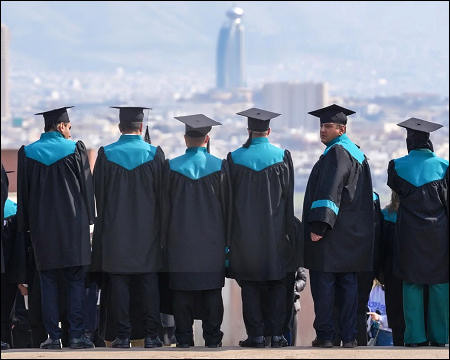
In recent years, the idea of “science as a public service and a public right” in the Kurdistan Region has moved backward toward the interest of “science as a commercial product.” This shift has made universities, instead of becoming centers for developing knowledgeable and thoughtful people, turn into centers for collecting capital and producing diplomas as a commercial brand. In this situation, the value of a diploma is reduced from its scientific content to the material price that a student pays to buy a seat.
The clearest sign of this commercialization is the uncontrolled increase in private universities without proper academic and national oversight. While there are only 20 public universities across the region, the number of private universities and institutes has reached around 35 institutions.
Most of these universities are run by political elites and large companies linked to parties, who see education as an “investment sector” rather than a national project. This has created a kind of “educational apartheid” and a harsh class division, where the quality of education is available only to the children of wealthy classes.
The government, under the excuse of a “financial crisis,” has ignored laboratories and basic services in public universities. But this neglect appears to be a deliberate policy to “weaken the public sector.” The goal is to make public universities less valued in the eyes of citizens, so people are forced to turn to private universities for the quality that was once a “right,” and pay heavy fees. In this way, higher education has changed from an opportunity for “equality and social mobility” into a “class privilege,” where the poor are left only with underfunded universities.
The logic of the market has not only affected the private sector but has also created a form of “internal privatization” in the public sector. Because of budget cuts and the lack of reform in management systems, the models of “parallel study” and “evening study” were imposed as sources of income for public universities. This has damaged the essence of the university as an independent institution and turned it into a government-run shop.
Under this system, the principle of “academic merit” has been broken. Students, regardless of their ability or real grades, can buy important study seats simply with money. This policy has turned the moral meaning of education into a market slogan: “Pay money and become whatever doctor or engineer you want!” This has weakened public trust in diplomas and expertise.
This large financial burden, which ranges annually between 2 and 12 million dinars, has made university admission no longer based on “intelligence,” but on the “size of the wallet.” This is not only unfair, but it deprives society of talented young people whose only fault is their family’s poverty. It is the destruction of national human capital for the benefit of a few wealthy individuals.
The most dangerous consequence of this commercialization is the change in the “definition of the student.” When the relationship between learner and university turns from a “knowledge-based relationship” into a “financial contract,” scientific quality becomes a sacrifice for customer satisfaction. The student is no longer seen as a “researcher and critic,” but as a “consumer” who only expects a service in exchange for money.
But students did not remain silent consumers. The strong protests in recent years demanding the restoration of stipends and improvement of dormitories were a legitimate cry against this system. These protests showed that Kurdish students still see themselves as holders of “rights” rather than consumers, and are not willing to stay silent in the face of policies that starve and destroy public education.
Here, the goal of the university becomes “customer satisfaction” instead of “producing knowledge.” The student is forced to think only about how to fill the pockets of investors in order to obtain a “piece of paper” (a diploma), which is only seen as a work permit. This reduces the university from an intellectual workshop into a certificate-printing office.
This situation has led to the gradual disappearance of the humanities (such as philosophy, literature, and history), because the market sees them as “non-profitable fields.” This creates a generation that is technically trained to obey instructions, but is intellectually powerless and unable to question oppressive structures. This is the killing of “critical thinking” inside the university itself.
The situation of teachers and academic staff within this market is extremely bad. The university professor, once a leading intellectual figure, has been reduced to a temporary employee under constant threat from short-term contracts and cuts to salaries and academic allowances. This has destroyed job security and academic dignity.
The ongoing struggle of teachers and their boycotts of classrooms for fair wages and rights is not only a material demand. It is also a defense of the public sector and the dignity of science. Teachers have shown through their stance that universities cannot survive when their scholars are struggling for basic living needs. This resistance is a way to prevent the complete collapse of education.
On the other hand, unhealthy competition in academic rankings is no longer about the progress of knowledge. Instead, it is used as advertising to attract more “customers.” This has emptied the scientific process of its real meaning and turned universities into companies that care only about external image, not the real quality of intellectual production.
The mixing of party culture with the interests of business oligarchs has reduced universities from centers of knowledge into “profit-making companies.” This is exactly a form of “investment in hopelessness,” where power uses the financial crisis and youth unemployment to sell diplomas and turn universities into tools for controlling society.
Higher education must be saved from this “commercial prison.” This requires a structural struggle to regain “academic independence,” provide fair funding for public universities through taxes on large corporations, and restore dignity to teachers and students. The minds of the new generation must not be sacrificed for the profit of a few businessmen. Science must be a tool for human liberation, not a product for sale.
This article was originally published in the Kurdish language in Awene Newspaper on June 16, 2026.
The opinions are those of the writer and do not necessarily represent the views of iKurd.net or its editors.
Copyright © 2026 iKurd.net. All rights reserved.
Facts about Kurdistan: Taxi drivers with college degree in Iraqi Kurdistan!
Related posts:
 University of Sulaimani ranked first in Iraqi Kurdistan in global academic ranking: SIR
 Iraq – The Cynical Swindle
 Sabotaging Syria
 The Dangers of Banning Cash: A Threat to Financial Freedom
 Dr. Abdul Latif Salafi sexual harassment case rocks University of Sulaimani
 Business with ISIS – Updated
 The Mustashar and the Jash – A View from the Position of ‘Iraqi National Unity’ on the ‘Descendants of Treason’
 Iraqi Kurdistan – “Sold Out!” – Part II
 Ethics Hammer and the Fall of Sacred Illusions
 The Resurrection (Ba’ath) Party – Before the Iran-Iraq War