

SWEIDA,— Tensions in southern Syria’s Sweida province eased on Friday after a fresh round of clashes between Druze armed groups and Syrian government militia Islamist forces, though concerns remain over a possible resurgence of violence.
The fighting on Thursday broke a fragile ceasefire that had ended several days of intense violence in July. Reports indicated injuries on both sides, but there were no confirmed fatalities.
The Druze National Guard, the province’s de facto military authority, accused government forces of attacking the town of al-Majdal on Thursday.
In a statement, the group said government troops used heavy and medium weapons, including attack drones, in what it described as “an aggressive attempt to breach our defensive positions and strike key locations.”
“Our fighters responded effectively and repelled the assault, causing substantial losses to the attacking forces in both personnel and equipment,” the statement added.
Meanwhile, Damascus officials blamed the Druze factions for breaking the ceasefire first. Mustafa al-Bakour, the governor of Sweida appointed by the central government, said that “some factions and the so-called National Guard” carried out attacks on designated de-escalation points.
He described these actions as “a clear violation of international agreements” and said they obstruct efforts to restore security and allow residents to return to their villages.
Political analyst Saber Abou Ras, based in Sweida city, described Thursday’s clashes as “very intense and violent,” involving drones, anti-aircraft machine guns, and mortar shells.
He also reported hearing Israeli warplanes over the city, though it was unclear whether they conducted any strikes.
Abou Ras suggested the government’s assault was likely retaliatory. He pointed to a recent takeover of a checkpoint in northern Sweida by the local police chief and a group of officers, previously controlled by Syrian government security forces.
On Thursday in London, Syrian Foreign Minister Asaad al-Shibani acknowledged mistakes by all sides during an event hosted by the Chatham House think tank.
“There are many problems, but we are not addressing them as if we are the opposing party,” he said. “We are treating this as a Syrian wound and as an internal issue within the same house.”
Sweida has been a hotspot for violence since July, when Druze groups clashed with local pro-government Islamist Bedouin tribes following a series of kidnappings.
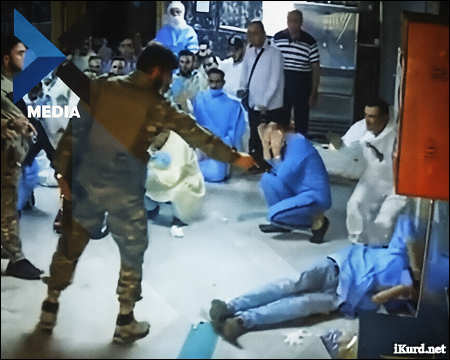
The conflict escalated when government security forces intervened, siding with the Bedouins, resulting in the deaths of hundreds of civilians, mainly Druze.
Israel intervened in support of the Druze, a minority that also resides in northern Israel, targeting government forces and a key defense ministry building in Damascus.
A U.S.-brokered ceasefire eventually led to the withdrawal of government troops from Sweida.
Since the July clashes, Druze factions have established a de facto military and governing body in Sweida, mirroring the autonomous Kurdish administration in Syria Kurdistan (Rojava Kurdistan), and have largely refused engagement with Damascus.
Tens of thousands remain displaced, including Druze residents within Sweida and Bedouins relocated to other areas. The province continues to face security challenges amid fragile governance and ongoing mistrust between local and government forces.
(With files from AP)
Copyright © 2025 iKurd.net. All rights reserved.
Related posts:
 Syria withdraws forces from Druze city of Sweida after Israeli strikes
 Syria’s Sharaa urges Bedouins to uphold ceasefire with Druze
 Druze in Syria’s Sweida besieged months after clashes, Israeli Druze leader says
 Israel strikes Syrian government forces in Druze city of Sweida
 Syria: The Hijacking of the Arab Spring: From ISIS to Hayat Tahrir al-Sham
 Druze leader urges int’l probe into Syria’s deadly Sweida clashes
 One year after Assad’s fall, genocide risk for Alawites and Druze
 The Resurrection (Ba’ath) Party – Before the Iran-Iraq War
 Business with ISIS – Updated
 Syria’s Shaara Proved He is Still a Jihadist Commander