


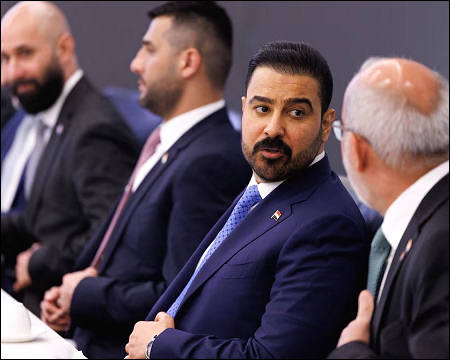
WASHINGTON,— Iraq and a group of Western energy firms signed dozens of deals on Friday covering oil, gas and pipeline projects, part of Baghdad’s push to build closer ties with Washington and find new routes for shipping its energy that bypass the Strait of Hormuz.
Prime Minister Ali al-Zaidi, speaking through a translator at a U.S.-Iraq business summit hosted by the U.S. Chamber of Commerce, said his government is taking an open approach to foreign investment.
Iraqi officials and American companies in energy, healthcare and technology signed non-binding agreements and memorandums of understanding worth more than $60 billion.
“Everybody who has a project can come and talk to us. We will not make it difficult for anyone,” Zaidi said.
The fighting between the United States, Israel and Iran has shaken the wider Middle East, including Iraq, which borders Iran.
Tom Barrack, President Donald Trump’s envoy to the region, said the conflict has brought disorder, but he also described Iraq as central to a developing security partnership involving the U.S. and other nations.
Before the summit, Zaidi stopped at Chevron’s headquarters in Houston on Thursday.
Iraqi officials later signed agreements with the company to explore its possible involvement in the West Qurna 2 and Nassiriya oilfields.
Jake Spiering, a Chevron corporate development executive, said at the Chamber event that the company plans to invest in a pipeline that would give Iraq an export path avoiding the Strait of Hormuz.
That pipeline could carry Iraqi crude to Syria’s Mediterranean coast.
Iraq’s oil exports have suffered during the war, partly because of restrictions at the strait, a waterway that normally carries about 20% of global oil and gas shipments.
Spiering added that over time, Iraq’s energy resources could position it as a regional trading hub similar to the Henry Hub natural gas market and the Cushing oil hub in the United States.
Separately, ConocoPhillips said it would acquire a 42% stake in BP Energy of Kirkuk Ltd, joining BP in redeveloping four oil-producing fields in northern Iraq.
BP chief executive Meg O’Neill said Iraq holds strong resource potential and that the new partnerships support both Iraqi and global energy security.
BP’s presence in Iraq dates back to the 1927 discovery of the Kirkuk oilfield.
ConocoPhillips CEO Ryan Lance said his company lacks BP’s long record in Iraq but has worked in difficult regions such as Alaska’s North Slope.
“We are anxious to bring our technology, our know-how, our people, and our capital to help the Iraqi people,” Lance said.
Zaidi, on a five-day visit to the United States, met Trump at the White House on Tuesday. Trump said the U.S. would pursue numerous deals with Iraq that would create jobs in both countries.
(With files from Reuters)
Copyright © 2026 iKurd.net. All rights reserved.
Related posts:
 Iraq – The Cynical Swindle
 Ali al-Zaidi from Da’wa to peak of Iraq’s rentier system
 Iraqi Kurdistan – “Sold Out!” – Part II
 Business with ISIS – Updated
 The Misleaders: Corrupt, Filthy Rich, and Proud of it
 Saddam Hussein was a Friend to the West
 Iraqi Kurdistan – “Sold Out!” – Part III
 Saddam Hussein’s Enemies: Paving the Road to the Invasion of Iraq
 The Resurrection (Ba’ath) Party – Before the Iran-Iraq War
 “ISLAMBUL”