

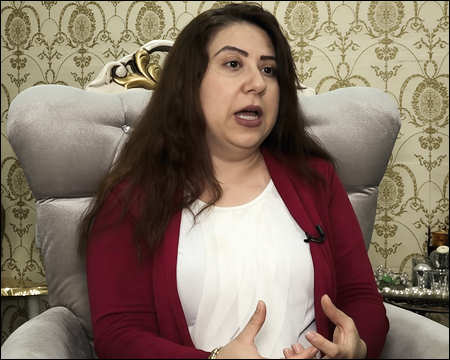
SULAIMANI, Iraqi Kurdistan,— Sociologist Kurda Ahmed says that the killing of women is not an authentic component of Kurdish culture but rather an imported practice, stressing that addressing women’s issues is fundamental to establishing stability in society.
In Southern (Iraqi) Kurdistan, violations against women are increasing day by day. According to the March 8 Network, 53 women were killed during the past 11 months alone.
These crimes have left deep impacts on families and society, particularly on children. Speaking to Rojnews, Ahmed discussed the roots of violence against women and ways to address it.
Violence Leaves Lasting Impacts on Children
Kurda Ahmed emphasized that violence against women directly affects the relationship between mothers and their children. She said that women in society become victims of wars and a patriarchal mentality, which negatively impacts the social structure and children in particular.
“Children have a strong emotional bond with their mothers, and therefore they also become victims,” she said, noting that the consequences of violence leave long-term psychological effects.
She added that gender discrimination remains present in upbringing practices, and that many families continue to exercise severe violence against women.
Honor Killings Are Not Rooted in Kurdish Culture
Addressing the role of social traditions in the continuation of violence against women, the sociologist said that violence against women has existed for thousands of years, but the practice of killing women in the name of honor is not rooted in Kurdish culture.
“This practice was imported to us,” she said, explaining that it does not stem from Kurdish cultural heritage. Instead, it took shape during the enactment of Iraq’s Personal Status Law between 1955 and 1958, which provided legal cover for the killing of women under the pretext of “honor.”
She stressed that this turned the practice into a socially enforced norm and emphasized that this mindset was imposed and does not originate from Kurdish culture itself.
Seeking Protection Remains a ‘Red Line’
Kurda Ahmed also spoke about the obstacles faced by women victims when attempting to file complaints. She said that when a woman turns to protection centers, it usually means her suffering has already become extremely severe.
“Seeking refuge in centers is considered a red line within families and tribes,” she said. “As a result, many women remain silent and continue to suffer abuse.”
She added that women’s freedom has not yet become stable and remains in a fragile state. While authentic Kurdish culture does not promote gender discrimination, she argued that a dominant and oppressive mentality has interfered with and distorted cultural values.
She stressed the need to raise individuals in a modern way, based on Kurdish history and ancient culture, without creating gender discrimination.
Women’s Issues Are the Basis of Social Stability
Regarding solutions to violence against women, Kurda Ahmed stressed the importance of spreading public awareness and redefining how women are viewed in society.
She said women must be recognized as independent individuals who own their bodies, thoughts, and lives, and who are capable of making their own decisions.
“Addressing women’s issues means laying the foundations of stability in society,” she said.
Kurda Ahmed also emphasized the role of families, civil organizations, and the government in providing psychological support to women. She noted that patriarchal mentalities are deeply rooted within families and government institutions alike.
To change this mentality, she said efforts must begin with marriage practices, gender discrimination must be eliminated, awareness must be raised within families, and programs should highlight women’s strength and capabilities.
She also called on families to work toward equality between both genders and urged women’s organizations to expand awareness efforts regarding women’s rights and responsibilities.
The term “honor killing”, also known as a shame killing, describes a murder carried out, usually by family members, to defend or restore what they see as the family’s honor. This is often based on the belief that the victim has brought shame to the family through their actions.
Most honor killings involve women and are a severe form of violence against women, especially in societies where traditional or legal restrictions limit women’s rights and freedoms.
While honor killings are most commonly reported in the Middle East, North Africa, and South Asia, they also occur in other parts of the world, including the Philippines, the Caucasus, Latin America, East Africa, and historically in Mediterranean Europe. They are also seen in immigrant communities in countries where such practices are not socially or legally supported.
Honor killings are often linked to rural or tribal communities, but they can also happen in cities. These crimes are rooted in cultural, social, and sometimes legal pressures that place a high value on family reputation and perceived social standing.
Copyright © 2025 iKurd.net. All rights reserved.
Related posts:
 Anonymous women’s graves highlight honor killings in Sulaimani, Iraqi Kurdistan
 Sabotaging Syria
 Syria: Revisiting The Caesar Torture Victim Photographs
 Anfal – The Black Stain on Iraqi History Spreads
 The Mustashar and the Jash – A View from the Position of ‘Iraqi National Unity’ on the ‘Descendants of Treason’
 The Absurd Cause For The Faili Kurds Holocausts – Part III
 The Rojava Revolution Has Lessons for Western Feminism
 In the name of ‘honour’ – lingering ghosts of the girls killed in Iraqi Kurdistan
 Powerful, yet are they Useless?
 Business with ISIS – Updated