


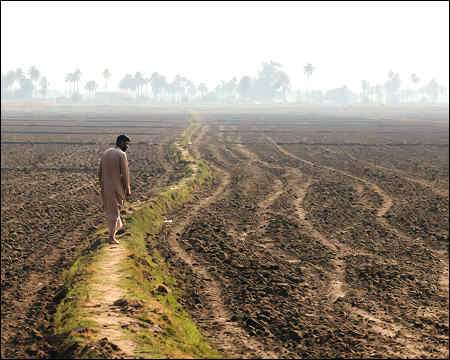
NAJAF, southern Iraq,— For decades, Iraqi wheat farmer Ma’an al-Fatlawi depended on steady flows from the Euphrates River to irrigate his farmland on the outskirts of Najaf, according to Reuters.
The river, long central to agriculture in southern Iraq, has shaped livelihoods for generations. This year, however, the water has not arrived as expected, leaving fields dry and farmers uncertain about the future.
Standing beside an irrigation canal that has delivered little water this season, al-Fatlawi said drilling wells is not a viable alternative.
He explained that underground water in the area contains high levels of salt, making it unsuitable for wheat cultivation. As a result, he must wait for limited allocations released through government-controlled canals.
Iraq, once one of the Middle East’s largest wheat importers, has spent recent years pursuing food self-sufficiency.
Through government-backed programs, wheat production has expanded enough to generate three consecutive years of surplus. Officials viewed these gains as a major step toward national food security.
Those gains are now at risk. Iraq is experiencing what officials and international agencies describe as the driest year in modern history.
Water levels in both the Tigris and Euphrates rivers have dropped sharply, forcing authorities to reduce agricultural planting. According to estimates cited by the U.N. Food and Agriculture Organization, this season’s wheat harvest could fall by as much as half.
“Iraq is facing one of the most severe droughts observed in decades,” Salah El Hajj Hassan, the FAO’s representative in Iraq, told Reuters. He said both rain-fed and irrigated agriculture have been affected nationwide.
The drought has exposed Iraq’s vulnerability to environmental pressures. The country is largely arid and ranks among the world’s most climate-exposed nations, according to United Nations assessments.
Average temperatures have increased steadily since 2000, and projections show further warming and declining rainfall in coming decades, according to data cited by international energy agencies.
Water scarcity is also shaped by regional dynamics. Iraq relies on neighboring countries for roughly 70 percent of its surface water.
Turkey and Iran control major upstream dams and have expanded water storage and hydropower projects, reducing downstream flows into Iraqi rivers. The FAO said reduced inflows from outside Iraq are the primary driver of the current crisis.
Baghdad has responded by introducing strict water rationing. Iraq’s total water reserves have dropped sharply, from about 60 billion cubic meters in 2020 to less than 4 billion cubic meters today, according to FAO figures shared by El Hajj Hassan. He expects wheat production to decline by 30 to 50 percent this season.
The threat to production comes after years of heavy government spending aimed at reducing reliance on imports. Authorities subsidized high-yield seeds, fertilizer, and modern irrigation equipment while encouraging cultivation in desert areas.
The state also purchased wheat at prices more than double international market rates to incentivize farmers.
These measures boosted national wheat stocks to more than 6 million metric tons in some seasons, exceeding storage capacity. The government said in September it bought roughly 5.1 million tons from the 2025 harvest and claimed reserves could cover domestic needs for up to one year.
Some analysts now expect imports to rise again. Harry Istepanian, a water specialist and founder of the Iraq Climate Change Center, told Reuters that Iraq’s water shortage poses broader economic and security risks.
He said increased imports could expose Iraq to price volatility and strain public finances.
A preliminary FAO forecast projects wheat import requirements for the 2025 to 2026 marketing year to reach about 2.4 million tons. While global wheat markets currently have ample supply, Iraq remains vulnerable to sudden price shifts.
The Iraqi trade ministry did not respond to requests for comment regarding possible increases in wheat imports.
To manage dwindling water supplies, the ministry of agriculture limited river-irrigated wheat cultivation to 1 million dunams for the 2025 to 2026 season, about half the previous year’s level.
Farmers are required to use modern irrigation methods such as drip and sprinkler systems, replacing traditional flood irrigation that loses water through evaporation and seepage. One dunam is approximately equal to a quarter of an acre.
Authorities also allocated 3.5 million dunams in desert areas for cultivation using groundwater, provided modern irrigation systems are installed. Mahdi Dhamad al-Qaisi, an advisor to the agriculture minister, said the plan was implemented in two phases, both dependent on updated irrigation techniques.
Rice farming, which requires significantly more water than wheat, was banned nationwide.
Experts warn that increased reliance on groundwater carries risks. Ammar Abdul-Khaliq, head of the Wells and Groundwater Authority in southern Iraq, said producing one ton of wheat requires about 1,100 cubic meters of water. Unregulated groundwater extraction could deplete reserves.
He said aquifers in Basra have already dropped by three to five meters. Groundwater irrigation systems also require costly infrastructure, adding financial pressure on rural households. Rural residents account for about 30 percent of Iraq’s population.
According to FAO estimates cited by El Hajj Hassan, roughly 170,000 people have already been displaced from rural areas due to water shortages.
“This is not only a food security issue,” he said. “It directly affects livelihoods.”
At his farm near Najaf, al-Fatlawi has reduced wheat planting to one-fifth of its usual size and dismissed most of his workers. Only two remain.
“We rely on river water,” he said.
(With files from Reuters)
Copyright © 2025 iKurd.net. All rights reserved.
Related posts:
 Iraqi Kurdistan’s Qaladiza town battles water shortages, navigates regional water diplomacy
 The Resurrection (Ba’ath) Party – Before the Iran-Iraq War
 Saddam Hussein’s Enemies: Paving the Road to the Invasion of Iraq
 Iraqi Kurdistan – “Sold Out!” – Part II
 Sabotaging Syria
 Iraq: Revenge and Corruption
 Spiritual Revival of the Forgotten Traditions of NuRoj
 Iraq – The Cynical Swindle
 Erbil faces water shortages in Iraqi Kurdistan’s summer heat
 Saddam Hussein was a Friend to the West