


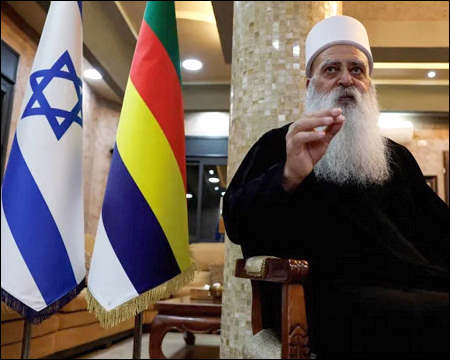
JULIS, Israel,— Seven months after deadly fighting in southern Syria, the spiritual leader of the Druze community in Israel said Druze across the border remain under serious threat.
Sheikh Mowafaq Tarif told AFP this week that Druze in Syria are still surrounded and cut off from outside help.
“They are still besieged, completely encircled. They are not allowed to bring in any humanitarian aid, including the aid we are trying to deliver,” Tarif said in an interview.
The cleric spoke in Julis, a quiet Druze village in northern Israel. There, members of the community have created what they call an emergency room to organize support for Druze in Syria.
Inside the room, Israeli and Druze flags hang on the walls. Posters written in Hebrew and Arabic call for an end to the killing of Syrian Druze.
The Druze follow a religion that broke away from Shiite Islam centuries ago. Their community lives mainly in parts of Syria, Israel, Lebanon and the Israeli Golan Heights.
Violence broke out last July in southern Syria between Druze fighters and pro-government Sunni Islamist Bedouin tribes. Syrian authorities said government Islamist forces stepped in to stop the clashes. However, witnesses and monitoring groups accused the authorities of supporting the Bedouin side.
During the fighting, Israel carried out airstrikes in Syria, saying it was acting to defend the Druze minority.

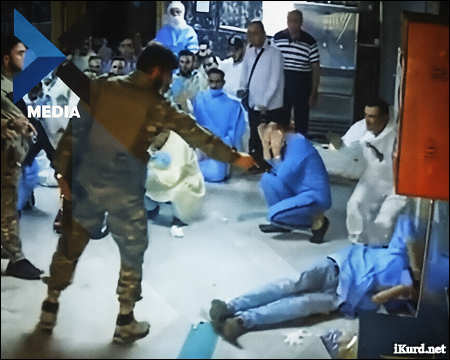
The Syrian Observatory for Human Rights reported that more than 2,000 people were killed in the violence. The group said 789 Druze civilians were summarily executed by personnel from the defense and interior ministries.
The UN Office for the Coordination of Humanitarian Affairs estimated that about 187,000 people were displaced by the clashes.
Tarif said many families have still not returned home.
“There are still more than 120,000 people displaced from their homes,” he said.
He added that 38 villages had been taken over and that residents were not allowed to go back. He also said more than 300 people, including women and children, were being held captive.
AFP said it was not able to independently verify those claims.
Although a ceasefire was reached in July, access to the southern province of Sweida remains limited. Residents accuse the Syrian government of enforcing a blockade on the area. Damascus denies this and says several aid convoys have been allowed in since the truce.
“Why not let them return to their villages? We are in the depths of winter and that is a mountainous area. It is very cold,” Tarif said.
Last month, Syria’s government and Kurdish led forces agreed to integrate Kurdish fighters and civil institutions into state structures. With that agreement, Sweida remains the last major area outside the control of Damascus.
Tarif said the Druze community does not need government security forces in Sweida.
“The Druze have forces capable of defending themselves and maintaining order,” he said. He referred to Syrian government forces as jihadists and Islamic State members.
Many Syrians remain cautious about Sharaa, noting that the jihadist group he once led began as an affiliate of Al Qaeda and that former members are now part of his government.
Israel’s leaders have repeatedly pointed to Sharaa’s jihadist past in urging Western countries not to legitimize him.
Despite this, Israel and Syria, which do not have formal diplomatic relations, have held several rounds of direct talks in recent months.
After negotiations in January and under pressure from the United States, both sides agreed to establish an intelligence sharing mechanism as part of efforts toward a broader security arrangement.
One issue being discussed is the possibility that Syrian Druze could work in Israel.
Tarif confirmed that he had heard about this possibility. He said he hoped any Syrian could be allowed to work as a daily laborer in Israel because the economic situation in Syria is very difficult.
He also called for Druze communities across the Middle East to be able to visit their religious sites in neighboring countries.
“Just as our Christian and Muslim brothers visit their holy places,” he said, adding that Druze should also have access to pray at their holy sites in Syria and Lebanon and to visit holy places in Israel.
(With files from AFP)
Copyright © 2026 iKurd.net. All rights reserved.
One year after Assad’s fall, genocide risk for Alawites and Druze
Related posts:
 Syria withdraws forces from Druze city of Sweida after Israeli strikes
 Syria’s Sharaa urges Bedouins to uphold ceasefire with Druze
 Druze, Syrian govt militias clash amid ceasefire violation claims
 Israel strikes Syrian government forces in Druze city of Sweida
 The Resurrection (Ba’ath) Party – Before the Iran-Iraq War
 Syria: The Hijacking of the Arab Spring: From ISIS to Hayat Tahrir al-Sham
 Druze leader urges int’l probe into Syria’s deadly Sweida clashes
 Sabotaging Syria
 Business with ISIS – Updated
 One year after Assad’s fall, genocide risk for Alawites and Druze