

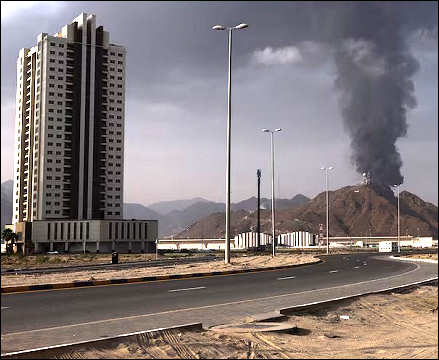
DUBAI,— Iranian airstrikes on Gulf states could push them into a wider coalition with the United States and expand the conflict with Iran, analysts said, after missiles and drones struck ports, cities and oil facilities in a key energy region.
The attacks targeted six Gulf states that are U.S. allies and host American military bases.
Analysts said Iran aimed to pressure those governments to convince U.S. President Donald Trump to halt the war. Instead, the strikes may have drawn the Gulf states closer to Washington and increased the chance of coordinated action against Tehran.
Abdulaziz Sager, chairman of the Saudi based Gulf Research Center think tank, told Reuters Gulf governments now face difficult choices.
They can openly support the U.S. military campaign by allowing their airspace and territory to be used and possibly joining operations. Or they can try to stay out and risk further attacks on their own soil.
Neutrality became less realistic once Iranian missiles began landing, he said. Countries that had sought to balance relations were forced to align more clearly with Washington and prepare to defend their territory and interests.
Iran launched the missile barrages after Supreme Leader Ali Khamenei was killed on Saturday, the first day of U.S. and Israeli military strikes.
Trump said those actions aimed to remove a security threat to the United States and prevent Iran from developing nuclear weapons.
The Gulf Cooperation Council, including Saudi Arabia, the United Arab Emirates, Qatar, Bahrain, Kuwait and Oman, held an emergency ministerial meeting on Sunday.
The bloc invoked Article 51 of the U.N. Charter, set red lines and signaled readiness for collective self defense as energy disruptions and security risks grew.
The GCC said Iran’s attacks strengthened unity among member states and warned that continued strikes could turn the Gulf from a defensive shield into an active theater of response. Joint air defense systems were activated and reconnaissance flights increased across regional airspace.
Analysts said leaders face a stark choice. Responding could risk a wider war. Holding back could weaken security, hurt economic stability and reduce international credibility under repeated attacks.
Gulf officials said warnings were sent to Tehran directly and indirectly, noting that further strikes would carry heavier consequences.
A Gulf source said governments are likely to wait as long as possible before escalating. He said U.S. and Israeli strikes against Iran are ongoing. It is unclear who directs events inside Iran.
Attacks on oil facilities may have been centrally ordered or carried out by rogue units. Two possibilities are emerging: command may have fractured, or decisions may remain coordinated at the highest level.
The conflict’s risks extend beyond the Gulf. Oil exports, shipping lanes and energy infrastructure face threats. A major global energy corridor could be disrupted, affecting international trade and markets.
Energy markets face one of their most serious shocks in decades. Missile threats forced shutdowns at some Gulf facilities, including Qatar’s liquefied natural gas sites, which account for roughly 20 percent of global supply.
Ebtesam Al Ketbi, president of the Emirates Policy Center, told Reuters that if strikes continue and Gulf states cannot withstand a prolonged conflict, disruption to oil shipping or closure of the Strait of Hormuz could prompt other countries to intervene.
Mohammed Baharoon, director general of the Dubai Public Policy Research Center, said the UAE describing the strikes as terrorism strengthens the case for broadening the coalition against Iran.
He said Tehran is pushing Gulf states into an expanding alliance, increasing the risk of wider conflict.
Strikes on Western linked facilities, including a British base in Cyprus and sites hosting French forces in Abu Dhabi, raise the possibility that NATO could eventually be involved.
The UAE has been the main target. Officials said 63 percent of strikes hit airports, ports and oil infrastructure. In the first 48 hours, an estimated 165 ballistic and cruise missiles and 600 drones were launched.
Missiles that struck Doha, Dubai and Manama also affected the Gulf’s image as financial, investment and tourism centers. The attacks hurt its reputation as a stable and secure location.
While the UAE seeks to avoid full-scale war, it has taken diplomatic steps. It summoned Iran’s ambassador, withdrew its own envoy, closed its embassy in Tehran and raised the issue at the U.N. Security Council.
Gulf officials said Iran’s large-scale missile and drone use has altered the diplomatic landscape.
They said Tehran’s actions make future U.S. negotiations on Iran’s missile program harder to separate from nuclear activities, a view now shared by Sunni Gulf Arab states and Western governments.
(With files from Reuters)
Copyright © 2026 iKurd.net. All rights reserved.
Related posts:
 Iraq – The Cynical Swindle
 Iraqi Kurdistan – “Sold Out!” – Part II
 Business with ISIS – Updated
 Saddam Hussein’s Enemies: Paving the Road to the Invasion of Iraq
 Saddam Hussein was a Friend to the West
 A War in Which Everyone Loses: Trump Attacks Iran Without Congressional Approval
 The Suffocation of Iraq Kurdistan
 “ISLAMBUL”
 US and Israel launch wide ranging attack on Iran
 The Resurrection (Ba’ath) Party – Before the Iran-Iraq War