

TEHRAN,— The United States and Israel carried out a large military assault on Iran on Saturday, opening a new and dangerous phase in tensions that have been building for months.
U.S. President Donald Trump, speaking in a recorded message, urged the Iranian public to rise up against the country’s Islamic leadership and take control of their future.
Iranian state media, citing the Red Crescent, reported Saturday evening that at least 201 people were killed and more than 700 wounded in the strikes.
Iranian forces responded by launching missiles and drones toward Israel and at U.S. military bases across the region. The exchanges of fire continued late into the night.
An Israeli official said Iran’s Supreme Leader Ayatollah Ali Khamenei and President Masoud Pezeshkian were both among the figures targeted in the strikes, but the official added that it was not yet clear what the outcome had been.
Israeli PM Netanyahu said in a televised statement that Khamenei does not exist.
Some of the first explosions in Tehran appeared to strike near offices linked to the 86 year old Khamenei.
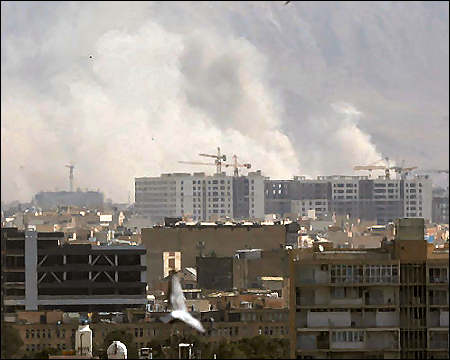
Smoke was seen rising from several parts of the capital. Iranian media said the attacks were not limited to Tehran and took place in various cities nationwide.

Iranian Foreign Minister Abbas Araghchi told NBC News that both Khamenei and President Masoud Pezeshkian were alive “as far as I know.” He described the assault as “unprovoked, illegal and absolutely illegitimate.”
In a video message announcing what he called “major combat operations,” Trump told Iranians that once the military action was completed, they should “take over your government.” He said the opportunity might not come again for generations.
The attack took place during the Muslim holy month of Ramadan. It marked the second time in eight months that the Trump administration has launched strikes against the Islamic Republic while negotiations over Iran’s nuclear program were underway.
About 12 hours after the first strikes, the U.S. military said it had suffered no casualties and reported only limited damage to American bases, despite what it described as hundreds of Iranian missile and drone attacks.
The Pentagon said American forces targeted Revolutionary Guard command centers, air defense systems, missile and drone launch positions, and military airfields inside Iran.
Two people briefed on the operation, including a U.S. official who spoke on condition of anonymity, said the list of targets also included members of Iran’s leadership. There was no immediate confirmation on whether any senior officials had been killed.
Even if senior leaders were eliminated, it remained unclear whether that would result in a change of government. Neither Washington nor Israel outlined any detailed plan for who might lead Iran if the current leadership were removed.
Democratic lawmakers in the United States criticized Trump for acting without formal authorization from Congress. White House press secretary Karoline Leavitt said senior Republican and Democratic leaders in Congress were informed ahead of the operation.
The United Nations Security Council scheduled an emergency meeting Saturday afternoon. In a letter addressed to the council, Araghchi wrote that “all bases, facilities, and assets of the hostile forces in the region shall be regarded as legitimate military objectives.”
Iran also requested an urgent session of the Board of Governors of the International Atomic Energy Agency, citing threats to what it called safeguarded nuclear facilities. The request was reported in a letter published by the semi official Tasnim news agency.
The U.N. nuclear watchdog said on the social media platform X that it was closely following the situation and had found no evidence of any radiological impact.
At the same time, internet monitoring group NetBlocks reported that Iran was experiencing a near total internet blackout, making communication with the outside world difficult.
After the strikes on its territory, Iran broadened its retaliation. It fired missiles and drones at Israel and targeted U.S. military installations in Bahrain, Kuwait and Qatar. It said it would continue its operations.
The immediate cause for the assault appeared to be the latest failed round of nuclear talks between Tehran and Washington.
But the confrontation also reflected wider changes in the region that have left Iran’s leadership in what analysts described as its weakest position since the 1979 Islamic Revolution.
Strikes by Israel and the United States last June significantly reduced Iran’s air defense capabilities, weakened parts of its military leadership and damaged elements of its nuclear program.
A regional conflict that began after a Hamas attack on Israel on Oct. 7, 2023, further strained Iran’s network of allied armed groups across the Middle East. Meanwhile, U.S. sanctions and diplomatic isolation have severely harmed Iran’s economy.
Israel’s military said Iran launched dozens of missiles toward its territory. Many were intercepted, and officials said there were no serious injuries. Emergency service Magen David Adom reported that 89 people were lightly injured.
Witnesses in Tehran said they heard at least three explosions near the Intelligence Ministry building in the northern part of the city on Saturday evening.
They said Iranian air defense systems were activated in the area. Israel’s military later said it had begun another wave of attacks against missile launchers and air defense systems in central Iran.
In southern Iran, a local governor told state television that at least 85 people were killed when a girls’ school was struck, and dozens more were injured. Captain Tim Hawkins, a spokesman for U.S. Central Command, said he was aware of reports that a school had been hit and that officials were looking into them.
Iran’s state news agency IRNA reported that at least 15 people were killed in the southwest. It quoted the governor of Lamerd, Ali Alizadeh, as saying that a sports hall, two residential neighborhoods and a hall near a school were among the sites struck.
Air travel across the Middle East was disrupted. Air defense fire was heard over Dubai, the commercial hub of the United Arab Emirates. State media in the UAE said shrapnel from an Iranian missile killed one person in the capital.
Officials said the attack was coordinated between Israel and the United States. Israel stated that the operation had been planned for months. Lt. Gen. Eyal Zamir, Israel’s military chief of staff, said air force pilots were striking hundreds of targets across Iran in coordination with U.S. forces.
A person familiar with the Israeli campaign, speaking on condition of anonymity, said targets included Iranian military facilities, intelligence sites and symbols of government authority.
Trump defended the military action by claiming Iran continued to develop its nuclear program, even though he had said last year that earlier strikes had destroyed it.
He acknowledged the possibility of American casualties, saying that such losses can happen in war.
The president said he aimed to destroy Iran’s navy and eliminate regional groups backed by Tehran. He called on members of the Revolutionary Guard to surrender, saying they would be granted immunity if they laid down their arms, or face severe consequences if they refused.
Iranian officials had previously said they hoped to avoid war but insisted on their right to enrich uranium. They declined to discuss limits on their long range missile program or their support for armed groups such as Hamas and Hezbollah.
Iran said it had not enriched uranium since June, but it blocked international inspectors from visiting certain sites that were later bombed by the United States.
Satellite images analyzed by The Associated Press showed new activity at two of those locations, indicating efforts to assess damage and possibly recover materials.
Trump had earlier threatened military action but delayed it after Iran launched a harsh crackdown on protests that began over economic grievances and grew into a nationwide movement against the ruling clerics.
The Human Rights Activists News Agency said it had confirmed more than 7,000 deaths in the crackdown and was investigating thousands more cases. Iran’s government has acknowledged more than 3,000 deaths.
Kamran Matin, an Iran specialist at the University of Sussex in southern England, said the Revolutionary Guard’s record during the protests could make many Iranians hesitant to return to the streets.
The conflict raised concerns about global energy markets. Analysts noted that Iran could attempt to disrupt shipping through the Strait of Hormuz, a key route through which about one third of the world’s seaborne oil exports passed in 2025.
Saudi state media reported that Iran targeted its capital and eastern region, but the attacks were repelled. Bahrain said a missile was aimed at the headquarters of the U.S. Navy’s 5th Fleet in the island kingdom.
Kuwait’s civil aviation authority said a drone targeted the main international airport, injuring several workers. The state news agency reported that three soldiers were wounded by shrapnel after strikes on Ali Al Salem air base. Explosions were also heard in Qatar. Jordan said it had dealt with 49 drones and ballistic missiles.
Two senior officials from Yemen’s Iranian backed Houthi movement, speaking on condition of anonymity, said the group planned to resume attacks on Red Sea shipping routes and on Israel.
U.S. embassies and consulates in Qatar, the United Arab Emirates, Bahrain, Jordan, Israel and in Karachi, Pakistan, instructed staff to shelter in place and advised American citizens in those areas to do the same until further notice.
(With files from AP)
Copyright © 2026 iKurd.net. All rights reserved.
Related posts:
 The Resurrection (Ba’ath) Party – Before the Iran-Iraq War
 The Assassination of Abdurrahman Ghassemlou: No Friends but the Mullahs?
 A War in Which Everyone Loses: Trump Attacks Iran Without Congressional Approval
 Israel hits Iran’s nuclear facilities as Tehran responds with drones
 Israel-Iran ceasefire in effect, Trump says respect it
 Iran – Toxic Theocracy – Part I
 Iran, a Failed Country by Enemies Within
 The Suffocation of Iraq Kurdistan
 Saddam Hussein was a Friend to the West
 Hope for reaching a U.S.-Iran peace deal is gradually fading away