


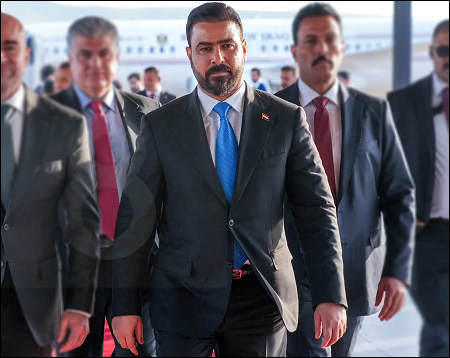
WASHINGTON,— The United States is seeking “concrete actions” from Iraq’s incoming prime minister to separate state institutions from pro-Iran Shiite armed groups before Washington restores financial transfers and security assistance, a senior U.S. official said Tuesday.
Iraq’s ruling coalition nominated Ali al-Zaidi as the country’s next prime minister.
He later received a congratulatory phone call from President Donald Trump, who had previously warned that the United States could end all support if former Prime Minister Nouri al-Maliki returned to office.
A senior State Department official, speaking on condition of anonymity, said Zaidi must address what the official described as a “blurry line” between the Iraqi state and armed groups backed by Iran in the Shiite-majority nation.
The United States halted cash transfers linked to Iraq’s oil revenue, which are managed through the Federal Reserve Bank of New York under an arrangement created after the 2003 U.S.-led invasion of Iraq.
Washington also suspended security assistance following a series of attacks targeting American interests in Iraq.
The official said restoring full U.S. support would require Iraq to remove “terrorist militias” from state institutions, stop budget support for those groups and prevent salary payments to militia fighters.
“Those are the type of concrete actions that would give us confidence and say that there’s a new mindset,” the official said.
According to the official, American facilities in Iraq faced more than 600 attacks after Feb. 28, when the United States and Israel launched military operations against Iran.
The attacks largely stopped after a ceasefire between the United States and Iran took effect on April 8, except for Iranian strikes in Iraq’s Kurdistan region, the official said.
“I’m not underestimating the severity of the challenge or what it would take to disentangle these relationships,” the official said, adding that Iraq could begin with a “clear and unambiguous” statement that militias are not part of the state.
The official also said some parts of the Iraqi government continued to provide political, financial and operational support to the armed groups.
Washington increased pressure on Iraq when it appeared Maliki could become prime minister again.
During his earlier time in office, ties with the United States worsened over accusations that he was too close to Iran’s Shiite leadership and encouraged sectarian tensions.
Pro-Iran Shiite armed group attacks in Iraq have targeted the U.S. Embassy in Baghdad, facilities at Baghdad airport and oil fields operated by foreign companies.
(With files from Reuters)
Copyright © 2026 iKurd.net. All rights reserved.
Related posts:
 The Resurrection (Ba’ath) Party – Before the Iran-Iraq War
 Saddam Hussein was a Friend to the West
 Iraq president asks PM-designate Ali al-Zaidi to form government
 The Suffocation of Iraq Kurdistan
 Saddam Hussein’s Enemies: Paving the Road to the Invasion of Iraq
 Business with ISIS – Updated
 Sabotaging Syria
 Iraq – The Cynical Swindle
 Iraqi Kurdistan – “Sold Out!” – Part II
 Iraq: Revenge and Corruption