


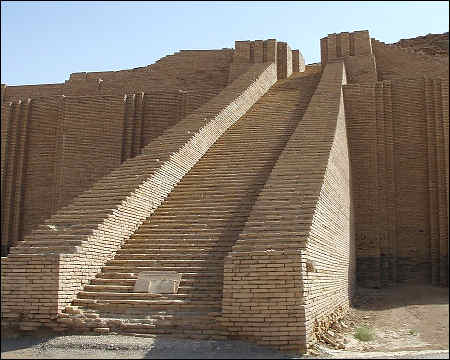
Sheri Laizer | Exclusive to iKurd.net
Migrating to the Mesopotamian plains from northern Iraq and the Zagros mountains, the Sumerians brought written literature and music whose echoes resound anew…
“Enten is behind us, the winter darkness is no more.
Imhullu lies coiled in the mountain.
Who would disturb him?”
(Sumerian text)
Introduction
Wondering how Sumerian music sounds when I first heard Kurdish uzun hava (long air) music playing in the hills outside Jerusalem I got an exciting tingle along my spine. It was probably an old recording of Hasan Zirek that I heard. By 1985, I had begun working with Kurdish singers and musicians and presenting them at World Music festivals and writing the notes for recordings.
For three years before this discovery, I’d been researching Sumerian civilisation, based in the Valley of the Kings and later in the West Bank. The protracted Iran-Iraq war had made visas to Iraq very hard to get. Finally, in September 1989, the Iraqi Cultural Centre presented me with an invitation to travel to Iraq.
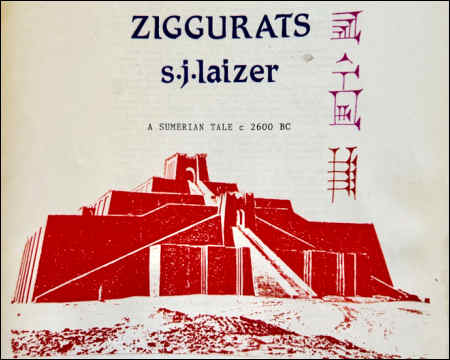
The ms. of my book, Ziggurats, was near completed and it was the key to the door. I was tactful not to mention living among the Kurds in Turkey between 1985-1988.
Years of reading Sumerian texts in translation and visiting the Mesopotamian sections of the British Museum took me inside Sumerian thought. Setting foot in Iraq did the rest. The passion burned bright.
The legacy of the great city of Ur dedicated to the moon deity, Nanna
The ruins of the Sumerian ziggurat of Ur were first re-appraised by King Nabonidus of Neo-Babylonian reign (556-539 BCE…), who began to restore Sippar, Ur and Babylon. Many inscriptions survive.
“This inscription emphasizes divine mandates for the restorations, references to earlier kings like Naram-Sin whose foundations were uncovered, and prayers for protection against threats from the Medes and Persians, reflecting Nabonidus’s efforts to legitimize his rule through religious renewal.[1] Similarly, a cylinder from Ur in the British Museum records the rebuilding of Sin‘s ziggurat there, invoking the moon-god’s favour for Nabonidus and his son Belshazzar, who acted as regent during the king’s prolonged absence.[2]”
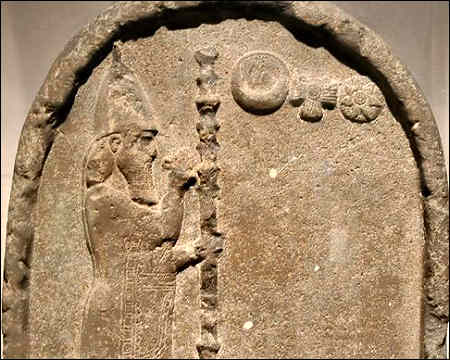
The ziggurat at Ur was originally constructed in the reign of King Ur-Namma around 2112-2095 BCE.2
Nabonidus is known as the last king of Babylon, long after the Sumerian era.
No further significant restorations were initiated until the 1980s by President Saddam Hussein. The ziggurats were visible from miles around standing above the flat plains, situated close to the Euphrates (Firat) and Tigris (Dicle) rivers, lush with palm groves and reeds. Restoration has finally begun anew. 3
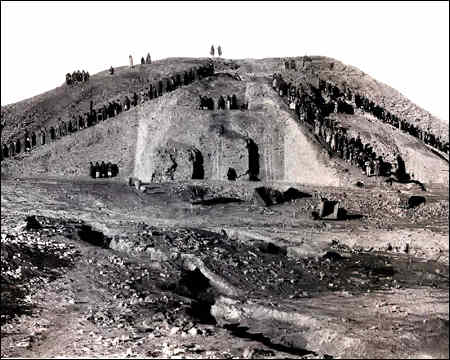
The ziggurat
In Sumerian, the pyramid structure was named an unir and ziggurratum (or ziggurartu) in Akkadian, meaning peak, pinnacle or high place. The top level offered a platform and temple where rituals would be performed for audiences far below.
Some rituals involved the high priestess of Inanna, the Sumerian forerunner of Venus, in initiation rites with the king of the city. Each city had its patron saint or deity.
The Sumerian people are currently thought to have originated from northern Iraq and the Zagros Mountain regions – long populated by the Kurds.
The Sumerians expressed emotions like nostalgia and remembrance for the mountains in poems, epics and hymns. They built ziggurat (stepped pyramids) as stairways to heaven where men could attain the realm of the deities.
The Sumerian archaeological period is known as the Uruk period dating to between 4000-3000 BC, taking its name from the city site of Uruk in southern Mesopotamia, today’s Iraq. It followed the period of the Ubaid culture spanning between 6000-4000 BC. The Early Dynastic period that succeeded Uruk then dates to 2900 – 2334 BCE.
Scientists most recently researching Mesopotamian DNA and that of the Levant consider there to have been mass migration from northern Iraq and the southern Zagros before 4000 BC with the movement of people down into the Mesopotamian plains all the way to the Persian Gulf after the Neolithic period.4
The south westerly migration is also traced to the Levant in Syria and Palestine with migration from northern Mesopotamia evident in the influential Neolithic cultures of Halaf (where the Khabur river meets the Euphrates in the north-east of Syria at Ras al-Ain/SE Turkey, the later Kurdish crossroads) and Hassuna (from c.7000 -5900 BCE). The site of Hassuna lies just 10 or kms south of the Abbasid stronghold of Samarra on the Tigris (Tell Hassuna/ Tell es-Sawwan).
Sumerian – A unique language (isolate)
Linguistic data about the relation of Hurrian and Sumerian further confirms the migration theory.5 Sumerian was a unique, isolate language. The Sumerians invented the cuneiform wedge-cut system of writing on clay tablets – the first known system.
They also invented the wheel and the sexagesimal numeral system with its base of 60, that passed down through the Babylonians to us. The sixty minute hour and the sixty second minute derive from this base. Their knowledge of mathematics and compiling lists extended to stock taking and economic record keeping on tablets. They maintained a list of kings from the earliest times.6
Irrigation, and the plough, are also a Sumerian legacy. The practised agriculture and farming keeping dairy herds, goats and sheep.
These passionate human beings made music, danced and sang, performed acrobats, and enjoyed drinking beer. Their pottery, sculpture and jewellery were all highly advanced and detailed. Artisans also undertook weaving.
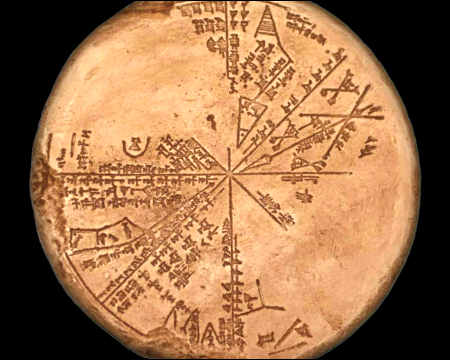
Astronomy and astrology
The Sumerians identified and depicted the five visible major celestial bodies, Mercury, Venus, Mars, Jupiter and Saturn, along with the sun and the moon. They composed maps of the stars on tablets and formed a system of astrological lore.
Eleven planets with a twelfth further away can be seen on some of the clay tablets demonstrating their understanding of the solar system as well as the relative sizes of the different planets.
Sumerian musical instruments from the 3rd millennium BCE
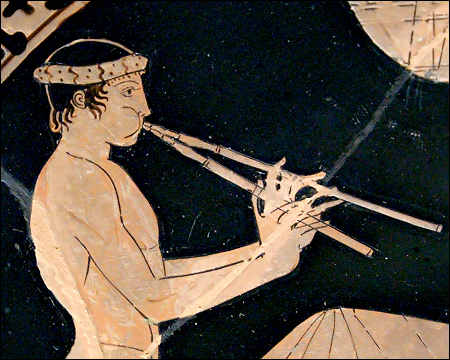
The flute (Kurdish ney) and the double reed pipe – (Kurdish, duduk).
An academic research article, Extant silver pipes from Ur, 2450 BC explains: “Several Mesopotamian texts associate pipes (Sumerian gi-írra, gi-gíd, di-di [from gi=tube]8, with the shepherd-god Dumuzi who was the lover of the goddess Inanna9…The pipes fell silent when he descended to the underworld; when he returned the pipes were again played, and the living rejoiced (Dalley 1988, 160). Perhaps the destruction of the pipes in PG/333 was a reference to the silence of Dumuzi’s pipes in the underworld…”10
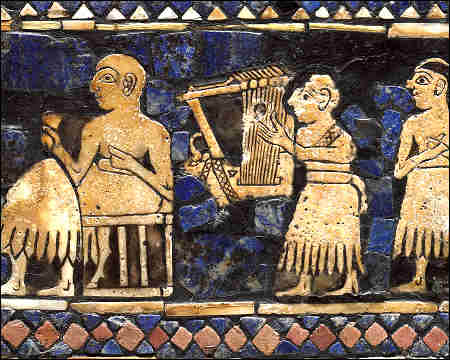
Dumuzi is the forerunner of the later Tammuz – a name still used as Temmuz, the month of July when everything perishes in the heat of summer in Mesopotamia.
The lyre
This was crafted in different sizes, the largest lyre is now thought to sound like a bass viol, the medium sized lyre like a cello, and small hand-held lyres. They range from three strings to as many as twelve strings.
The angular lyre
The Silver lyre found in the Royal Graves of Ur
The gold lyre with bull’s head, found in the Royal Graves of Ur
The boat-necked lyre, found in the Royal Graves of Ur
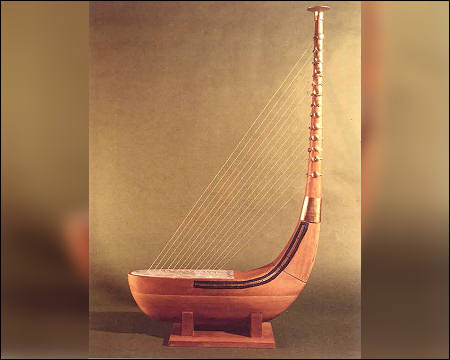
This harp or lyre (Queen Puabi’s harp) is thought to sound like a small guitar.
The long-necked lute (gish-gu-du)
This stringed instrument is akin to the Kurdish saz, tanbur or Anatolian baglama. The sound depends on the depth of the bowl.
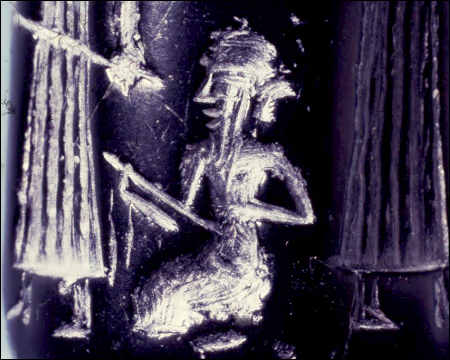
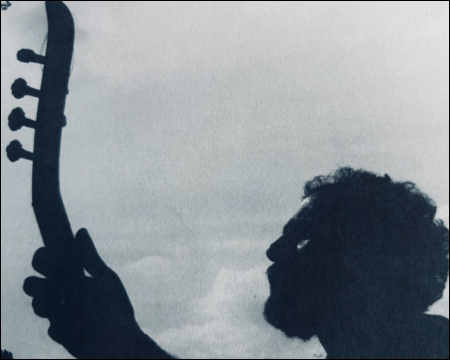
It can have had eight or fewer strings. Canadian musician, Peter Pringle, performs a number of profoundly evocative renditions singing in Sumerian. Various compositions from the Epic of Gilgamesh etc. are played on a reconstructed instrument with just three strings. Pringle has recorded several other pieces of ancient music using reconstructed instruments and now dead languages.
Video: Peter Pringle accompanying Sumerian songs on the gish-gu-du
Drums
Drums included small kettledrums and frame drums whether made of coniferous wood (boxwood), or clay
The percussion instruments
The Sumerian musicians played rattles (sistrum) and used cymbals, and clappers
Trumpet and horns
The qarn, were made from animal horns, mainly from bulls and goats)
Key Discoveries at the Ur site
Eleven stringed instruments were recovered from the Royal Graves at Ur comprising two harps with decorative bulls’ heads and two wind instruments made of silver. (Other sites revealed some flutes or pipes made of bone).
Cuneiform tablets revealed the tuning as well as the playing of the instruments. Penn Museum writes:
We now know that by the Old Babylonian period in ancient Iraq (i.e., by at least ca. 1800 BC, or about 850 years after the period of the Royal Cemetery of Ur), there existed standardized tuning procedures that operated within a heptatonic, diatonic system consisting of seven different and interrelated scales…
The fact that these seven scales could be equated with seven ancient Greek scales (dating some 1400 years later) quite startled the scholarly community; and the fact that one of the scales in common use was equivalent to our own modern major scale (do-re-mi) seemed difficult for many to believe (Fig. 6). But research on the part of several cuneiformists and musicologists working together has been strengthened over the years by the steady accumulation of cuneiform tablets that use the same standard corpus of Akkadian terms to designate the names of the musical strings; the names of the instruments and their parts; fingering techniques; the names of musical intervals (fifths, fourths, thirds, and sixths); and the names of the seven scales that derive their nomenclature from the particular interval of a fourth or a fifth on which the tuning procedure starts…
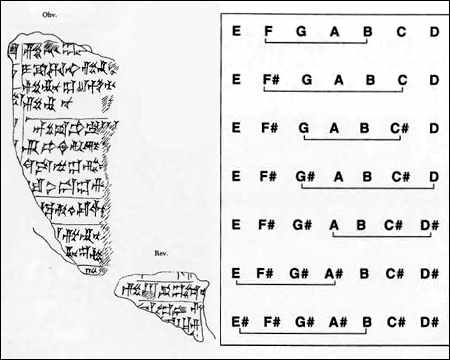
It is highly probable that the tuning systems evidenced in the Akkadian language in texts dating from the Old Babylonian to the Neo-Babylonian period (ca. 1800-500 BO had earlier Sumerian antecedents, because many of the technical terms in Akkadian have Sumerian equivalents.
Seven scales
The third from bottom scale is equivalent to do-re-mi.
Unlike most documented accounts of music history, the findings at the cemetery of Ur suggest that it was specifically female musicians who maintained and spread Sumerian oral musical tradition…13
Equality of the female with the male
The Abrahamic religions have undermined that natural, harmonious equality that exists between men and women, as was extolled in ancient Sumer – in daily life as in the realm of the natural forces and celestial deities.
Deity was not a man glaring down from the heavens upon homo sapiens, fingering a long beard, with a scroll, and dishing out punishments. This system was created through Judaism, diffuses through Christianity and subsequently Islam. The system remains divisive, and fear based.
The Sumerians were US not THEM. To return intuitively, consider their words and listen to how their music may have been performed with all its passion and emotion is, in my experience, akin to being (psychologically) freed of the accretions of imposed, patriarchal monotheism.
1 https://wikimedia.og
2 https://oracc.museum.upenn.edu/amgg/listofdeities/nannasuen/
3 https://www.instagram.com/reels/DYAJn69DLYK/
4 There is no evidence of migration from Turkmenistan, India or Siberia once proposed as possible homelands of the Sumerians. https://www.facebook.com/groups/Ethnogenesis.of.Armenians/posts/1368869756851770/
5 https://www.facebook.com/groups/Ethnogenesis.of.Armenians/posts/1368869756851770/
6 “The Babylonians, who thrived from 2000BC to 540 BC, adopted both the cuneiform script and sexagesimal number system from the Sumerians. By around 1000BC, says Meszaros, they had developed a calendar based on how long it took for the sun to return to the same position in the sky – a little more than 360 days.”
7 http://wikimedia.org
8 Hartmann 1960, 108–112; Ebeling 1957–1971)
9 Black and Green 1992, 72, 108.
10 https://www2.hunter.cuny.edu/pending-migration/physics/faculty/lawergren/silver-pipes-from-ur-lawergren.pdf
11 The lute-player should perhaps be identified as the owner of the seal. It is extremely rare that such an identification can be made -even tentatively. https://www.britishmuseum.org/collection/object/W_1888-0512-Bu-770
12 See: “The Musical Instruments from Ur and Ancient Mesopotamian Music.” Expedition Magazine 40, no. 2 (July 1998): -. Accessed June 08, 2026.
https://www.penn.museum/sites/expedition/the-musical-instruments-from-ur-and-ancient-mesopotamian-music/
13 https://confluence.gallatin.nyu.edu/context/interdisciplinary-seminar/puabis-lyres-feminine-musicianship
14 https://www.worldhistory.org/Gutians/
Sheri Laizer, a Middle East and North African expert specialist and well known commentator on the Kurdish issue. She is a senior contributing writer for iKurd.net. More about Sheri Laizer see below.
The opinions are those of the writer and do not necessarily represent the views of iKurd.net or its editors.
Copyright © 2026 Sheri Laizer, iKurd.net. All rights reserved.
Related posts:
 From Ancient Sumer to Kurdistan of Iraq
 The Resurrection (Ba’ath) Party – Before the Iran-Iraq War
 Saddam Hussein’s Enemies: Paving the Road to the Invasion of Iraq
 Iraq: Revenge and Corruption
 Understanding the Yazidis of Kurdistan
 Egypt opens massive new museum honoring ancient civilization
 The Truth About The Saddam Hussein Affair
 Iraq comes full circle: The rehabilitation of Abd al-Karim Qasim
 Saddam Hussein was a Friend to the West
 Iraq – The Cynical Swindle