

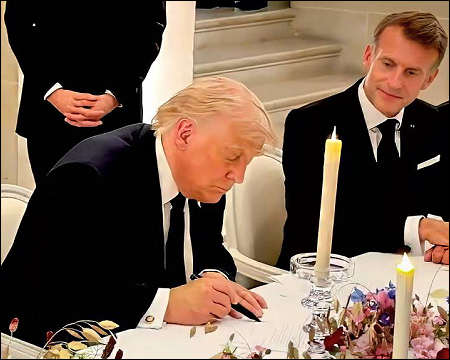
PARIS,— U.S. President Donald Trump signed an interim agreement with Iran on Wednesday that requires Tehran to reduce its stockpile of highly enriched uranium while the United States moves to lift sanctions, a step that would immediately allow Iran to resume unrestricted oil exports, based on details released by both governments.
The signing took place shortly before Trump attended a formal dinner with French President Emmanuel Macron at the Palace of Versailles, a landmark historically associated with the treaty that ended World War One.
At the G7 summit in Evian-les-Bains, France, leaders welcomed the agreement. U.S. officials said a formal signing ceremony for the U.S.-Iran deal was expected Friday on the Swiss side of the border near Lake Geneva.
Pakistani Prime Minister Shehbaz Sharif, who helped mediate the agreement, said the arrangement takes immediate effect once signed by both sides.
The United States and Iran also published the text of an interim memorandum signed by their presidents aimed at ending the conflict.
Trump warned that military action could resume if Iran failed to comply, while also saying it would be “unfair” to deny Iran ballistic missile capabilities, a shift from earlier positions calling for their elimination.
Speaking during the G7 summit, Trump said the United States would respond with force if Iran violated the agreement.
He said negotiations over the next 60 days could lead to a permanent truce and wider stability in the Middle East while helping lower oil prices. He also described Iranians as “smart people.”
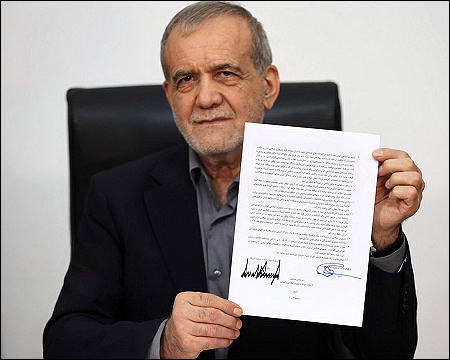
Iranian officials did not respond directly to Trump’s warnings. Instead, they released photographs of what is believed to be the first agreement signed by both U.S. and Iranian presidents since Iran’s 1979 revolution.
Iranian lead negotiator Mohammad Baqer Qalibaf said on state television that diplomacy had achieved results that military action could not. He also said the agreement includes the release of billions of dollars in frozen Iranian assets.
The conflict involving the United States, Israel, and Iran began on February 28 with military strikes that escalated rapidly and included the killing of Iran’s Supreme Leader Ayatollah Ali Khamenei, 86, along with senior military officials.
The war expanded into a regional crisis that increased energy prices, fueled inflation, and raised concerns about food supply disruptions in developing countries.
The 14-point memorandum extends a ceasefire first announced in April by an additional 60 days, including in Lebanon, to allow negotiations on a final agreement.
Both Trump and Iranian President Masoud Pezeshkian signed the document electronically in English and Farsi, and Iran’s foreign ministry said it took effect Wednesday.
European leaders said they share concerns about Iran’s nuclear program but did not support the decision to use military force without United Nations approval.
They also expressed concern that Iran may have gained leverage by enduring the conflict and asserting influence over key regional waterways.
Trump also criticized Israeli Prime Minister Benjamin Netanyahu over military actions in Lebanon involving Hezbollah, reflecting ongoing disagreements over Israel’s operations during ceasefire negotiations.
The memorandum of understanding includes 14 specific provisions.
- The United States, Iran, and their allies in the conflict agree to immediately and permanently end military operations on all fronts, including Lebanon, and commit not to use or threaten force against each other while respecting Lebanon’s territorial integrity and sovereignty.
- Both countries agree to respect each other’s sovereignty and territorial integrity and to avoid interference in internal affairs.
- The two sides commit to negotiating a final agreement within a maximum of 60 days, which may be extended by mutual consent.
- Upon signing, the United States will begin removing its naval blockade and related restrictions immediately and fully lift the blockade within 30 days. During this period, maritime traffic will be adjusted to levels consistent with pre-war activity. The United States will also withdraw its forces from areas near Iran within 30 days after a final deal.
- Iran will take steps to ensure safe passage for commercial vessels in both directions between the Persian Gulf and the Sea of Oman for 60 days without charges. Maritime traffic will resume immediately, and within 30 days Iran will address technical and military obstacles, including demining. Iran will also consult with Oman and regional states regarding future administration of the Strait of Hormuz in line with international law.
- The United States, with regional partners, will develop a $300 billion reconstruction and economic development plan for Iran. Implementation details will be finalized in the final agreement within 60 days, and all required financial licenses and permissions will be issued by the United States.
- The United States will end all sanctions against Iran, including United Nations Security Council measures, IAEA Board of Governors resolutions, and unilateral sanctions, according to a phased schedule to be agreed in the final deal.
- Iran confirms it will not pursue nuclear weapons. Both sides agree to manage Iran’s stockpiled enriched uranium under a mutually agreed mechanism, involving downblending under International Atomic Energy Agency supervision. Future enrichment and nuclear-related matters will be addressed in the final agreement.
- Until a final deal is reached, both sides will maintain the current status quo. Iran will not alter its nuclear program, and the United States will not impose new sanctions or deploy additional forces in the region.
- The United States will immediately issue waivers allowing the export of Iranian crude oil, petroleum products, and related services, including banking, insurance, and transportation.
- The United States will release frozen or restricted Iranian funds and assets and ensure they are made available for use, with procedures to be agreed during negotiations. Iran’s central bank will be allowed to access and direct the use of these funds.
- Both countries agree to establish an executive mechanism to monitor implementation of the memorandum and compliance with the final agreement.
- Negotiations on the remaining issues of the final deal will begin after implementation of key provisions, including paragraphs 1, 4, 5, 10, and 11, and will continue while those measures remain in effect.
- The final agreement will be submitted for endorsement through a binding United Nations Security Council resolution.
(With files from Reuters)
Copyright © 2026 iKurd.net. All rights reserved.
Related posts:
 The Resurrection (Ba’ath) Party – Before the Iran-Iraq War
 The Assassination of Abdurrahman Ghassemlou: No Friends but the Mullahs?
 Saddam Hussein was a Friend to the West
 The Suffocation of Iraq Kurdistan
 Business with ISIS – Updated
 Iraqi Kurdistan – “Sold Out!” – Part II
 Iran – Toxic Theocracy – Part I
 Iraq: Revenge and Corruption
 What makes a good NATO ally? The Case of Turkey
 The Mustashar and the Jash – A View from the Position of ‘Iraqi National Unity’ on the ‘Descendants of Treason’