


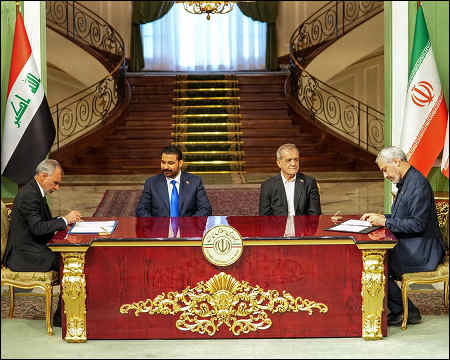
TEHRAN,— Iraqi Prime Minister Ali al-Zaidi traveled to Tehran on Thursday for talks with Iranian President Masoud Pezeshkian, where officials from both countries signed four cooperation agreements, Zaidi’s office said.
The premier also took part in broader discussions with Iranian officials covering economic ties, security matters and other shared concerns, the office added.
The two leaders took part in a signing ceremony for the agreements and memoranda of understanding, meant to strengthen cooperation and partnership between the two countries, according to a statement from Zaidi’s office.
The four accords include a deal on international road transport and freight, along with a memorandum to extend a rail line from Kermanshah in western Iran, through the border crossing at Khosravi, to Khanaqin in eastern Iraq and eventually to Baghdad.
A separate memorandum established a twinning arrangement between Baghdad’s mayoralty and the municipality of Tehran.
A fourth agreement focused on public administration and training for human resources, the statement said.
Zaidi led the Iraqi delegation during the expanded discussions with Iranian counterparts, headed by Pezeshkian. He raised regional security as a shared concern, saying Iraq would not allow any threat against Iran to originate from Iraqi soil.
He also acknowledged Iran’s backing of Iraq during its war against the Islamic State group between 2014 and 2017.
No sign of Mojtaba Khamenei
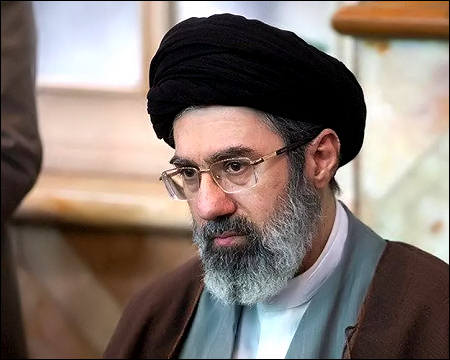
U.S. President Donald Trump said on July 14 that Iran’s military leadership had effectively collapsed, saying Ali Khamenei’s son, Mojtaba Khamenei, was “90% gone.”
The comment came months after Defense Secretary Pete Hegseth said in March that Mojtaba Khamenei, identified as Iran’s new supreme leader, had suffered injuries and was likely left disfigured.
Iranian officials have continued to refer to Mojtaba Khamenei by name, yet no footage, recording, written statement or public appearance linked to him has ever emerged.
He was also absent from his father’s funeral procession, an event that drew millions of mourners in Iran.
That absence, along with the total lack of any confirmed sighting, has led some observers to suggest he may have been killed.
A number of analysts and political figures around the world have said Iran’s current leadership no longer functions as a diplomatic government, describing it instead as acting more like an armed militant faction.
Some have gone further, characterizing the leadership as behaving like gangs or pirates rather than a recognized government.
Zaidi described his trip to Iran as a reflection of the strength of ties between the two nations and said it renews a relationship built on what he called a bridge of goodwill between the Iraqi and Iranian people, citing shared religion, culture, geography and civilization.
Pezeshkian thanked the Iraqi people for what he called a generous gesture during a recent funeral of Ali Khamenei procession in Iraq.
The Tehran visit follows Zaidi’s return to Iraq on Sunday after a five-day trip to the United States, where he met with Trump, Hegseth and other senior U.S. officials.
The trip also comes as tension between Iran and the United States continues to build. The standoff, which started in early July, reached its sixteenth day on Thursday. Iranian officials have warned they could target regional infrastructure and oil shipments if Iranian sites come under attack or if Iran is blocked from exporting oil.
That warning followed comments from Trump, who said the U.S. would strike a bridge and a power plant for every vessel Iran’s military attacks in the Strait of Hormuz. Trump also threatened to strike a new nuclear site Iran is allegedly building in Isfahan province.
(With files from Agencies)
Copyright © 2026 iKurd.net. All rights reserved.
Related posts:
 Ali al-Zaidi from Da’wa to peak of Iraq’s rentier system
 The Resurrection (Ba’ath) Party – Before the Iran-Iraq War
 The Assassination of Abdurrahman Ghassemlou: No Friends but the Mullahs?
 Khamenei lies in state in Tehran after months in cold storage
 Iran Now Under Military Rule
 The Suffocation of Iraq Kurdistan
 Mojtaba Khamenei appointed Iran’s new supreme leader
 Saddam Hussein was a Friend to the West
 Iraq: Revenge and Corruption
 LOSING IRAQ — to Iran