


Dr. Pirot Mohammed Amin | Exclusive to iKurd.net
Translated by iKurd.net from Kurdish Awene
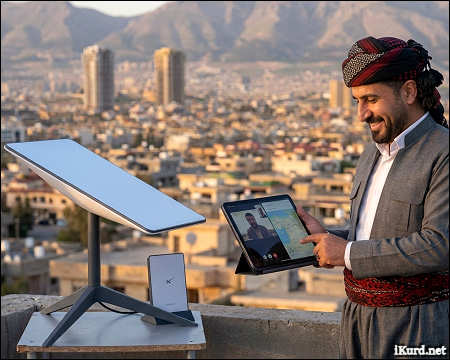
Starlink is a satellite internet service developed by Elon Musk’s SpaceX. To provide internet access, the system uses thousands of connected satellites that form a network capable of delivering high-speed internet.
The official introduction and launch of Starlink’s satellite internet service in Iraq and the Kurdistan Region mark a strategic turning point in the region’s technology landscape.
At the same time, following the Iraqi federal government’s decision in Baghdad to approve Starlink’s operating license, the Kurdistan Regional Government’s Ministry of Transport and Communications announced that the company has officially submitted an application to operate and provide its services in the Kurdistan Region.
Starlink offers an internet service that does not rely on international cable lines or ground towers. This feature allows citizens and institutions, even in the most remote mountain villages of Kurdistan and the isolated deserts of Iraq, to access the global internet with very low latency.
This technological transformation supports the economic sectors and social communications, while also becoming a major driver for the public sector. Greater confidence in digital infrastructure will encourage foreign investment, as stable and secure internet access has always been one of the main requirements for investors.
The arrival of Starlink technology in the Kurdistan Region will have a significant impact on the local internet service market and will directly challenge the position of local companies that have operated for years through land-based infrastructure and fiber-optic (FTTH) networks.
This development marks the beginning of the end of an era in which citizens had no choice but to choose from a limited number of local providers. The impact of this new technology is not limited to providing faster internet; it will fundamentally change the entire strategy, pricing, and service quality offered by the local telecommunications sector.
Although this step presents a promising future, it also places government authorities under significant pressure to establish the legal and financial framework for this service. The issue of pricing and the purchasing power of citizens will be one of the main challenges, as Starlink equipment and monthly subscription fees are relatively high compared to the income levels of citizens.
Starlink’s major impact on land-based internet service providers will lead to a loss of market share in large projects and the commercial sector because Starlink will become a strong alternative for providing internet services to companies, institutions, banks, and government offices.

In response, local internet companies will be forced to accelerate and expand the installation of fiber-optic internet connections to homes in urban areas. To retain customers, they will also need to lower prices, remove data caps, and improve the quality of their technical support services.
Political and economic interests are another important reason behind the strong support for this project. The telecommunications and internet sector in the Kurdistan Region has long been one of the main and most profitable sources of income for groups with political and business interests.
For this reason, the entry of a giant company like SpaceX into the local market is unlikely to happen without negotiations and behind-the-scenes agreements. The main interest of these groups is to become authorized dealers for selling Starlink equipment and providing its services within the region. As a result, Starlink could become a new source of financial profit, but this time under the name of a modern global brand.
At the same time, Starlink will also be used for national projects, government institutions, shopping centers, large commercial buildings, and oil fields, which are also under the control of these interest groups.
The political benefit of this model lies in obtaining “authorized dealership licenses.” In most countries, SpaceX cannot directly sell Starlink equipment without having a local partner to handle legal and logistical matters.
In this case, groups with vested interests receive official dealership licenses from the government, purchase the equipment in bulk at discounted international prices, and then resell it in the local market to citizens at much higher prices. The difference between the original purchase price and the local selling price becomes a large and quick source of profit for these companies.
Examining Starlink’s costs within the economic reality of the Kurdistan Region leads directly to the conclusion that, instead of becoming a general solution, this service may become a heavy financial burden when compared with the purchasing power of citizens.
When we consider the cost of about $600 (approximately 900,000 Iraqi dinars) just for the Starlink dish and router, along with a monthly subscription of $110 (more than 165,000 Iraqi dinars), it becomes clear how this technology shifts from being a communications option to becoming a significant economic burden that most families cannot afford.
This initial payment, which is close to one million Iraqi dinars, is equivalent to the full salary of one or two months for a mid-level government employee or the monthly income of a local small business owner. In a financial environment such as the Kurdistan Region, where economic confidence remains low, paying such an amount in advance puts the service beyond the reach of most people.
A quick comparison between the cost of Starlink and the fiber-optic or 4G internet services currently used by people makes this financial gap even clearer. Today, the average monthly household spending on internet services in the Kurdistan Region ranges between 35,000 and 50,000 Iraqi dinars. Therefore, paying 165,000 Iraqi dinars per month means tripling the average communication expenses.
For an average citizen living in urban areas who already has a reliable internet connection through land-based infrastructure, switching to Starlink would be an economically illogical and impractical decision that would place a serious strain on household finances.
In conclusion, this entire process demonstrates how political interests can transform any new global technology from a tool for expanding access into a new source of financial profit. In such a system, at every stage—from importing and selling the equipment to installation and monthly subscriptions—the interests of powerful stakeholders are fully protected, while the customer is left to bear the cost of every intermediary involved.
This article was originally published in the Kurdish language in Awene Newspaper on July 23, 2026.
The opinions are those of the writer and do not necessarily represent the views of iKurd.net or its editors.
Copyright © 2026 iKurd.net. All rights reserved.
Related posts:
 Facial Recognition Technology, Monitoring and Infiltration of the opposition in Iraq
 Iraqi Kurdistan – “Sold Out!” – Part II
 Iraq – The Cynical Swindle
 Business with ISIS – Updated
 The Suffocation of Iraq Kurdistan
 Anfal – The Black Stain on Iraqi History Spreads
 Iraq: A State of Surveillance – Databases, Tracking And Corruption
 The Resurrection (Ba’ath) Party – Before the Iran-Iraq War
 The Mustashar and the Jash – A View from the Position of ‘Iraqi National Unity’ on the ‘Descendants of Treason’
 The illusion of modernity: UAE’s crackdown on digital freedoms