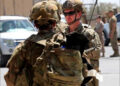


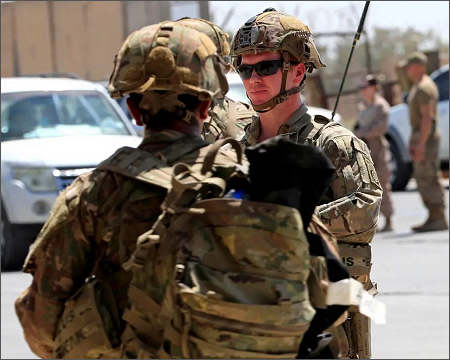
BAGHDAD,— U.S. troops concluded their mission in Iraq on Wednesday, withdrawing from their final military bases in a nation where more than 4,500 American service members died over two decades of conflict.
Iran and its allies are calling the exit a triumph.
Iraqi security analysts say the pullout, agreed upon in 2024 under President Joe Biden and executed by Donald Trump’s administration even while Washington wages war against Iran, could hand Tehran and its allied militias greater freedom of action.
Analysts also warn the move may open the door for other U.S. adversaries, including Islamic State, to regain strength.
Jasim al-Bahadli, an Iraqi security analyst who studies Iran-aligned Shi’ite armed groups, said Iran is positioned to gain strategically because the coalition’s exit removes a military presence that had long balanced Tehran’s sway in Iraq.
He said pro-Iranian militias will likely present the withdrawal as their own victory and attempt to convert that momentum into stronger influence over Iraq’s security and political decisions.
Abu Mojtaba al-Yasiri, a commander with the Islamic Resistance in Iraq, a coalition of Iran-backed armed factions, called the U.S. departure a historic win for Iraqi resistance groups and a major defeat for what he described as the American project.
He told Reuters that September 30 will mark the end of a dark chapter and proof that Iraq’s sovereignty depends on resistance and the will of its people, not foreign troops.
Although the withdrawal is widely supported among Iraqis, some worry it is happening too soon.
Abdulrahman al-Zobaie, a Sunni tribal leader in Fallujah, once a center of anti-American resistance, told Reuters that Iraq is not yet fully prepared to manage its own security.
He said all Iraqis want full sovereignty, but fear the coalition’s exit could leave a dangerous security vacuum.
U.S. troops first entered Iraq in 2003 to remove dictator Saddam Hussein, then occupied the country, backed a new Shi’ite-led government and battled an insurgency for years before leaving in 2011.
They returned less than three years later to help Iraqi forces fight Islamic State during a war that lasted from 2014 to 2017.
Roughly twice as many American troops died during the Iraq war as in the simultaneous conflict in Afghanistan, which ended with a rapid U.S. withdrawal in 2021.
In recent years, Iraq has remained the only nation with close political and military ties to both Washington and Tehran, and its territory has sometimes served as a battleground for the rivals.
The U.S. killed senior Iranian commander Qasem Soleimani in a 2020 strike near Baghdad’s airport. Iranian-backed forces have repeatedly attacked American bases, at times triggering retaliation.
During this year’s conflict with Iran, seven of the 18 American troops killed were stationed in Iraq. The most recent death was an Army sergeant who died in July during a controlled drone detonation near Erbil.
Iran, which says its goal is to push American forces out of the entire Middle East, describes the Iraq withdrawal as a victory for its network of allied armed groups across the region.
Amir Hayat Moqaddam, deputy chairman of the National Security Commission in Iran’s parliament, said Monday that lasting security will come to Iraq once American troops leave the country and the broader region.
He told Iran’s parliamentary news agency that Tehran supports the withdrawal and that resistance groups continue to confront American forces.
Washington has accused Iran-backed militias in Iraq of contributing to regional conflict by striking neighboring countries under Tehran’s direction, including a recent attack on a major Saudi oil pipeline.
Baghdad’s government says it is working to limit the militias’ influence.
Some Iraqi officials, including those in the semi-autonomous Kurdish region, warn the withdrawal could also revive Islamic State, which once controlled a third of Iraq and killed thousands, including captives filmed being executed at a former U.S. base.
Kurdish commander Sirwan Barzani said the loss of American intelligence, logistics and drone support could allow the group to regroup.
He said Islamic State sleeper cells have shown increased activity in recent weeks, boosting fighter morale after the withdrawal was announced.
While others, like Kurdish politician Adham Barzani, viewed the U.S. withdrawal from Iraq and the Kurdistan Region as the close of what he called an occupation, an outcome he said should be celebrated.
Iraqi security officials said a suspected Islamic State cell was planning suicide attacks timed to the pullout.
Four officials said the plot shows the group still poses a threat despite years of losses. Col. Khalid al-Bayati, a senior security official in Kirkuk, said Islamic State wants to prove it remains capable of deadly attacks.
(With files from Reuters)
Copyright © 2026 iKurd.net. All rights reserved.
Related posts:
 The Resurrection (Ba’ath) Party – Before the Iran-Iraq War
 Business with ISIS – Updated
 Iraq: Revenge and Corruption
 Saddam Hussein was a Friend to the West
 Saddam Hussein’s Enemies: Paving the Road to the Invasion of Iraq
 Iraq’s Internal Enemies: Shi’a rivalries and the fallout from the US-led invasion
 The Suffocation of Iraq Kurdistan
 The Truth About The Saddam Hussein Affair
 Iraq: A State of Surveillance – Databases, Tracking And Corruption
 Iraq – The Cynical Swindle