

Sheri Laizer | Exclusive to iKurd.net
The Shi’a and Kurdish exiles had long been groomed by Bush and Blair to take over once the Ba’ath government was felled
On 19 March 2003, the first phase of the U.S-led war on Iraq, codenamed “Shock and Awe” officially got underway by air: 40 Tomahawk missiles were fired on targets in Baghdad where it was alleged that the Iraqi leader and his sons had taken shelter. Some commentators claimed several missiles had been fired earlier against the city. The ground assault began the day after on Kurdish New Year’s Eve (Newroz). The combined forces of the United States, United Kingdom, Poland and Australia would pound Baghdad without cease for almost one month (26 days is the official period).
The Shi’a and Kurdish exiles had long been groomed by Bush and Blair to take over once the Ba’ath government was felled. The destruction, once begun, continued for the next two decades.
Just days into the invasion, U.S military attention turned to another target in the Kurdish north of the country: Ansar al-Islam. U.S fighter jets attacked Ansar al-Islam’s base in the Khurmal region close to the border with Iran inside Iraqi Kurdistan with devastating consequences. The strike was pronounced a U.S victory and Ansar al-Islam was declared defeated – but not for long.
Two weeks further into the war, on 4 April 2003, Iraqi State Television featured Saddam Hussein taking one of his well-known public walkabouts, alive and well, confident and defiant.
Further U.S strikes would directly focus on getting their so-called, Highest Value Target. They began symbolically by bombing the palaces, followed once occupation was secured, by bringing down the leader’s statues and disfiguring his monuments.
Within five days of the Iraqi broadcast that had shown the leader at large, world headlines were dominated in the propaganda war by scenes of Saddam’s forty-foot statue in Square being felled by U.S troops with the American flag covering his face.
Iraqi citizens –largely of Shi’a origin – were shown stamping on portraits of the President and beating his picture with the soles of their shoes – an insult in Arab culture. Meanwhile, in the theatre of combat, intense gun battles, aerial sorties, buster bombs, drive-by ambushes and suicide attacks continued. Friendly-fire also killed scores of Kurdish Peshmerga fighters on the road to “liberate” Kirkuk.
Kirkuk falls
Kirkuk city fell to U.S troops backed by PUK Peshmerga forces on 10 April 2003. Mosul city was taken just hours later. U.S friendly fire also hit a Kurdish convoy in which BBC reporter, John Simpson, was travelling, narrowly missing him but killing several others and injuring the brother of the KDP leader. Criticism of the invasion at this early stage was still muted. “This is a war situation and these things can happen,” KDP foreign affairs spokesman, Hoshyar Zebari responded glibly.

Just two weeks later, the KDP leader, Massoud Barzani, was speaking with newfound enthusiasm and indeed, confidence over his recent meeting with Jay Garner, the US administrator for Iraq. Barzani said: “What we discussed with Garner is that the opposition leadership council would meet in Baghdad very soon, to be followed by a broader meeting of all Iraqi parties, forces and figures. But if matters stabilize and the national authority takes over and fills the security and administrative vacuum, there will no longer be any justification for the coalition forces to remain, and their (presence) would then be regarded as an occupation,” Barzani said. Barzani also added that Garner had promised the United States would deal with that government as “the legitimate representative of the Iraqi people.” Barzani stated that Kurds were committed to a post-Hussein federal arrangement agreed with other groups that opposed the regime despite the fact that they in principle have the right to statehood. “Like all other nations, the Kurdish nation is fully entitled to self-determination and the establishment of a Kurdish state,” he said. “But at the moment, we do not have an agenda different to that of the Iraqi opposition. We are pursuing the agenda hammered out at the London conference and the Salahaddin conference” in February, he said.
Asked whether the Kurds would eventually demand statehood, Barzani said: “Life progresses, the world progresses, and the Kurdish people too are entitled to progress with others.”
Referring to Turkey’s fears about the possible resurgence of separatist aspirations among Kurds in Turkey, Barzani said he was speaking strictly about Iraqi Kurds. [2]
The Turks remained deeply unhappy about Kurdish gains from the war. Kirkuk was effectively now in Kurdish hands and localised conflicts over land ownership issues and control of the Kirkuk oil revenues erupted anew between the Kurdish, Turkoman and Arab populations there. These tensions have continued to accelerate because the status of Kirkuk has still not been resolved according to Article 140 of the new Iraqi constitution. [3]
Guerrilla-style resistance to the U.S-led invasion – 2003
Meanwhile, a guerrilla-style push-back against the occupying forces throughout Iraq continued. A variety of Sunni, Shi’a and nationalist forces were involved on various fronts.
On 3 June 2003, a convoy in which British Minister and PUK friend MP, Ann Clwyd, was travelling came under attack. Mrs Clwyd narrowly escaped. Such incidents were occurring on a daily basis and against a variety of targets. Media reports noted that in the six-week period since the official cessation of war, at least one American had been killed every day. Front page headlines in The Daily Telegraph on 17 June 2003 said: “America’s rebuilding of Iraq is in chaos, say British” and went on to state: “The original post-war plan was to solve the humanitarian crisis – should it have arisen, which it did not – and then use the existing Iraqi ministries and officials to get the country running again as quickly as possible… In the event, the coalition arrived in Baghdad to find the ministries looted and destroyed and Iraqi civil servants ‘unable to make decisions themselves’ after years of living in a police state…within weeks it became obvious that the operation would take years not months…”
Suicide bombings, urban guerrilla-style hit and run attacks in which RPGs and small arms were used at close range, and ambushes staged against convoys in which US military personnel or foreign contractors and NGOs were travelling, dramatically increased.
By the end of June 2003, the figure for casualties had already exceeded those of the 1990-1991 Gulf War. This was not what the Americans and their British allies had planned for. Thousands of Iraqis had simply gone to ground to try and salvage whatever they could from the turmoil. No one could predict where the secular mainly Sunni opponents of regime change, or Islamic militants, would strike next.
The Coalition forces were making gains at a high cost of lives but Western morale rose when on 22 July 2003, Saddam’s two sons, Uday and Qusay, were pronounced dead in Mosul after a gun battle and strikes targeting the house they were sheltering in. Qusay’s young son was also killed in the remorseless attack that wiped out whoever was present. Saddam Hussein could not be located and the manhunt against him intensified.
Already, the KDP and PUK set about establishing regional offices outside the Kurdish Autonomous Zone, seeking to extend their influence throughout Iraq. KDP leader, Massoud Barzani, and PUK leader, Jalal Talabani, also began to be criticised by independent Kurdish intellectuals for having established their new headquarters in Baghdad rather than in Kurdistan and accused them of failing to promote the Kurdish cause and Kurdish interests.
By August 2003, clashes were once again erupting inside the Kurdish enclave between the PUK and Ansar al-Islam extremists. These clashes abated only after a number of Ansar al Islam members were captured with the help of the Americans.
The American “liberators” were, however, by now being reviled throughout Iraq, and indeed, the Arab world as “Occupiers.” This designation lent huge momentum for Islamic jihad to drive the occupiers from Iraq along with all those who “collaborated” with them.
On 19 August 2003, the UN headquarters in Baghdad became the latest target of suicide bombers. The scope of the bombers’ targets had broadened – foreign NGOs, foreign workers, contractors, mercenaries, and the military were proclaimed just targets.
Suicide bombings and hostage taking
On 10 September 2003, a car bomb exploded in Erbil causing numerous injuries. Two people were killed, one of them thought to have been the bomber, while around 47 others were injured in the suicide bomb attack outside a US military office at one of the checkpoints between Erbil and Salahaddin, Massoud Barzani’s post-1991 headquarters. Six US soldiers were also reported to have been among the injured. By late September, Western NGO’s began pulling their staff out, including members of the International Red Cross as the violence deepened.
Reports from Iraq throughout the month of October 2003 into the first weeks of November documented an escalating pattern of suicide bombings, rocket attacks and the shooting of members of the Coalition Forces, as also of targets within the Iraqi Governing Council, within the fledgling Iraqi police, and against foreign NGOS, foreign diplomats, and journalists. Thousands of Iraqi civilians were caught in the cross fire and died under explosions.
Attacks were attributed to both Ba’athist loyalist elements that had gone underground and to various Islamic militants said to be sympathetic to Al Qaeda. The name of Ansar al-Islam also repeatedly arose in connection with such violence. The US administration did not name their Shi’a counterparts carrying out similar atrocities at the same time with impunity.
The U.S administration under George W. Bush had predicted that American soldiers would be hailed by ordinary Iraqis as their liberators but the tide had turned – the insensitivity, and indeed brutality and terror unleashed by US forces on the ground towards the local people and their traditions soon cast them as objects of fear and hatred.
Video-taped executions

More than 150 Western hostages had by now been seized, of whom some forty had already been executed and their killings displayed on video. The victims included American contractor, Nick Berg, whose throat was cut with a knife, and British contractor, Kenneth Bigley, abducted from Sunni Mansour district with his colleagues Jack Hensley and Eugene Armstrong on 16 September 2004. He was held for three weeks before being beheaded on camera on 6 October 2004. Al Tawhid & al-Jihad claimed responsibility for killing Bigley and two of his American colleagues. Their banner was shown behind Mr Bigley in the murder video. They had demanded the release of female prisoners by Britain and the Coalition.
ABC News network reported his last message: “Here I am again, Mr. Blair,” Bigley said, “very, very close to the end of my life. You do not appear to have done anything at all to help me.”
Did the Wolf Brigade murder Margaret Hassan?
In October 2004, Dublin-born aid worker, head of CARE International [4], Margaret Hassan. was stopped in al-Jamaa en route to CARE’s office in the adjacent neighbourhood of al-Kadra, West Baghdad by two men wearing Iraqi police uniforms. Gunmen then materialised. She, her driver, and a single unarmed bodyguard were forced from the car and pistol whipped into agreeing to go with the kidnappers.
This is a well-off Sunni area considered to be reasonably safe for foreigners. The police operating there would also likely be known to local Sunnis. It was not a district of the city where AQI had a following nor bases of the pre-existing Shi’a militias.
Margaret Hassan was held hostage and displayed on several videos appealing for her release, fainting and having a bucket of water thrown over her, fatigued and being made to demand the withdrawal of the British Black Watch regiment from Iraq. The kidnappers threatened to hand her over to AQI leader, Abu Musab al-Zarqawi5, but he had demanded her release. It was not AQI that had seized her.
Direct contact with the British Embassy was also sought in order to dictate terms, and raise the propaganda stakes through having seized a western woman, a more valuable catch than a soldier. The British Foreign Secretary, Jack Straw, refused to negotiate – a decision Margaret Hassan’s family hold the government responsible for in leading to her death.
Married to a Sunni Iraqi man, she had been living in Iraq for the past thirty years while helping the people throughout the period of sanctions that she opposed. Her earlier years had also been spent working in the Palestinian refugee camps. She opposed the war on Iraq.
A final video released to Al-Jazeera television in Doha early in November 2004 showed a woman blindfolded, wearing an orange jumpsuit, (a reference to Guantanamo Bay and US detention practices), before being shot in the head by a hooded executioner. She was later identified by her family as her face was not shown. There were no branding details in the footage of who held her nor messages from the Quran as had become common. Al Jazeera had handed the execution video to British diplomats, invited to the Doha TV station, refusing to broadcast it.

What if it was in fact the Shi’a US-allied Wolf Brigade that took and killed Margaret Hassan, thinking to implicate the Sunni resistance?
The killers then demanded $1 million from the British Embassy for her dead body. That being refused, the whereabouts of her remains have been kept secret.
The botched investigation
British senior detective assigned to the case, Anthony Nott (MBE), included a large section on Iraq in his 2017 memoir, Investigating Organised Crime and War Crimes – A personal Account of a Senior Detective in Kosovo, Iraq and Beyond [6]. Chapters 13-20 of his record are devoted to the case of Margaret Hassan and the scene at the time of her abduction and murder. The account is necessarily somewhat filtered through the lens of a UK state employee in relation to the US-led/UK partnered invasion of Iraq. Nor could all details be disclosed in terms of the ongoing criminal investigation. However, Detective Nott interestingly encountered obstruction and ridicule from the pro-Iran dominated Shi’a officials in the Ministry of Interior(MOI) including the now notorious Interior Minister of the time, Baqir Jabr. Nott and his team had planed to follow a lead to Jordan requiring a letter from Jabr for their flight of 25 October 2005 to be handed to the Jordanian Minister of Interior. He recalled: “The Minister’s suite of opulent offices was on the first floor in the Palace, behind a series of lattice screens. We were met by two well-dressed Iraqi men in expensive suits who were the Minister’s assistants and who, General Raad told me, were related to the Minister…Both men looked us over in an arrogant and disdainful way, at me in particular, as if I was something unpleasant stuck on the underneath of his shoe. One of the assistants made some kind of pretence of examining my passport and identity cards. We were then kept waiting while the two aides wafted in and out of the Minister’s office, whose voices I could clearly hear. I approached the two aides and and requested that we have one minute of the Minister’s time as our departure was becoming imminent. The response was more cool looks from our hosts, one of whom seemed to be oblivious to us and when talking on the phone convulsed into fits of laughter so pronounced I thought he was going to choke. Finally, at one o’clock, an hour and twenty minutes after our arrival, I told the two flunkies that we were going…Well, it was too late, we were off without the all-important letter of introduction. As I walked out of the Adnan Palace, a western man approached me in civilian dress and started asking me where I was going in Jordan; he had a pronounced American accent. He started to want to talk about the case…”7
On reaching Jordan without the letter and going to the locations where the then suspect, Sheikh Hussein had been “I got the distinct impression that somebody else had been to each address we visited before us, I was a small player in a big game.” [8]
In my surmise, it is plausible that Margaret Hassan was abducted by members of the Wolf Brigade operating under Baqr Jabr himself. If not the kidnappers and her actual killers, Baqr Jabr did a great deal to delay and obfuscate a vital criminal investigation.
The question is why? Contempt for the West that had helped hand him and his cronies power or something darker? None of the Shi’a militant or criminal groups have been accused. As even AQI leader, al-Zarqawi’s call for Margaret Hassan’s release went unheeded, it is perhaps plausible. She was married to a Sunni and had never converted to Islam but remained a Catholic. Shi’a groups were also responsible for a countless number of execution murders of Sunnis by gunshot to the head (or power drill). A suspect was let slip from prison. No on has been prosecuted and no one has exposed the burial place. If this led back to the interim premiership of US-appointed, Iyad Allawi, of the INA no one would now be surprised. Shi’a death squads were terrorising civilians and had infiltrated the police. Any such links would explain the lingering mystery.
Margaret Hassan’s husband and Irish Catholic family have been prevented from giving her a burial in keeping with civilised values and beliefs. The murder was carried out during the US siege of Fallujah where the US marines and ground troops backed by an INC brigade, largely made up of Kurdish Peshmergas, were involved in mass slaughter in urban areas. [9] Pinning the execution of Margaret Hassan for public consumption on Sunni ‘insurgents’ would provide a certain cover for the atrocities being unleashed against Sunni rebels. No group has to date claimed responsibility for killing Margaret Hassan.
Fellow Dubliner, Robert Fisk, one of the few Western journalists in the Middle East refusing to succumb to western propaganda, wrote days after her killing:
“…If Margaret Hassan can be kidnapped and murdered, how much further can we fall into the Iraqi pit?
There are no barriers, no frontiers of immorality left. What price is innocence now worth in the anarchy that we have brought to Iraq? The answer is simple: nothing.
I remember Margaret arguing with doctors and truck drivers over a lorry-load of medicines for Iraq’s children’s cancer wards in 1998. She smiled, cajoled and pleaded to get these leukaemia drugs to Basra and Mosul…
And when it percolated through to Fallujah and Ramadi that the mere act of kidnapping Hassan was close to heresy, the combined resistance groups of Fallujah – and the message genuinely came from them – demanded her release.
So, incredibly, did Abu Musab al-Zarqawi, the al-Qaeda man whom the Americans falsely claimed was leading the Iraqi insurrection, but who has definitely been involved in the kidnappings and beheadings…[10]
A first defendant in the Hassan case named Mustafa Salman al-Jubouri received a life sentence in June 2006 but this was reduced on appeal to 18 months as his role in the Hassan kidnapping was not at all significant [11].
A subsequent defendant named Ali Lutfi Jassar al-Rawi (Abu Rasha) [12] also pleaded not guilty but was still convicted of her murder at the Baghdad Central Criminal Court after his arrest in May 2008. He had only been attempting to extort money through claiming to reveal the location of the body. Indeed, he appears not to have been responsible in any way nor even present at the time. He also failed to appear for his appeal hearings in 2009 having already been helped to slip out of custody.
Other suspicious abductions – also possibly by Shi’a militants
The Sunni Sheikh of the al-Mustafa mosque adjoining Nahrain University was conveniently named by some as being allegedly linked to the kidnappings of three Western female journalists – Florence Aubenas (French reporter for Liberation, abducted with her fixer on 5 January 2005 from Nahrain (Twin Rivers University, formerly Saddam Hussein University) when reporting on IDPs from Fallujah living on the campus site and held for five months [13] and Il Monitor’s Giuliana Sgrena from the same location. [14] There is no real evidence for the accusation and neither of the journalists knew who kidnapped and held them aside from that they were Islamists using them as a political tool. [15]
Jill Carroll (a Christian Science Monitor reporter was kidnapped on January 7, 2006 in an ambush in west Baghdad’s al-Adel district after interviewing Sunni politician Adnan al-Dulaimi of the Iraqi Islamic Party (IIP). Her Christian translator was killed. When released after almost three months she was freed near the IIP’s offices. The IIP is the oldest Sunni Islamic party that evolved from the Muslim Brotherhood and was the largest in the Iraqi Accord front. At the time of the abductions, it had withdrawn from the new government in protest over the U.S offensive at Falluja. It also criticized the American presence in Iraq.
American sources later accused Salim Abdallah Ashur al-Shujayri (Abu Uthman aged 25) and tried to link him to Margaret Hassan claiming he was one of the leaders of AQI in Baghdad. The evidence for this against him is not openly cited. American media reporting requires constant cautious consideration.

As for the Sunni Sheikh of the al-Mustafa mosque, he disappeared after his name was raised in connection with the kidnapping. His innocence – or otherwise – still appears to remain unknown. The mosque itself was once a famous building designed by Walter Gropius, as also the arched entranceway to the main campus from the street after crossing the bridge from the Sindbad Palace. It is very difficult to access now and has been allowed to fall into disrepair by the Shi’a dominated regime in power.
The same group was accused of seizing four Christian Peacemakers Team evangelists and killing the only American member, Tom Fox but evidence is scant.
In some videos posted in relation to the hostage takers, the name Mujahideen Without Borders was used, as in Sgrena’s case. It does not have wider reference. Some 131 foreigners had been taken hostage by a plethora of Islamist groups. As I was travelling regularly between Erbil and Sulaymani via Kirkuk between 2004-2006, I had to exercise extreme care as Kirkuk was rife with criminal and Islamist gangs taking hostages for ransom.
Unlike with the circumstances surrounding Margaret Hassan’s kidanpping, the three western female journalists that were kidnapped after her were all released after negotiations and not physically ill treated aside from being deprived of light, comforts and possibilities to communicate. Unlike them, Margaret Hassan was ill-treated throughout the period of her capture, as shown on the videos. The British Embassy had also refused to negotiate a ransom for her release or even speak to the hostage takers when they made contact. Her husband was left alone to deal with this, a factor highly criticised by the investigating detective, Anthony Nott, both then and now.
The other three female journalists that had been held hostage may have been freed after their governments paid ransom demands but they were not party to such information, and had been held in the dark in extremely small spaces.
In Giuliana Sgrena’s case, her release went very wrong when an American gunner opened fire from a parked Humvee from ten yards behind as her car neared the Baghdad Airport terminal on the fast-track road used by foreigners despite the Italians having notified the Americans. Her Italian intelligence handler, Nicola Calipari with her but died in protecting her from the gunfire with his own body. [17] When brought to trial, the gunner tried to blame Sgrena for having reported on Falluja (and probably for her anti-war stance).18 She was severely injured in the so-called ‘friendly-fire’ incident. She strongly denies the details of the account given by the American gunner in his defence. Those close to her also claimed that her car was attacked because “she knew too much.” Sgrena wrote her account after her recovery, Friendly Fire: The Remarkable Story of a Journalist Kidnapped in Iraq, Rescued by an Italian Secret Service Agent, and Shot by US. Forces. [19]
Kidnappings were rife and for three key reasons:
1. As a source of lucrative income
2. To make political headlines
3. In service of religious extremism
Shi’a militia kidnapping gangs
The main Shi’a militia groups were also involved in kidnapping at the time and not only of foreigners but of Sunni Iraqis and all manner of professionals from the previous administration. Shi’a extremists had by this time penetrated the state security and police forces. Shi’a extremists, motivated by revenge – and/or power and money – were terrorising the professional sector, but also making life hell for ordinary people.
As the whereabouts of Margaret Hassan’s body has still not been revealed, it may point to the involvement of the Shi’a militia and Iraqi government connections. The location, if ever revealed, would likely expose the real killers.
Both the al-Mahdi Army under Moqtada al-Sadr’s leadership and the pro-Iran Badr Brigade, as the armed wing of SCIRI were taking hostages and killing them. Both groups have been responsible for widespread abuses then and now as has al-Da’wa itself under Nouri al-Maliki’s leadership. [20]
The al-Mahdi Army was linked with local and foreign hostage taking. By mid 2004, the militiamen were already conducting patrols with, or against, the new police force in Baghdad, Basra and points between, in the Shi’a dominated south of the country. The al-Mahdi army militants were engaging American and British troops o a constant basis urging their withdrawal from Iraq.
Al Mahdi militiamen kidnapped two British undercover soldiers in Basra. In many locations they also infiltrated the police and took over control from them. Such indeed remains the case today nearly twenty years later.
From as early as 2004, they had set up kangaroo courts and tortured detainees to death. They arrested thousands of targets, carrying out executions. Former Chief of police in Basra, General Hassan al-Sade, told the media “half of his 13,750-member police force secretly worked for political parties, including the Supreme Council for the Islamic Revolution in Iraq (SCIRI) and al-Sadr’s militia. Other officers remained politically neutral, but had no interest in policing or following his orders, he said. “The militias are the real power in [Al-Basrah] and they are made up of criminals and bad people,” he said. “To defeat them I would need to use 75 percent of my forces, but I can rely on only a quarter.” [21]
This set a pattern that remains unbroken despite a series of name changes for the militia.
Al Sadr’s ‘victory’ in the flawed elections of 10 October 2021 arises despite his past history of terror.
Other alleged acts by Moqtada al-Sadr’s militiamen included the 2007 kidnappings of five British nationals from the Iraqi Finance Ministry’s office. The British forces in Basra had killed an al-Mahdi Army commander the previous week. “The men were abducted from inside an Iraqi Finance Ministry office by about 40 heavily armed men wearing police uniforms during daylight hours. The group then drove toward Sadr City in a convoy of 19, four-wheel-drive vehicles…” [22] The men were all employees of foreign consultancy and security firms, including Garda World Security Corporation.
On January 23, 2010, pro-Iran Shi’a militia As’aib Ahl al-Haq (AAH) under Qais al-Khazali’s extremist vision, told AFP they had abducted an American contractor named Issa T. Salomi in Karada, east Baghdad23, an area with strong support for the Shi’a militias. AAH claimed the abduction was in response to the Iraqi government’s failure to release its members from US-run jails and because of fresh arrests.” It also called for the Blackwater guards to be prosecuted and for an immediate withdrawal of US troops. AAH’s banner was shown hung behind the hostage’s seat on a video posted on the group’s website. He was freed on March 25h despite such demands not being met but after a prisoner swap of some of AAH’s leaders held in Iraqi and US custody. [24] That included both Qais al-Khazali earlier in December 2009 and his brother, Laith in July 2009. Both would go on to pursue further attacks against the Americans and ‘collaborators.’ The military also released Iran Qud’s force members of the IRGC.
The Long War Journal noted in 2010: “The US military caught a break when it detained Laith and Qais and several other members of the network during a raid in Basrah in March 2007. Also detained during the raid was Ali Mussa Daqduq, a senior Hezbollah operative who had been tasked by Iran with organizing the Special Groups and “rogue” Mahdi Army cells along the lines of Lebanese Hezbollah. Daqduq is a 24-year veteran of Hezbollah, and he had commanded both a Hezbollah special operations unit and the security detail of Hezbollah leader Hassan Nasrallah…” [25]
AAH had also previously kidnapped British IT expert Peter Moore and his four British bodyguards in May 2007, also from Karrada. Moore was released unharmed in December of that year but his guards were killed and three of their bodies returned.26 It was known to be responsible for numerous sectarian murders and is one of the most extreme of the pro-Iran Shi’a militias in Iraq today. It split from Sadr in 2006. Sadr has been unable to rein them in. AAH has also been active in the Syrian conflict alongside Iran and Hezbollah in backing up the Assad government. [27] Elements joined Hezbollah in Lebanon in the 34-day war of the summer of 2006 against Israel. It had been supervised and trained by the late Qassem Soleimani to whom the group pays reverence as a martyr. [28]
Highly vocal, militant Sunni Islamist demands were also being made of the US at this time for the release of blind Egyptian cleric, Sheikh Omar Abd al-Rahman, serving life for the 1993 bombing of the World Trade Centre. The so-called “mastermind” behind the 1993 strike and the 2001 9/11 plot, Khalid Sheikh Mohammed, remains in Guantanamo Bay detention. His trial has not been concluded after twenty years in custody.29 The trial has run into difficulties because of the CIA’s “Enhanced Interrogation Techniques” – an arsenal of torture methods – inflicted at length on the defendants by their military interrogators. Innocent detainees were also tortured and several killed by the same methods, just as in Iraq.
The Abu Ghraib scandal photographs arose from the same mentality engendered amongst serving US military personnel and members of the intelligence communities. [30] These methods were not successful in extracting key intelligence, as vaunted by Rumsfeld and Cheney but have caused lasting physical and mental damage to former detainees. [31]
British troops were similarly caught red handed with serious abuse photos.
U.S Massacre in Fallujah and the Blackwater connection
US Marines bombarded Fallujah during April 2004 after four employees from the private security company Blackwater, were killed and their bodies burned. It was an act of mass revenge. Jeremy Scahill called Blackwater “Bush’s shadow army.”
Military contractors and mercenaries were beginning to pay the price with their lives for their ongoing role in Iraq. The four Blackwater Guards that were publicly executed in Fallujah were all from ex-Army Special Operations and Navy SEALS backgrounds. The bodies of the contractors were hung from a bridge in a grim expression of the public mood. A base hosting 4,000 marines had been set up in Fallujah after the marines took over from the army. [32] On 16 September 2007, employees of the Blackwater Security Consulting Company – private security firm opened fire with live ammunition against unarmed civilians, killing two young boys, a young doctor and 14 other civilians and injuring at least 20 other people [33].
A short documentary film, “Fallujah: The Hidden Massacre,” directed and produced by Italian journalists, Sigfrido Ranucci and Maurizio Torrealta, provided evidence of the US army and marine’s use of white phosphorus in the city in 2004, in the course of its overzealous operation, Phantom Fury. Two war veterans, Jeff Englehardt and Garret Repenhagen, who had taken part in the operation had been told: “that every single person in that area that was “walking, talking and breathing was an enemy combatant…as such everyone was a target.”
Fallujah’s residents had widely reported how the US military had used incendiary bombs and white phosphorus (Whiskey Pete) against civilians during ongoing attacks there since 2003. Depleted Uranium (DU) had been used as well as cluster bombs in the earlier Gulf Wars. Lasting health issues and birth defects ensued.
US President George W. Bush set up this overblown operation after the Blackwater guards had been killed and their corpses mutilated. He had only held off launching it until after the elections contested against John Kerry were over, ordering the Pentagon to told off the troops until then. US military forces were then given a free fire ‘’weapons (are) free” tasking, after being indoctrinated during their training to look down on Iraqis as open targets, dubbing them ’ sand niggers and rag heads. [34]
In Fallujah, the American forces kept the population under siege, trying to starve them out and break all resistance, attacking clinics and hospitals and blasting residential areas with bunker bombs and white phosphorous from above. U.S marines are reported to have killed as many as 30,000 people, most of whom were civilians desperate to stay alive.
The human rights abuses committed by American military personnel in Iraq had become endemic and widespread. Journalists there that were critical of Phantom Fury seem, ironically, to have been the main ones were being kidnapped.
The treatment of Iraqi prisoners held in American custody at the Fallujah base and in Abu Ghraib Prison was much the same. Detainees were suffering the same kinds of torture methods as were in use in US “black sites”.
Many of these suspects had been spirited out of Afghanistan and Pakistan, held incognito and then subjected at length to ‘enhanced interrogation techniques’ (EITs). Leaked photographs began to turn the tide of liberal public opinion against the American occupation of Iraq as news of the tools in use in the War Against Terror emerged.
The lasting legacy of the US invasion of Iraq has been to incite deep-seated popular hatred for the Americans. It has strengthened the hand of the extremist Shi’a militias aiding them to become the lords of Iraq in partnership with their venal Kurdish counterparts and Iranian mentors.
The quota-based system (muhasasa) based on sect and party has undermined unity and security in Iraq just as it has in Lebanon.
A new generation, disillusioned with corruption express increasing defiance demanding change – even when faced with the guns of the MOI’s snipers and Counter-Terrorism Service (CTS) hit men.
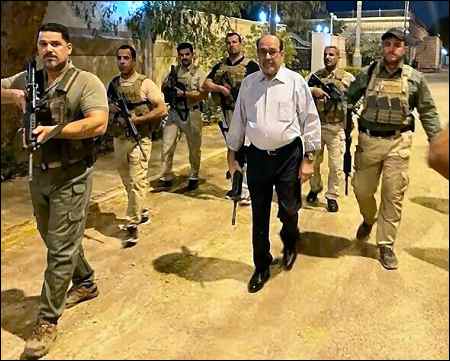
State of Law Coalition expresses itself in arms
Nine months after the elections, the internal wrangling over cabinet formation, resources and alliances continued. After al-Sadr, the victor that still lacked the necessary majority to form a cabinet – even with its KDP alliance – quit the process altogether. The tactic aimed to highlight the corrupt players remaining in the field. On 27 July, his mob stormed the parliament (in recess) to protest against the nomination by his rivals of the pro-Iran Coordination Framework (CF) candidate Mohamed Shia al-Sudani an al-Maliki henchman. Nouri al Maliki from the so-called State of Law Coalition was seen calling for ‘law’ whilst wielding a machine gun amongst an armed flank of guards and aides. Al-Sudani had been rejected by the protest movement in 2019. “Iraqi protesters have repeatedly made it clear that they do not want the future prime minister to have held any official positions in the previous cabinets, while al-Sudani formerly served as the Minister of Labour and Social Affairs.” [35]
Intra-Shi’a divisions are deepening, as are the divisions between the two main Kurdish parties. After almost twenty years, the usurpers handed power by Bush and Blair have failed to achieve a state of law. The law of the gun, lies and corruption remain supreme.
1 https://fr.wikinews.org/wiki/Un_journaliste_irakien_lance_ses_chaussures_sur_le_pr%C3%A9sident_George_W._Bush.
2 Barzani: Kurds are entitled to have an independent state, 27/04/2003, KurdishMedia.com (The site is now closed down).
3 The Kurds lost control of Kirkuk and the disputed territories on 16 October 2017 in reaction to the Kurdistan independence referendum’s overwhelming YES vote of 92.7%. See my paper, Former Kirkuk Governing Council Member talks about Kirkuk fallout: interview of May 25, 2018 at https://wordpress-1318350-4815544.cloudwaysapps.com/kirkuk-fallout-talks-2018-05-25 and Kirkuk: Wars of Deception and Elections, February 20, 2018 at https://wordpress-1318350-4815544.cloudwaysapps.com/kirkuk-identity-2018-02-20
4 The CARE charity provided medical aid, health car and sanitation to the most vulnerable during the devastating sanctions imposed on Iraq.
5 Born, 30.10.1966 in Zarqa, Jordan, in an area adjoining the sprawling Palestinian refugee camp there, al Zarqawi was killed by US forces in an aerial bombing raid of a residential building on 07.06.2006, Hibhib, Iraq. See an interesting article by Mary Ann Weaver on the background of al-Zarqawi at https://www.theatlantic.com/magazine/archive/2006/07/the-short-violent-life-of-abu-musab-al-zarqawi/304983/
6 Anthony Nott. Investigating Organised Crime and War Crimes – A personal Account of a Senior Detective in Kosovo, Iraq and Beyond (Pen & Sword Books, Great Britain, 2017)
7 Nott, pp. 144-147
8 Ibid.
9 See, Blood on Our Hands; The American Invasion and Destruction of Iraq by Nicolas J.S.Davies, in his chapter on Falluja.
10 https://www.countercurrents.org/fisk181104.htm My note: Robert Fisk died on 30 October 2020 from a suspected stroke and departed this world aged 74. Journalism and truth is the weaker for his passing.
11 At his trial, al-Jibouri said that Sheikh Hussein al-Zubayi, who headed the Mustafa Mosque in Falluja, gave him a bag containing Margaret Hassan’s purse and ID cards for safekeeping. He said in his defense that he didn’t know they were Mrs Hassan’s. The Sheikh, a member of the Muslim Scholars Association considered the ring leader in the abductions of Ms. Sgrena, Ms. Aubenas, and Mrs Hassan went into hiding after the abduction of Ms. Segrena from the grounds of his mosque. (My note: he can also have realised he could be scapegoated if not the guilty party given the disinformation campaign at work. https://www.csmonitor.com/2006/0816/p01s03-woiq.html
12 Ibid
13 https://www.aljazeera.com/news/2005/6/15/french-reporter-recounts-iraq-ordeal
14 https://www.reuters.com/article/us-italy-usa-shooting-lozano-idUSN1432174620070514
15 See Giuliana Sgrena’s account of her month in captivity and the ordeal following her release, shot by US forces at close range killing her Italian liberator, Nicola Caliperi, some say deliberately for being against the US position in Iraq.
16 https://postwarcampus.wordpress.ncsu.edu/2018/05/07/walter-gropius-the-architects-collaborative-the-university-of-baghdad-baghdad-iraq-modern-ideals-and-regionalism-in-a-tumultuous-world/
17 http://edition.cnn.com/2005/WORLD/meast/05/02/italy.report/index.html
18 https://www.reuters.com/article/us-italy-usa-shooting-lozano-idUSN1432174620070514
19 Sgrena, October 2006.
20 https://newlinesinstitute.org/wp-content/uploads/Shia-Militia-Briefing-Newlines-Institute-1.pdf
21 https://www.rferl.org/a/1062653.html
22 https://www.npr.org/2007/05/30/10553826/mahdi-army-may-be-responsible-for-kidnappings
23 https://www.denverpost.com/2010/02/06/shiite-militants-kidnap-american-in-iraq/
24 https://www.longwarjournal.org/archives/2010/03/iraqi_terror_group_f.php
25 Ibid.
26 https://www.france24.com/en/20100207-iraq-shiite-militant-group-2-usa-hostages-contractor
27 https://web.stanford.edu/group/mappingmilitants/cgi-bin/groups/print_view/143
28 Please see my article on his assassination, A New year, a New Threat to Peace and Stability of January 4, 2020. https://wordpress-1318350-4815544.cloudwaysapps.com/new-year-new-threat-peace-2020-01-04
29 https://www.france24.com/en/americas/20210907-trial-of-alleged-mastermind-of-9-11-resumes-days-before-20th-anniversary
30 See my paper, from Abu Ghraib to Guantanamo, the CIA’s Enhanced Interrogation (EITs) techniques.
31 https://www.npr.org/2020/09/08/910640336/former-fbi-agent-addresses-post-sept-11-torture-in-newly-declassified-book
32 The NY Times reported on 31 March 2004, “Men with scarves over their faces hurled bricks into the blazing vehicles. A group of boys yanked a smoldering body into the street and ripped it apart. Someone then tied a chunk of flesh to a rock and tossed it over a telephone wire. “Viva mujahedeen!” shouted Said Khalaf, a taxi driver. “Long live the resistance!” Nearby, a boy no older than 10 ground his heel into a burned head. “Where is Bush?” the boy yelled. “Let him come here and see this!” Masked men gathered around him, punching their fists into the air. The streets filled with hundreds of people. “Falluja is the graveyard of Americans!” they chanted…”
33 https://tidingsmedia.org/blog/nisour-square-massacre “Blackwater, which has since rebranded itself twice and is now known as Academi, is a private military company that, at the time, had a $1 billion contract with the United States government to provide security services to US officials in Iraq. There were 1,000 Blackwater security guards in Iraq on the day of the massacre… Blackwater had a history of being violent and aggressive: Blackwater guards regularly drove convoys up the wrong side of the road, used smoke bombs, crashed into civilian vehicles, and fired their guns as warnings. One journalist, Robert Young Pelton, spent one month with Blackwater in Iraq and stated that Blackwater guards “use their machine guns like car horns.” See full article at: https://www.seattletimes.com/opinion/blackwater-bulging-biceps-fueled-by-ideological-purity/
34 “When some rag head comes lurking from behind you’re gonna give em ONE” barked the training DI. We all howled in unison, “Kill!” Extract from Doctoral Thesis: Brianna Gallagher https://scholarspace.manoa.hawaii.edu/bitstream/10125/100319/1/Gallagher_Brianne_r.pdf
35 https://wordpress-1318350-4815544.cloudwaysapps.com/iraqi-protesters-reject-sudani-2019-12-15
Sheri Laizer, a Middle East and North African expert specialist and well known commentator on the Kurdish issue. She is a senior contributing writer for iKurd.net. More about Sheri Laizer see below.
The opinions are those of the writer and do not necessarily represent the views of iKurd.net or its editors.
Copyright © 2022 iKurd.net. All rights reserved
Related posts:
 Iraq: Revenge and Corruption
 The Resurrection (Ba’ath) Party – Before the Iran-Iraq War
 Kirkuk – Wars of Deception And Elections
 The Truth About The Saddam Hussein Affair
 Saddam Hussein’s Enemies: Paving the Road to the Invasion of Iraq
 Saddam Hussein was a Friend to the West
 Iran’s Grip on Kirkuk
 Iraqi Kurdistan – “Sold Out!” – Part II
 The Suffocation of Iraq Kurdistan
 Iraq – The Cynical Swindle