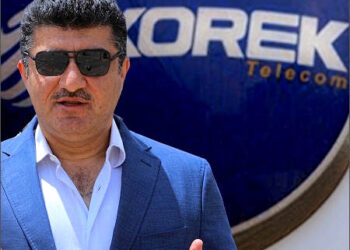


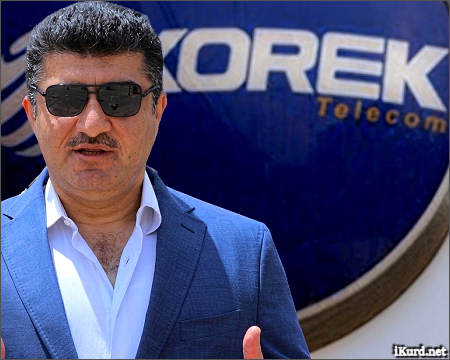
ERBIL,— Iraq’s Communications and Media Commission says Korek Telecom cannot resume service until it pays 500 billion dinars, close to $330 million, and hands over a federal tax clearance certificate, according to the commission’s chief executive.
The commission’s executive body chief, Baligh Abu Kalal, described the sum as just the opening payment toward a debt load exceeding 2 trillion dinars, roughly $1.3 billion.
The tax clearance, he said, must be issued by the federal Finance Ministry.
Once Korek clears both hurdles, the commission is prepared to finalize a fresh settlement and reopen the company, he said.
He also confirmed the commission has officially requested a leadership shake-up at Korek, a move he said is permitted under its contract.
Subscribers were urged by Abu Kalal to hold on to their existing numbers, since the commission intends to keep the lines active.
Separately, the commission has instructed Korek customers to lock down their online accounts ahead of November 1, the date it says it will begin disconnecting the company’s exchanges.
That cutoff was initially set for late September before being extended a month at the request of parliament’s Transport and Communications Committee.
Customers with accounts linked to multiple numbers were told to register a second carrier’s number as backup, while those limited to one number should transfer to an alternate provider.

The commission also recommended email or authenticator-app backups to keep verification codes flowing, stressing that none of this means customers should abandon their Korek SIM cards.
These requirements come after the Rusafa Court of First Instance in Baghdad ruled on September 28 to void the commission’s June cancellation of Korek’s settlement, keeping the original agreement intact.
Korek praised the ruling and pressed the regulator to resolve the standoff.
The commission pushed back, saying the court decision does not put Korek back in business or undo its other penalties, which it links to the August 2022 expiration of Korek’s mobile license.
The company’s offices stay closed and its outstanding debt to the government remains unchanged, the commission maintained.
Tensions escalated on August 9, 2026, when the regulator disconnected Korek’s network, seized its equipment, and froze company assets, citing breaches of financial and legal terms as grounds for scrapping the settlement.
Korek fired back the same day, arguing the commission’s chief executive lacked authority to void the agreement, and appealed directly to the prime minister for intervention.
On August 20, 2026, commission officers working alongside Iraq’s National Security Service padlocked Korek’s Baghdad headquarters in the Jadriya district along with three retail outlets.
A Rusafa court temporarily halted the regulator’s actions three days afterward, though the commission said the same court later reversed itself on appeal. The crackdown widened to Kirkuk, Nineveh, and Salah al-Din by September 6, bringing the total number of shuttered provinces to eight.
Back in April, the commission had already put Korek’s debt at roughly 1.4 trillion dinars, worth about $1.06 billion at the time, tied to a settlement reached in September 2025, with interest continuing to build.
The roots of the conflict stretch back to a 2007 license auction, where the commission insists Korek still owes $375 million. Korek counters that the payment was tied to receiving the subscriber base of the defunct Iraqna network, something it says never materialized.
Korek Telecom has faced legal and financial disputes for years. The conflict dates back to 2011, when a joint venture between French telecom company Orange and Kuwaiti logistics firm Agility acquired a 44 percent stake in Korek for $810 million.
In 2022, Kuwait’s Agility won a $490 million appeal against the Iraqi Kurdistan government over Korek Telecom.
Company founder Sirwan Barzani, nephew of tribal leader Massoud Barzani, has managed Korek since launching it in 2001, with the company’s value over $2 billion and more than 7 million subscribers in 2015. Mazen Sirwan Barzani holds the post of director of relations at the firm.
Observers have raised doubts about how Korek would cover such a massive bill, and whether the Barzani family, long accused of corruption and of siphoning billions from the region’s oil and trade industries, might lean on public resources to rescue a privately held business.
Critics have repeatedly branded the ruling Barzanis as Kurdish oligarchs who prioritize family enrichment from oil wealth over public service.
According to analysts, Massoud Barzani still wields the greatest influence from behind the scenes, even as his son Masrour serves as the Kurdistan Region’s prime minister and his nephew Nechirvan Barzani holds the presidency of Kurdistan.
(With files from +964 | Agencies)
Copyright © 2026 iKurd.net. All rights reserved.
Related posts:
 Business with ISIS – Updated
 Iraq blocks Barzani’s Korek Telecom internet service over $1.3 billion debt
 Iraqi Kurdistan – “Sold Out!” – Part II
 Iraqi Kurdistan: The Emperors’ New Clothes
 Iraq – The Cynical Swindle
 Why Massoud Barzani failed to become a charismatic Kurdish leader?
 The Resurrection (Ba’ath) Party – Before the Iran-Iraq War
 The Capture of The State of Iraq
 ORANGE can be bitter, so is KOREK
 Death of Kurdish Independence and the Beginning of Kurdish National Nightmare