

“Fascism is a gangrene”
Sheri Laizer | Exclusive to iKurd.net
The Day of the Dead (in Spanish, El Dia de Los Muertos) arises on November 2nd, aligning with All Saints Day following Halloween. The departed are remembered, their resting places if known, are visited and decked with flowers and tributes.
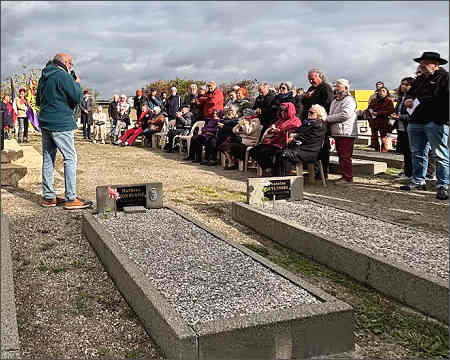
For those never found by their families in the concentration camps special ceremonies take place, like at the Concentration Camp of Le Vernet in the Ariège, SW France, where I paid my respects yesterday.
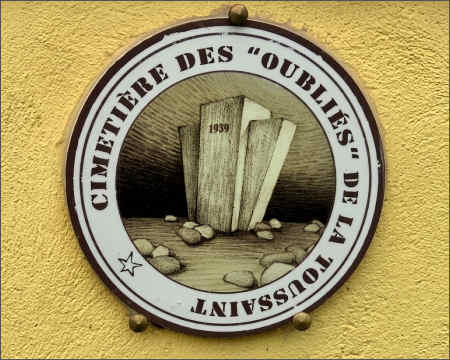
Eighty years after the beginning of the Spanish Civil War, around on hundred people gathered on Toussaint (All Saints Day) to remember those buried in the former camp cemetery. Their remains were never collected by their families and are honoured each year by the Amicale du Camp de Concentration du Vernet d’Ariege gathering in the Cimetière des ‘Oubliés” de la Toussaint.
Hundreds of thousands of people fell victim to the forces of fascism during the Spanish Civil War (1936-1939) through the Nazi Occupation. The graves of known and unknown fighters that took a stand against the rise of fascism in Europe by joining the International Brigades and French Resistance lie in many lands from Europe to north Africa. Resistance combatants of 79 nationalities fought shoulder to shoulder for shared freedoms in Spain during the Civil War. Many of the valiant fell captive and were rounded up and transported to concentration camps or prisons. Others fell in battle.
One of the main hubs for transportation and internment of the ‘foreign undesirables’, Republicans, intellectuals and later, European Jews, was the Concentration Camp of Le Vernet Ariège in SW France. The village lies a day’s march from the Spanish border where France adjoins the northern territories of Catalonia, and the Basque Country that were administered by the Republican government until its toppling.
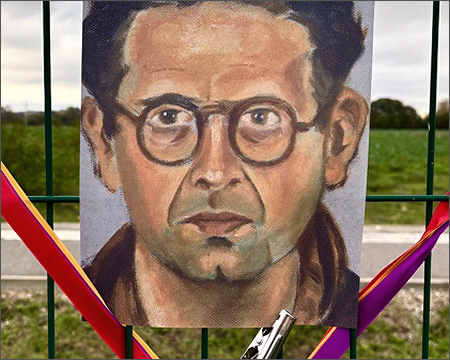
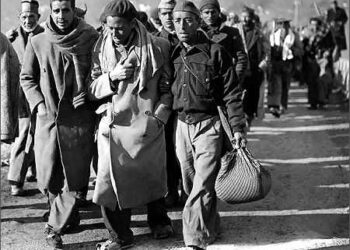
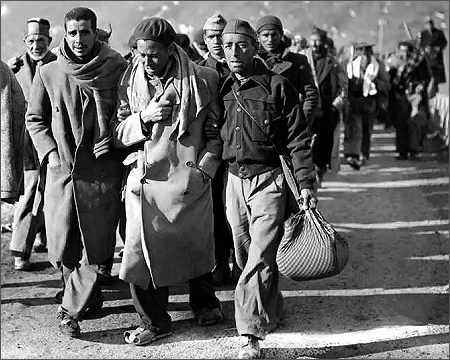
The mass exodus known as the Retirada, or Retreat, then ensued. Thousands among the half million refugees perished en route and lost their lives in the inhospitable interment and deadly concentration camps.
Today, eighty years on, the legacy of those that opposed fascism transcends their graves. Several internationally acclaimed writers and thinkers of the period include George Orwell who fought with the International Brigades and composed A Farewell to Catalonia, Animal Farm, 1984 reflecting their values; Max Aub, interned in Le Vernet and transported in 1941 with other ‘foreign undesirables’ to the barbaric, French-controlled Djelfa camp in Algeria; Arthur Kostler, author of Scum of the Earth, who was another prominent intellectual and writer interned at Le Vernet survived extreme deprivation and constant punishments for his political opinion.
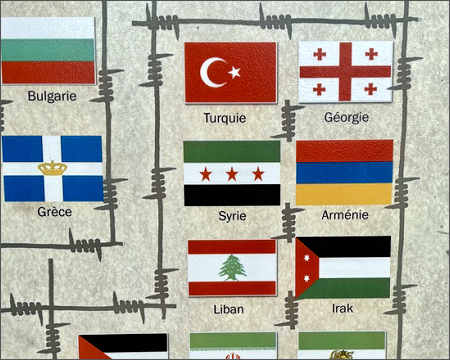
Among the thousands of men whose nationalities became known often only when they were registered in the concentration camps were Armenians, two Iraqis, Persians, socialist Turks, Lebanese, Palestinians, Greeks, Moroccans, Russians, Poles and Europeans of all nations.
It was only in the later phases, that European Jews began to be summarily rounded up and thrown in with the rest before the Holocaust truly began. Kurds are not documented to date as having joined the Republican forces perhaps by omission of ny nation recognised as ‘Kurdistan’ but Arabs from Iraq, Palestine, Egypt, Lebanon, Morocco and Algeria did so. The forces of the International Brigades came to number more than 45,000 volunteers standing up to oppose Franco, Hitler and Mussolini.
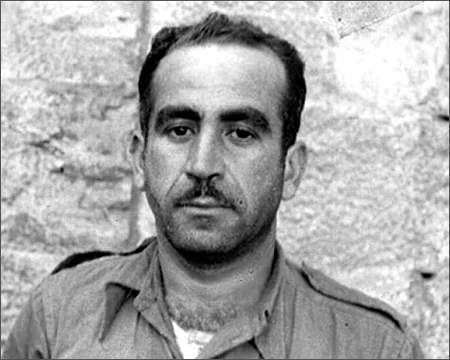
Baghdadi Christian, Nouri Rafael Kotani is remembered in a plaque erected in his honour in the Spanish town of El Pinell de Brai in Taragona. He went under the nom de guerre of Anwar R or Nuri Anwar Rafael.
Having been awarded an Iraqi government scholarship to study engineering at MIT in the United States, he joined the Brigades in 1938 and was first listed as ‘American.’ Hie engineering skills were very useful to his unit but after leaving Spain he fell prisoner and was transported to one of the French camps, possibly even Le Vernet.
He had joined the Syrian Communist party taking part in the Movement for the Liberation of Palestine (from the British) and was also a founding member of the Association against Fascism and the Committee for Combating Imperialism and Exploitation. He later explained to family members how he had tried four times to escape before being helped by a friend called Yusuf Ismail whose wife smuggled him out concealed under a load of goods in a wagon.
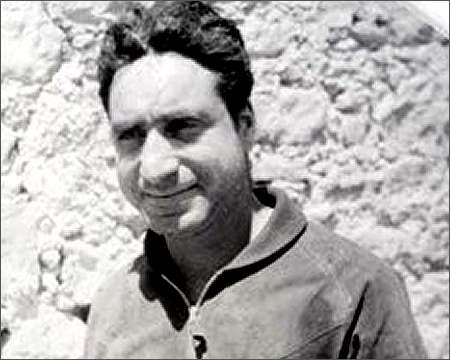
He then reached Paris and stayed with Yusuf’s family obliged to contact the Iraqi Consulate there having lost his documents in Spain. Fortunately, he there encountered Ali Hayder Suleyman, a friend who was an alumni of the American University of Beirut (that at the time still belonged to Syria) and helped him with a new passport and funds to return to Iraq in November 1939 where he remained politically active against the British-instilled kingdom.
He was imprisoned for his views and activism not seeing freedom until the revolt of 14 July, 1958 led by General Abd al-Karim Qasim. He became Minister of Railways and held the post until the first Ba’ath Party coup of 1963. He lived an intriguing life until death overcame him in 1980.
Another Baghdadi intellectual, Setty Abraham, the son of a Jewish family, also went to train in Spain and was sent to join the XVth International Brigade that his countryman Nouri Kotani had also served with. He did not end up in Le Vernet camp.
In 1929, Setty had first left Baghdad to work in Argentina remaining there between 1929-1934, before moving on to Uruguay where he stayed working as a translator, typographer and writer till 1934, speaking Arabic, Spanish and English.3 In 1937 he reached France so as to enter Spain and join the Brigades. For an in-depth account see the Biography of the Militants.
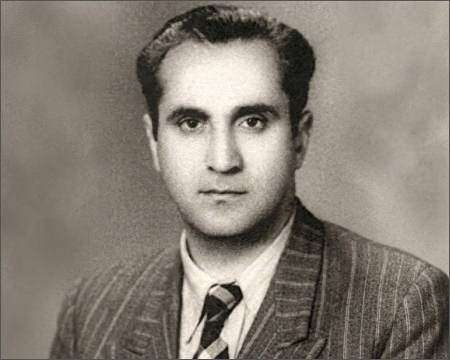
Palestinian journalist, translator, trade unionist, and critic, Muhammad Najati Sidqi, born in Jerusalem, was sent to Spain by the Comintern.
Of Communist persuasion, Sidqi believed that the conquest of European fascism would help liberate the Arabs through self-determination. Sidqi recalled introducing himself to local Spanish Republican militias saying: “I am an Arab volunteer, I have come to defend the Arabs’ freedom on the front in Madrid. I have come to defend Damascus in Guadalajara, Jerusalem in Cordoba, Baghdad in Toledo, Cairo in Andalusia, and Tetouan in Burgos.” 4
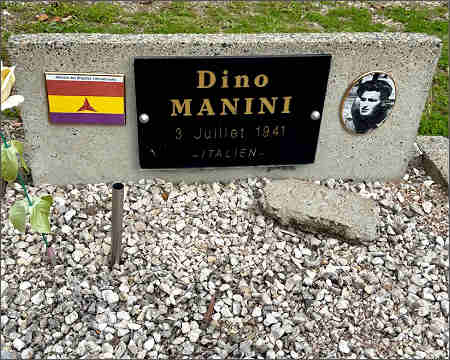
He was active in propaganda including in promoting the quest for Moroccan independence. He adopted a Moroccan alias to this end working as Mustafa Ibn Jala and urged Moroccans serving with the forces of General Franco to desert their positions. Franco’s so-called Army of Africa then numbered around 60,000 Moroccans and greatly exceeded those in the Republican forces, generally giving Moroccans a bad name with the Spanish.
The three-sided red star of the International Brigades represented the unity of the workers, the peasants and the intellectuals during the Spanish Civil War.
According to Catalan historian, Andreu Castells (and figures collated by the Russian State Archive of Socio-Political History), “211 Moroccans, 11 Syrians, four Palestinians, three Egyptians, two Iraqis and one Lebanese man …took up arms for the International Brigades.”5 Many of the Arabs were registered as French nationals owing to French colonial control over much of north Africa at the time.
A new sculpture unveiled against fascism at Le Vernet 1.11.2026
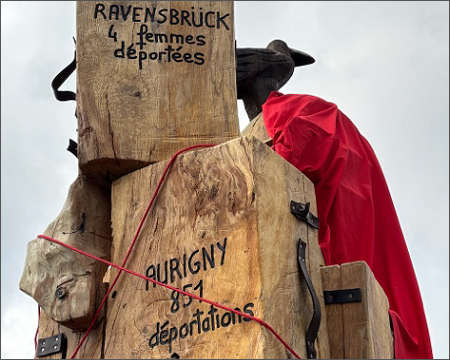
The wooden sculpture draws part of its theme from a book by Max Aub, Manuscit Corbeau -The Treatise of the Crow.
The sculpture created by artist, Rico Sculptu, was hewn from the ancient oak tree that witnessed thousands of people transported/deported beneath its branches from the station to the cattle trains bound for Auschwitz, Dachau, Ravensbrück (four women) and other French camps at Aurigny, and refouled to Franco’s Spain.
Crowned by the crow, a verse inscribed down the centre front panel reads, “Jacobo was a tame crow who observed the concentration camp of Le Vernet d’Ariège. He wrote a treatise on the lives of men that Max Aub found in his suitcase.”
The wood is carved into many suitcases along with the principal destinations of the deportees – destinations and journeys that were largely fatal as they left with their last meagre possessions packed in their carrying cases.
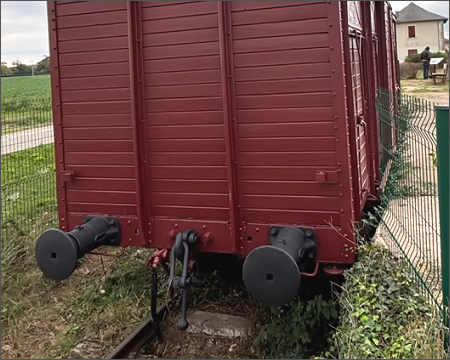
The deportations included the final voyage of the ‘ghost train’ that left Le Vernet even as France celebrated its liberation from the Nazi occupation: it took two months to reach Dachau despite the peace. A lone carriage sits on a side runner with the names of the last victims inscribed inside the wagon.
Max Aub and hundreds of others were subsequently shipped off to Algeria’s Delfa Camp. He survived and escaped to Mexico where his books on his ordeal were published.
A Moroccan who had fought for Franco’s forces is heard speaking in the documentary The Forgotten, reflecting on his experience saying: “Franco was an ungrateful bastard, after winning the war he forgot about us. We were no longer useful to him.”6
Speeches, readings and the singing of the French Marseillaise and Patriots Song of the International Brigades continued from the unveiling of the sculpture to the graveyard that is all that remains of the camp, now agricultural land aside from the old entrance gates and a number of guards houses occupied as private homes.
The present rise in fascism and the acceleration of desperate wars unite those who stand firm to remember the fallen of Le Vernet d’Ariège Concentration Camp.
1 Ibid.
2 https://thespanishcivilwar.com/a-jewish-iraqi-in-the-spanish-civil-war/
3 Biografia de Militantes, April 15, 1938. RGASPI Fond 545, Opis 6, Delo 437, ll. 10-11, Translated from Spanish.
4 https://www.middleeasteye.net/discover/spain-civil-war-arab-republicans-forgotten
5 Ibid.
6 Ibid
Sheri Laizer, a Middle East and North African expert specialist and well known commentator on the Kurdish issue. She is a senior contributing writer for iKurd.net. More about Sheri Laizer see below.
The opinions are those of the writer and do not necessarily represent the views of iKurd.net or its editors.
Copyright © 2026 Sheri Laizer, iKurd.net. All rights reserved.
Related posts:
 Iraq: Revenge and Corruption
 The Resurrection (Ba’ath) Party – Before the Iran-Iraq War
 A Century Ago, Lynette Soane, Hailed the Kurds as “my friends” Rather Than “Kurdish Brigands”
 PKK’s Assassination of Kani Yilmaz and Serdar Kaya
 The 19th Anniversary of the U.S. Invasion of Iraq, 20 March 2022
 The War of Attrition on Lebanon
 The Misleaders: Corrupt, Filthy Rich, and Proud of it
 Iraq in the Shadow of Khomeinism – Part III: Iraq is NOT Iran!
 Anfal – The Black Stain on Iraqi History Spreads
 The Terror Instructor – Nouri al-Maliki