

Sheri Laizer — iKurd.net
Syria’s failed ‘Arab Spring’
Bashar al-Assad was not incorrect soon after the ‘Arab spring’ took hold in Syria in April 2011 in claiming that ‘foreigners’ were aiming to take over the country.
Looking at the footage emerging at that time it was evident that those fighters with long beards crying “Allah Akbar’ as they launched their attacks were not Syrian democrats demanding greater democracy; they were the same branch of Sunni extremists that had undermined swathes of Iraq as well the Palestinian refugee camps in Lebanon.
Indeed, inroads made by the Sunni extremists led to the Lebanese army besieging Nahr el Bared camp to uproot them in 2007. Meanwhile, they made gains in Syria, Turkey and Iraq whilst pursuing their goals against Hezbollah and ally, Bashar al-Assad in Syria inside Lebanon.
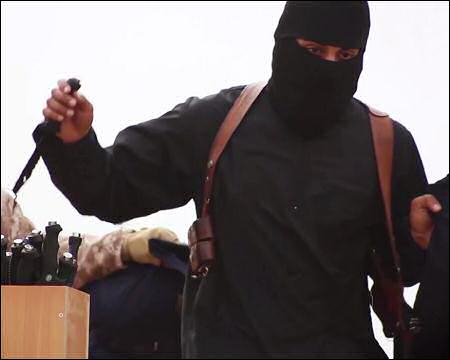
If today, heads were severed and placed on spikes outside the city walls ringing the ancient citadels of Damascus, Aleppo, and sprawling semi-desert towns like Kobane few would be surprised given that large sectors of the human population choose to spiral down into organised barbarism comparable with that of medieval times.
Beheadings inspire terror and make headlines. It must not be forgotten that beheadings were an effective tactic deployed against Westerners, in particular, but also Iraqi locals like taxi drivers after the insurgency got underway in Iraq following the overthrow of Saddam Hussein and the Ba’ath Party.
In 2004, captives were often filmed and footage of their beheading soon after death threats made were then disseminated in the media along with further warnings. On 18 September, 2004, the Tawhid and Jihad (“Oneness of God and Jihad”) group headed by the late Abu Musab al-Zarqawi, ‘released a video of the three men kneeling in front of a Tawhid and Jihad banner.
The kidnappers said they would kill the men within 48 hours if their demands for the release of Iraqi women prisoners held by coalition forces were not met. Armstrong was killed on 20 September when the deadline expired, Hensley 24 hours later, and Kenneth Bigley over two weeks later, despite the attempted intervention of the Muslim Council of Britain and the indirect intervention of the British government. Videos of the killings were posted on websites and blogs.[1] The tactic exploited currently by ISIS has the same effect.
Many thousands of survivors of ISIS’s barbarism suffered as their towns and villages were overrun in Iraq and Syria are either still fleeing, eking out a desperate existence in miserable camps or courageously facing down a bigoted foe, brainwashed into delusions of gaining paradise through martyrdom whilst considering human life and values as nothing.
Syria in crisis – Kurds embattled anew
According to an educated Syrian Kurdish commentator in the still free, Kurdish city of Qamishly, who spoke with me on condition of anonymity, “Kurdish society is now more divided more than at any previous time. Before the uprising there were sixteen political parties, now there are thirty-two in addition to more than 40 independent groups classified as “civil society organizations.” More importantly, there’s a vertical and horizontal dichotomy in Kurdish society of Apocus (followers of Öcalan and the PKK) and Barzanies (followers of Massoud Barzani and the KDP).”
I asked him to say more about the PKK and its sister group, the PYD as an inside observer and a Syrian Kurd, rather than Kurd from Turkey. He replied: “During the blockade of Kurdish areas by ISIS and other opposition groups, owing to the PYD/YPG’s coordination with the Assad regime many Kurds soon found themselves jobless and were obliged to look for work outside Syria. Some chose to migrate because of obligatory recruitment orders issued by the PYD’s local administration. PYD activists would go to the workplaces and homes of those known not to support them and would demand that they take up arms for the organisation or show financial support.” External sources confirm that the PYD enacted a ‘conscription law’ in July:
“A “conscription law” was ratified in November 2014 by the legislative council of the Auto-Administration in northeastern Syria (led by the Democratic Union Party “PYD” and other allied parties. The law stipulates “the duty of self defence in the Syrian areas which falls under the rule of the “Democratic Auto-Administration”. The law obliges families living in the region to send one of their 18-30 year-old members to the defence duty, which lasts for six months, either continuously or intermittently over one year time… [2]
ISIS targets the Kurdish town of Kobane
By 7 October 2014, the security and future of the residents of Kobane, a large Kurdish town close to the border with Turkey hung in the balance, while Turkish tanks remained ranged passively on the sidelines simply watching – would Turks come to the rescue of Syrian Kurds? No, indeed, the reverse was true and could have been predicted. Turkey likened the PYD to the PKK and declared it a terrorist group, seemingly preferring ISIS to Assad.
The Turkish military also attacked PKK positions at the same time as Iraqi Kurds were eventually allowed by the Turkish administration to send reinforcements to the Syrian Kurds battling ISIS in Kobane. However, Turkey had long been allowing ISIS and Jabhat al-Nusra fighters access to Syria across the Turkish border, according to numerous eye -witnesses including former IS fighters.
A former (reluctant) recruit sidelined by ISIS, an Iraqi Kurdish communications technician told Newsweek on 7 November: “ISIS commanders told us to fear nothing at all because there was full cooperation with the Turks,” said Omer of crossing the border into Turkey, “and they reassured us that nothing will happen, especially when that is how they regularly travel from Raqqa and Aleppo to the Kurdish areas further northeast of Syria because it was impossible to travel through Syria as YPG [National Army of Syrian Kurdistan] controlled most parts of the Kurdish region.”[3]
ISIS and the Turkish Deep State
A number of ISIS commanders are said to speak Turkish. It must not be forgotten that Turkey has in the past been home to various Sunni extremist Islamist groups. At a certain point, the interests of such Islamists, the AK Party government and ultra-nationalists may also coincide – especially in their attitude to the Kurds.
The Ergenekon trials established that the Turkish ‘Deep State’ – an inner core establishment including former military personnel and nationalist businessmen, journalists and politicians conspired to murder designated enemies, establish their own government through a military coup and in service of those ends hatched a number of finely detailed plots to stir up civic strife within Turkey and cause agitation with some of Turkey’s neighbours, such as Greece. Minorities were also targeted: non-Muslims including Greek Orthodox remnants in Turkey, Armenians, and Kurds. Even some judges and prosecutors where these were not already securely alongside Ergenekon were targeted from the list of designated opponents.[4]
In service of these shared goals, Islamists, secularists, military figures of high rank and political figures worked clandestinely behind the scenes. Some 275 Ergenekon defendants were sentenced in August 2013.[5]
Time magazine observed: “The defendants were charged with forming a clandestine ultra-nationalist “terrorist organization,” dubbed Ergenekon, the name of a mythic valley in Central Asia where, in lore, the Turkic peoples originated. Their alleged plan was to feed social unrest by staging high-profile assassinations and bomb blasts, creating a pretext for the military to step in and take control.”
The Turkish military has been fighting the PKK for almost forty years: its ethos remains unchanged despite Erdoğan’s ‘peace’ negotiations. MIT operatives have allegedly infiltrated ISIS to the extent of planting operatives to further Turkish goals in both Syria and Iraq.
Islamist extremists have been used in the past, such as with the deployment of Turkish Hezbollah, a murderous terrorist organization with links to the Deep State responsible for many murders throughout the Kurdish southeast in the 1990s.
Turkey’s passivity in relation to the life and death struggle of the Kurds in Syria is therefore hardly surprising, and should, indeed, have been foreseen by Western politicians who instead sought to coerce Turkey into taking military action against ISIS in Kobane.
Conversely, wounded fighters from ISIS have reportedly been treated all along in private hospitals in Turkey, according to, among others, the Co-President of the PYD.
Turkish military and ex-military figures are also said to be fighting within and alongside the Islamist groups. On occasion, Turkish military interrogators have dealt with PYD captives speaking in Turkish. Many ISIS fighters have been found carrying Turkish documentation.
Fundamentalism erodes freedoms for women in Turkey
Recep Tayyip Erdoğan and the AK Party government have been responsible for Turkey’s drift into fundamentalism. One glimpse at the attire of his wife stood at his side in public, sheathed in a tight turban and long sleeved gown would make Atatürk shudder in his grave.
Indeed, women on Turkey’s beaches have been threatened by Islamist fundamentalists with increasing frequency this year, handing out threatening leaflets for them to cover up.[6] The UK Foreign Office warned British tourists against the risks of attack and kidnap in Turkey this summer. The Turkish Doğan News Agency/Hürriyet Daily News observed:
“On the sandy beaches of Kaynarca, two men wearing thobes and kufis distributed brochures to beach-goers, offering advice about correct Islamic deportment.
The two men, who were accompanied by a child, said they were members of an Islamic foundation from the ultra-conservative neighborhood of Çarşamba in Istanbul’s Fatih district.
The brochure, titled “The lady that God wants” contained a total of 72 points, including the following instructions: “The lady should be covered; she should not shake hands with male strangers; she should not go outside without asking permission from her husband; she should not go to weddings where there is music; and she should not sit in public areas.”
Domestic violence remains high throughout Turkey, frequently justified on religious grounds. [7]
ISIS links to MIT, the military and Turkish ‘Deep State’?
ISIS captured several diplomats and Turkish citizens when they successfully stormed the Turkish Consulate in the course of taking control of Mosul on 11 June 2014.
Although, to the public eye, the Turkish hostages were seemingly threatened with death like other ISIS captives, on 20 September, Erdoğan secured their release unharmed. [8] Indeed, a trade off took place. Turkish intelligence (MİT) agents managed to escort 49 captives out of Syria and back to Turkey earlier today” ran one report[9]. In return, Turkey released some 180 ISIS fighters close to Kobane, transporting them in military trucks just like it transports its own soldiers.
Interestingly, some 32 Turkish lorry drivers seized in Mosul some days before the diplomats were also freed unharmed and then too, no details disclosed.[10] Turkish PM, Ahmet Davutoğlu stated “their release was the result of the Turkish intelligence agency’s “own methods”, and not a “point operation” involving special forces. He gave no further details.”[11] MIT enjoyed direct links with JITEM and Turkish Hezbollah in the past.
Other commentators on developments in the region have also reported on the active support, arming and indeed freedom of operation and freedom of movement of pro-ISIS and ISIS militants by the Turkish state.
Daniel Pipes, in a list of articles compiled on the subject in his blog cited Ahmed Kurdi, the leader of the Kurdish Front Brigade emphasising that they had definite proof and documentation of this support. He added that some of the Kurdish Front’s fighters and supporters who had been captured by ISIS had been interrogated by Turkish officers, saying: “all our people said that Turkish officers had taken part in interrogation. This proves support is continuing. They pretend to be in conflict with this organisation, but this is not true.”
Pipes included citations from an important article published in Aydınlık newspaper: “MİT’ten IŞİD’e paralı asker (MIT’s paid soldiers with ISIS) with an English translation:
“One group of retired Turkish soldiers from the Special Forces Command are reportedly fighting together with militants of the Islamic State of Iraq and the Levant (ISIS) in Iraq, a fact that shockingly even PM Erdoğan knows.
“The soldiers are believed to be joining ISIS in exchange for high wages. Some of the anonymous colleagues of the soldiers have identified them from images taken during combat. The investigations have discovered that the Turkish Intelligence Organization (MİT by its Turkish initials) sent the retired soldiers to Iraq to support the terrorism in the region.
“… MİT controls the operation. They did the same in Syria, as well. They also took part in the attack by the opposition forces in Keseb. Most of those with masks are from this group. They keep their masks on even in hot weather to avoid being recognized. They are now side by side with ISIS in Mosul. They act like legionaries. It has become explicit when some took their masks off…As it can be imagined, the incidents of the Turkish flag being taken down in Diyarbakır and Turkish diplomats kidnapped in Mosul were all in accordance with the plans of MİT.”[12]
Some 10% of ISIS fighters are considered to be recruits from Turkey according to opposition CHP Konya deputy, Atilla Kart, in Today’s Zaman magazine 4 September 2014. The piece is headed CHP’s Kart reveals high level of participation in ISIL from Turkey. [13]
Some funding for ISIS derives from the sale of oil that is taken from Mosul and from northern Syria before being refined on the Turkish border and converted into cash in Turkey, estimated to be worth some $800 million.[14]
PKK veteran commander, Cemil Bayik, spoke with Patrick Cockburn of the Independent on Armistice Day, 11 November 2014, warning of ISIS intentions to move on Afrin where the group had begun threatening the Kurdish inhabitants.
“Mr Bayik is careful to stress that the PYD and the YPG, the People’s Defence Units, are not directly controlled by him, though he heads the PKK umbrella organisation, the KCK, which unites PKK affiliates in different countries” Cockburn reported.[15]
The US differentiates between the PYD and its affiliate the PKK, allowing US aid to Syria’s struggling Kurds by means of this legal loophole.
The KRG peshmerga, PYD and PKK guerrillas should unite against ISIS
The de-facto mini state of Kurdistan in northern Iraq is at grave risk of being overrun by ISIS barbarians. Rather than the PKK putting down its arms and focusing its energy and indeed, media attention on that elusive enterprise ‘peace with Turkey’, would it not be more fitting with the goals of Kurdistan and Kurdish freedom to commit their training and arms to assist in the defeat of ISIS? It is far more pressing to drive these dark forces from the region and re-secure the autonomous sectors of Kurdistan than concentrate the chief focus on Turkey.
Fundamentalism in Turkey is alive and well. There will be no stopping ISIS unless Turkey also alters its policy and commits to internal changes, clamping down on extremist Islamist organizations operating freely on its home soil and using Turkey’s borders as points of transit.
It may well be too late. Secular Turkey is closer than ever to an Islamic state curtailing freedoms and imposing Islamist dictates in the guise of ‘soft’ Islam while supporting hardliners in its back garden.
[1] http://news.bbc.co.uk/2/hi/uk_news/3726846.stm
[2] http://www.mesop.de/2014/07/19/conscription-law-pyd-calls-on-syria-kurds-to-defend-dignity/
[3] http://www.newsweek.com/isis-and-turkey-cooperate-destroy-kurds-former-isis-member-reveals-turkish-282920
[4] http://ergenekonisourreality.files.wordpress.com/2010/07/ergenekonisourreality-final.pdf
[5] http://world.time.com/2013/08/05/how-the-ergenekon-verdicts-may-deepen-turkeys-political-divide/
[6] http://pamelageller.com/2014/06/bikini-jihad-sharia-enforcers-hit-beaches-turkey-tell-women-cover.html/
[7] http://www.kurdmedia.com/article.aspx?id=16953
[8] http://www.thetimes.co.uk/tto/news/uk/article4227988.ece
[9] http://warincontext.org/2014/09/20/turkey-somehow-secures-release-of-49-hostages-held-by-isis/
[10] Thirty-two Turkish lorry drivers who were seized in Mosul on 6 June were released a month later. No details of the negotiations to secure their release have been revealed.
[11] http://www.theguardian.com/world/2014/sep/20/isis-releases-hostages-turkish-consulate-mosul
[12] http://www.danielpipes.org/blog/2014/06/more-on-turkish-support-for-isis
[13] http://www.todayszaman.com/national_chps-kart-reveals-high-level-of-participation-in-isil-from-turkey_357687.html
[14] http://themuslimissue.wordpress.com/2014/10/14/isis-fighters-killed-by-kurds-were-members-of-turkish-mit-intelligence-services/
[15] http://www.independent.co.uk/news/world/middle-east/war-against-isis-pkk-commander-tasked-with-the-defence-of-syrian-kurds-claims-we-will-save-kobani-9854818.html
Updated 26 March 2015. An older version of this article also apperaed on academia.edu.com
Sheri Laizer, a Middle East and North African expert specialist and well known commentator on the Kurdish issue. She is a senior contributing writer for iKurd.net. More about Sheri Laizer see below.
The opinions are those of the writer and do not necessarily represent the views of iKurd.net or its editors.
Copyright © 2015 Sheri Laizer
Related posts:
 Business with ISIS – Updated
 Turkey: Nato’s Islamic State Member
 Iraqi Kurdistan – “Sold Out!” – Part II
 What makes a good NATO ally? The Case of Turkey
 Hiding in Plain Sight: Turkey’s ISIS Links, Al-Baghdadi’s Last Refuge and the Jihadist-Controlled “Safe” Zone
 “ISLAMBUL”
 Interview with Kurdish hostage, Huseyin Baybasin
 The Resurrection (Ba’ath) Party – Before the Iran-Iraq War
 Saddam Hussein…The Hell That is Iraq!?
 Iraq – The Cynical Swindle