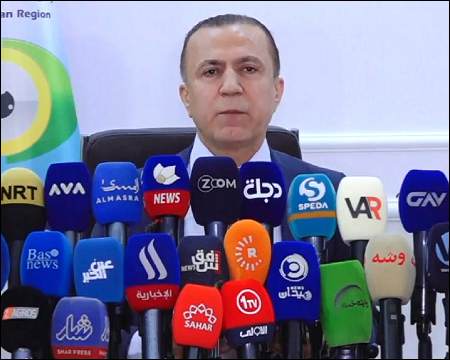
ERBIL, Iraqi Kurdistan region,— The head of the Integrity Commission in Iraq’s Kurdistan region has revealed that between 800 and 1,300 corruption cases are reported annually, emphasizing the need for a dedicated court to handle these cases.
Judge Ahmed Anwar, the commission’s chief, shared these figures during a press conference on Monday,
“The number of corruption cases continues to rise, with 800 to 1,300 cases registered every year,” Judge Anwar stated. He noted that public trust in the commission has grown, with more citizens and government institutions filing complaints and cooperating in providing evidence.
In 2024, there were 573 corruption-related lawsuits filed. Out of these, 223 were brought to court, while 1,047 cases are still under investigation, with some spanning multiple years, according to Anwar.
Judge Anwar proposed the establishment of a specialized court in the Kurdistan region to focus exclusively on corruption cases.
“Such a court, similar to the one in Baghdad, would streamline the process and ensure faster resolution of cases,” he explained. He also disclosed that more than 100 senior officials, including individuals holding ministerial-level positions, have been investigated by integrity courts.
However, none of these cases have yet resulted in convictions and no one—particularly individuals with ties to the ruling parties—has been sentenced for corruption in Iraqi Kurdistan.
Observers and watchdog groups have repeatedly highlighted corruption as a pervasive issue in the Kurdistan region, which is considered one of Iraq’s most corruption-prone areas.
Leaked documents and reports from watchdog organizations indicate that billions of dollars in oil revenues remain unaccounted for. Critics claim that the Kurdistan Regional Government (KRG) lacks transparency in disclosing oil revenue figures to the public and the regional parliament.
For decades, the region’s political landscape has been dominated by the Barzani-led Kurdistan Democratic Party (KDP) and the Talabani-led Patriotic Union of Kurdistan (PUK). Both ruling families have faced consistent allegations of corruption and nepotism.
According to analysts, the absence of robust oversight mechanisms has created an environment conducive to illicit financial activities.
The Barzani family, often referred to as the “Kurdish oligarchs,” has been accused of enriching themselves through the oil industry rather than investing in public welfare.
The lack of transparency and accountability in the KRG has made the region a haven for financial misconduct, noted local and international analysts.
According to analysts, over the past three decades, efforts to combat corruption have largely been superficial, as many leaders driving these initiatives are themselves implicated in corrupt practices.
Observers note that even the establishment of a dedicated anti-corruption court may have little impact on addressing corruption at the highest levels, particularly among the leaders of Kurdistan, who are widely regarded as the most corrupt.
Systemic reforms and genuine accountability are essential to restoring public confidence.
Copyright © 2024 iKurd.net. All rights reserved
Related posts:
 Iraqi Kurdistan – “Sold Out!” – Part II
 Syria: Revisiting The Caesar Torture Victim Photographs
 Iraq – The Cynical Swindle
 The Capture of The State of Iraq
 Business with ISIS – Updated
 The Suffocation of Iraq Kurdistan
 Iraqi Kurdistan: The Emperors’ New Clothes
 The Mustashar and the Jash – A View from the Position of ‘Iraqi National Unity’ on the ‘Descendants of Treason’
 The Misleaders: Corrupt, Filthy Rich, and Proud of it
 Iraqi Kurdistan – “Sold Out!” – Part III