

The Unification of the Peshmerga Forces, A Show!!
Abdulla Mahmoud | Exclusive to iKurd.net
Translated by iKurd.net from Kurdish Awene
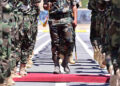
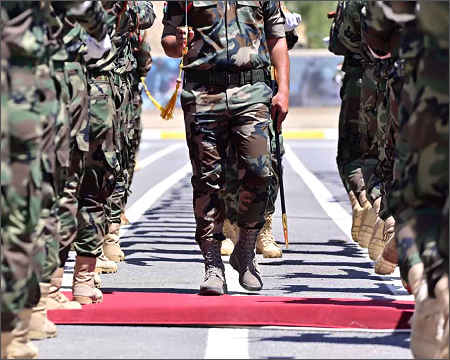
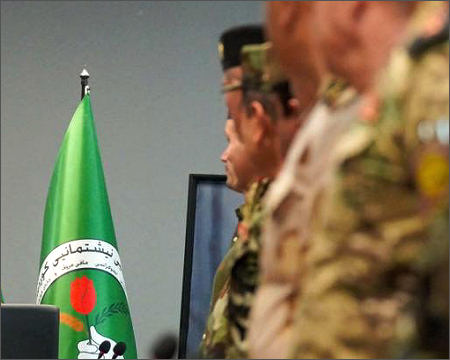
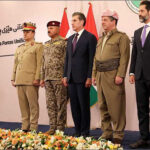
On September 21, 2026, in the presence of party and government officials!!, a ceremony was held to unify the two Peshmerga forces, Forces 70 and 80, belonging to the Kurdistan Democratic Party (KDP) and the Patriotic Union of Kurdistan (PUK).
After the ceremony, many party and government officials, as well as party-affiliated media outlets and journalists, presented the unification of the two forces and their renaming as the First and Second Regional Forces as an important and historic achievement.
The armed and security forces in the Region are, on the one hand, one of the main pillars that keep the KDP and PUK in power, and, on the other hand, a major pillar of the division between these two political forces.
Clearly, the armed forces are not limited to Forces 70 and 80. They are only part of a much broader network of armed forces, including Special Forces, Zeravani, Counter-Terrorism, Commandos, security forces, and party- and family-affiliated armed forces, among others. There are even many other forces, such as emergency forces, special brigades, and units protecting officials. In addition, some tribes have their own armed forces.
One of the main and most important pillars protecting the power of the KDP and PUK is their armed forces. Unifying these two armed forces and removing them from party control and influence would mean the loss of one of the main pillars of their power. At the same time, it would mean removing a major obstacle to reducing the division between them.
. Photo: Talabani’s Press Office/via iKurd.net
What is noteworthy in this situation is that the KDP and PUK announced the ceremony to unify part of their forces, Forces 70 and 80, at a time when relations between them are extremely distant and complicated.
For more than two years, they have been unable not only to form even a symbolic and ceremonial government like those of the past or agree on positions and powers, but also to hold joint high-level meetings. Yet, in this situation, they are unifying two large party-affiliated armed forces, Forces 70 and 80!!
The KDP and PUK are responsible for dividing the Region into two separate administrations. They have divided the two areas with something resembling the Berlin Wall and the Great Wall of China. They each have their own administration and authority within their respective zones, while outside those zones neither has any real authority.
At the same time, they have separate security forces, separate police forces, separate counter-terrorism and intelligence agencies, and separate administrative and governing ministries. Even more fundamentally, they are aligned with two different regional powers, Iran and Turkey.
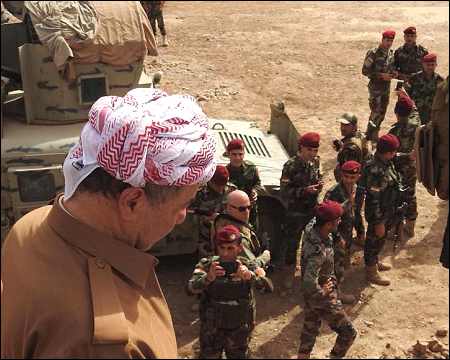
Yet, instead of beginning the process of unification with basic issues, they are putting on a show of unification starting with the most sensitive and fundamental issue, the armed forces.
In a Region where the KDP and PUK have divided power between themselves, job opportunities and employment at every level are still dependent on party connections and support, especially in the armed and security sectors. There is great sensitivity around this issue.
These armed forces are also the KDP’s and PUK’s ready armies in the electoral game. Beyond that, the KDP and PUK have created separate systems not only for sensitive positions but also in other areas such as education, health, sports, and culture, extending even to the judiciary and courts. They have created such a divided system that every ordinary person can understand and see it.
At the most basic level, the logical thing would have been for the KDP and PUK, before putting on a show of unifying their party-affiliated armed and Peshmerga forces, to first work toward unifying ordinary government positions and ministries, and to see and treat the citizens of the Region outside the boundaries of party affiliation.
Then they could think about other security and military matters. The fact that the KDP and PUK have been forced to start with such a sensitive issue, one directly connected to protecting their power and influence, is not a sign of strong ability or determination to overcome a major political problem in society. Rather, it is a political and legal show that has already lost before it began.

If the KDP and PUK cannot unify sports, education, culture, law, the courts, security, and the police, how can they unify their party-affiliated armed forces?
If the KDP and PUK cannot remove the organizational structures of their Peshmerga forces at the centers and branches, how can they claim that they are unifying the Peshmerga forces from the top?
If the KDP and PUK cannot employ an ordinary civil servant without party connections or affiliation, how can they claim that their armed and security forces are politically neutral?
If the KDP and PUK cannot remove all the checkpoints between their cities, and cannot remove the Digala boundary as a symbol of dividing the Region into two zones, how can they give up their party-affiliated armed forces, which are the source of their power and protection?
What happened and was presented to the public was an empty and obvious play. The campaign to bring Iraq’s armed forces under one umbrella and organize them within the framework of the army and the authority of the central government was the source of this show and performance.
The campaign to return weapons under the control of the army and the state was the source of this step by the KDP and PUK, so that they could present the Peshmerga as a unified, legal, non-party force.

In this way, they seek constitutional support for its continued existence as a border protection force and, in future disputes over the issue of weapons, to gain domestic support, public support, and official international support, especially from the United States and the West.
What is clear in all of this is that no independent, free, and informed person, whether in Kurdistan, Iraq, or the region, sees this step by the KDP and PUK, the unification of party-affiliated armed and Peshmerga forces, as a step toward establishing a unified national army.
Ending party-affiliated armed forces, removing the Digala boundary [A border between areas controlled by the PUK and KDP], normalizing Kurdistan’s political situation and turning it into one zone, removing party barriers to employment and job opportunities, unifying administrative and regular ministries, unifying the judicial authority and ending its division along party lines, and ensuring the independence of the courts would all be steps that could create the basis for integrating the armed forces and taking weapons out of the hands of the parties.
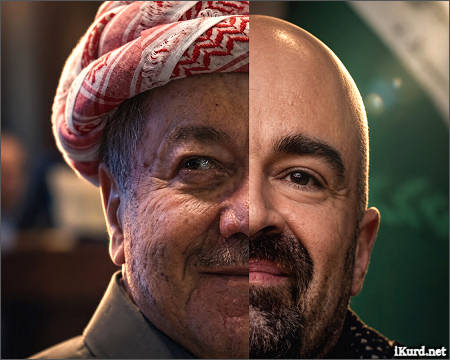
But what actually prevents the Kurdistan Region from being treated as one zone, the establishment of unified and nationwide institutions and authority, citizens from being treated without regard to their party identity, and the judiciary and courts from becoming independent is the KDP’s and PUK’s own power.
The power of the KDP and PUK, and this form of party-based, family-based, and armed rule, can neither be reformed nor fundamentally changed through ordinary legal and political means.
The precondition for any progressive or revolutionary change, any fundamental transformation of the system of power, and the return of political will to the people is the end of the party-based, family-based, and armed rule of the KDP and PUK.
This article was originally published in the Kurdish language in Awene Newspaper on October 4, 2026.
The opinions are those of the writer and do not necessarily represent the views of iKurd.net or its editors.
Copyright © 2026 iKurd.net. All rights reserved.
Related posts:
 The Mustashar and the Jash – A View from the Position of ‘Iraqi National Unity’ on the ‘Descendants of Treason’
 The Suffocation of Iraq Kurdistan
 The Resurrection (Ba’ath) Party – Before the Iran-Iraq War
 Peshmerga Unification Completed, a Farce
 Iraqi Kurdistan: The Emperors’ New Clothes
 Iraqi Kurdistan – “Sold Out!” – Part II
 Iraqi Kurdistan: An Elusive Autonomy – Lost Opportunities For Peace
 Iraq: A State of Surveillance – Databases, Tracking And Corruption
 Developments in Syria Can Give Opportunity to ISIS to Bounce Back: Peshmerga
 Anfal – The Black Stain on Iraqi History Spreads