


Nick Kossovan | Exclusive to iKurd.net
Toronto in late autumn rarely offers an afternoon like the one this past Friday, when warm air disperses silver sunlight that lights up decades of worn brick, making the old storefronts along College Street appear to glow like amber.
Walking beside me through Little Italy (a historic, vibrant neighbourhood built on generations of immigrant hustle), as if to compound the weather’s rarity, is someone who’s profoundly impacted my life, yet someone I seldom get to spend uninterrupted time with: Halime Aktürk.
Halime, as I’ve written before, is an up-and-coming filmmaker whose striking beauty, sharp intellect, defiant dark eyes, and a smile Hollywood’s still searching for never fail to intimidate me. Add her casual flirtation with political activism, and I’m entirely outmatched. I’m hopelessly, shall I say, to keep within emotional boundaries, “devoted” to her.
Sadly, my devotion’s unreciprocated, making Halime hard on my heart. Still, as I walk beside her, a cup of coffee in my hand while Halime is holding an herbal tea concoction, the rhythm of our stroll feels intrinsically Kurdish: unhurried, grounded, and temporarily free of overhanging grief.
It’s my devotion that keeps me hanging on to every word Halime says. She walks with brisk, sharp elegance, her velvety, sandpaper voice cutting through the screeching streetcar brakes, café chatter, and honking traffic as she speaks of the West’s indifference to the Kurdish struggle. While waiting for a traffic light to change, Halime pauses, turns to me, and says, her dark eyes flashing with quiet exhaustion and sudden fury: “Kurds keep it in the house.”
Halime’s words felt like a sudden drop in temperature. They lay bare why the constant, bubbling Kurdish diaspora remains virtually invisible to the rest of the world. For generations, Kurds have been displaced across hostile borders or have lived under regimes seeking to eradicate them, keeping their culture (language, music, history, ancient fabrics, and political trauma) to themselves, behind closed doors, not only to survive but to ensure it wouldn’t be destroyed.
As Halime sips her tea, she pulls out her phone and shows me runway models wearing uncredited faranji vests and ancestral Kurdish motifs.
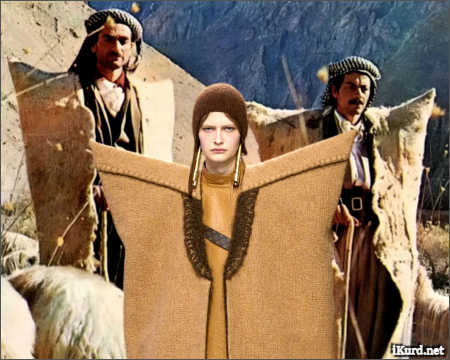
The images hit me with a jolt of embarrassment. Here I am, hopelessly devoted to a Kurdish woman, claiming to care about her world, yet completely blind to the cultural extraction from Kurdish culture that’s underway.
During the recent Paris Fashion Week, Louis Vuitton sent models down its Fall/Winter 2026–2027 runway wearing structured felt capes under the guise of ‘futuristic folklore,’ effectively looting Kurdish heritage and selling it as European avant-garde chic.
I stood there, staring at Halime’s phone, stung by my ignorance. I embodied the very Western indifference she’d just described. I like to think I stay informed, yet I’d completely missed this high-fashion heist, a stark reminder that the Kurdish struggle remains largely unknown outside the Kurdish community because Western media never covers it. My own blind spot mirrors a much larger one: mainstream media not only tunes out Kurdish reality but also actively ignores the slow, systematic dismantling of their heritage.
Corporate piracy on this scale is enabled by a legal loophole. Western intellectual property law is designed to protect the patents of industry oligarchs and individual owners, yet it remains willfully blind to collective, ancestral ownership.
Without statehood, Kurdistan’s cultural identity is legally classified as “public domain.” It’s a bureaucratic eraser: luxury houses can poach the kapanak, derpey, salta, or sharwall, tweak a seam, label it “boho-chic,” and monetize a stateless people’s ancestral heritage without paying royalties or giving credit.
Louis Vuitton didn’t make a harmless misstep; they knowingly participated in a long, predictable legacy in which Western fashion houses treated the heritage of Indigenous and stateless communities as a free-for-all pillage. For over a century, fashion houses based in Paris, Milan, and New York have operated under the self-serving excuse of ‘global inspiration.’ Design teams travel to rural mountain villages and Indigenous territories, returning with patterns that belong to living cultures.
This playbook has been executed repeatedly.
- The Şal û Şepik and Kapanak: Traditional pleated suits and seamless felt shepherd capes lifted and sold as “desert utility suits” or “avant-garde felt wraps.”
- Mesoamerican and Andean Communities: High-fashion labels and fast-fashion giants alike have repeatedly lifted traditional embroidery from Oaxacan and Zapotec artisans, prompting Indigenous coalitions to issue public condemnations.
- Eastern European Folk Craft: Centuries-old coats, hand-embroidered by Romanian villagers, have been replicated stitch-for-stitch by luxury brands and sold for thousands of dollars.
- North American First Nations and Native American Motifs: Sacred weaving patterns and ceremonial garments were transformed into generic music festival accessories and “ethno-tribal” prints.
What makes monetizing Kurdish culture truly appalling is that it checks off several predatory boxes at once. First, it’s structural erasure. When a multi-billion-dollar fashion house strips a stateless people of their identity, it reduces complex historical symbols to decorative noise for wealthy consumers.
Second, it exposes the hypocrisy of global commerce. Western markets eagerly consume a persecuted minority’s aesthetic markers while remaining indifferent to the geopolitical violence that displaces them.
Third, it commodifies hard-won survival. When your heritage has been criminalized, banned, or bombed in your homeland, seeing a Paris fashion house put your people’s traditional dress on a runway model isn’t flattery; it’s salt in an open wound.
Such ongoing exploitation thrives because international law was explicitly designed to enable it. Current intellectual property and copyright frameworks fail to protect the traditional cultural expressions of stateless and Indigenous groups because Western legal systems protect individual commercial ownership, whereas cultural heritage is rooted in collective, intergenerational guardianship. By exploiting these glaring legal loopholes, fashion houses operate with complete impunity:
- The Individual Ownership Paradox: Copyright requires a single identifiable author or corporate entity, whereas traditional Kurdish weaves evolve over centuries across multiple communities. Western law doesn’t recognize communal ownership, so Kurdish heritage is treated as unowned.
- The “Public Domain” Trap: Western IP law sets strict expiration dates for artistic ownership. Kurdish motifs have existed since antiquity, so international courts deem them “in the public domain,” allowing corporate giants to raid ancestral archives without paying a single cent in royalties.
- The Statelessness Penalty: International IP enforcement relies on sovereign nation-states to enter into treaties and register assets. As a stateless people, Kurds lack a national government to defend their cultural property or to represent them in global courts.
Call it what it is: predatory extraction, not creative exchange. The West adores the art but detests the artisan. They want the bold geometries, the heavy felt, and the vibrant weaves of Kurdish clothing, but they don’t want any of the messy, stateless baggage of the people who’ve bled to keep those traditions alive.
Anyone who admires Kurdish aesthetics should stop funding corporate giants who couldn’t find Kurdistan on a map. Redirect those dollars to authentic Kurdish creators who weave their history into every thread. Seek out independent designers and platforms such as H&L Designs, Kurdish House London, and Lara Dizeyee. Buy directly from Kurdish fashion designers. (Google’s your friend.) Wear their work. Give credit where it’s genuinely due.
Kurdish history is a punishing one. Over the past century, the Kurdish people have been repeatedly used, manipulated, and discarded. They were promised a state in the 1920 Treaty of Sèvres, only to see it torn up three years later at Lausanne.
They were abandoned to poison gas attacks in Halabja in 1988, uprooted by endless regional wars, and are now systematically denied basic political autonomy.
Blatantly lifting Kurdish cultural identity to manufacture fleeting ‘fashion statements’ isn’t just another insult added to a hundred years of geopolitical abuse. It’s a glaring display of Western capitalist greed, a system that consumes everything authentic in its path, strips away its soul, and sells the empty shell back to us at a markup.
Nick Kossovan, a self-described connoisseur of human psychology, writes about what’s on his mind from Toronto. You can follow Nick on Twitter and Instagram @NKossovan. He is an occasional contributing writer for iKurd.net.
The opinions are those of the writer and do not necessarily represent the views of iKurd.net or its editors.
Copyright © 2026 iKurd.net. All rights reserved
Related posts:
 The Rojava Revolution Has Lessons for Western Feminism
 Kurdish fashion designer Lara Dizeyee named among 2025’s most inspiring personalities
 Kurdish Women Are Our Intellectual Firepower
 Iraq: Revenge and Corruption
 Who Are the Persians? – Part X
 Business with ISIS – Updated
 The Sun Also Rises in Western Iran
 Who Are the Persians? – Part VI
 Behind the Veil of Turkey’s ‘Zero Problem’ Policy – A Kurdish Perspective
 The Syrian Al-Jazeera Province: An Ethnic, Social and Political Study – Book