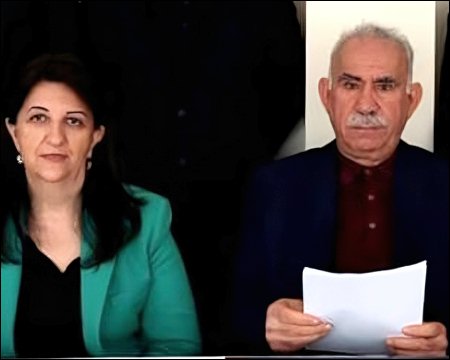
DIYARBAKIR (AMED),— Abdullah Ocalan, the imprisoned Kurdish leader of the founder of the Kurdistan Workers’ Party (PKK), appears physically aged but remains resolute in his push for peace, according to Pervin Buldan, a parliamentarian from Turkey’s pro-Kurdish DEM party.
Buldan shared details from recent meetings with Ocalan, who is in his late 70s and serving a life sentence on İmralı Island. She noted that while he remains mentally strong, he has shown signs of aging, including watery eyes, despite undergoing cataract surgery.
At a press conference in Istanbul on Feb. 27, 2025, Buldan conveyed Ocalan’s renewed call for a peaceful resolution to the Kurdish issue in Turkey. She said the recent visit by a delegation from the DEM party to Iraq’s Kurdistan region was made at Ocalan’s request, reflecting his belief that the region’s political leaders play a crucial role in the process.

Speaking to a women’s Kurdish news outlet, Buldan said Ocalan specifically urged discussions with tribal leader and the head of Kurdistan Democratic Party KDP Massoud Barzani and Nechirvan Barzani, as well as with Patriotic Union of Kurdistan PUK’s leaders Bafel and Qubad Talabani in Sulaimani. “He considers the Barzani and Talabani families essential to the Kurdish cause,” she stated.
Last week, Ocalan’s message was read aloud by an HDP delegation, in which he called on PKK fighters to lay down their weapons and dissolve the organization. His statement emphasized that the decades-long conflict has failed to produce lasting solutions.
Kurdish PKK fighters declared a ceasefire with Turkey on Saturday, March 1, responding to a historic appeal from their jailed leader, Ocalan.
The appeal drew support from political groups in Iraqi Kurdistan, with the Barzani headquarters confirming a recent meeting in Salahaddin between Massoud Barzani and representatives of three Kurdish parties from Iraqi Kurdistan. According to the statement, Barzani reaffirmed his commitment to a peaceful resolution.

In his message, Ocalan called for the restoration of Kurdish-Turkish brotherhood and urged concrete steps toward ending hostilities. “A war that repeats itself without a solution benefits no one,” he stated.
Buldan refrained from discussing Ocalan’s personal circumstances in detail but confirmed that his health has visibly declined. He has access to a television with 22 channels and spends much of his time reading and writing. Prison officials say he watches news and discussion programs before retiring early.
Three senior PKK members—Hamili Yıldırım, Veysi Aktaş, and Ömer Hayri Konar—remain incarcerated with him on İmralı Island.
The PKK launched its armed struggle in 1984, seeking greater autonomy for Kurds in Turkey, who are estimated to make up at least 30% of the country’s population. The conflict has resulted in over 40,000 deaths, including Turkish soldiers and Kurdish guerrillas.
The PKK primarily directs its attacks at Turkish military and government security installations while deliberately avoiding civilian targets. This strategy has prompted various international organizations to urge governments to reevaluate the group’s classification as a “terrorist” organization.
Ocalan, who founded the PKK in 1974, has been in Turkish custody since his capture in Kenya in 1999. Over the years, he has become a highly symbolic figure among Kurds in Turkey and abroad, representing their demands for cultural and political rights.
(With files from VOA Kurdish service | Agencies)
Copyright © 2025 The Insight International. All rights reserved
Related posts:
 Business with ISIS – Updated
 Turkey: The Psychological War Against the Kurds Through the PKK – Part I
 The PKK’s Personality Cult: Changing Influences – Part II
 Debunked PKK Leader Ocalan Will Never Be Set Free
 The Resurrection (Ba’ath) Party – Before the Iran-Iraq War
 Distorting the Kurdish Question in Turkey
 What makes a good NATO ally? The Case of Turkey
 There is no hope in Ocalan’s unilateral peace initiative
 Can Apo Save The Kurds?
 Turkey’s Parliamentary Approval to Dissolve the PKK