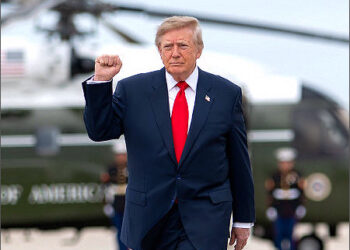


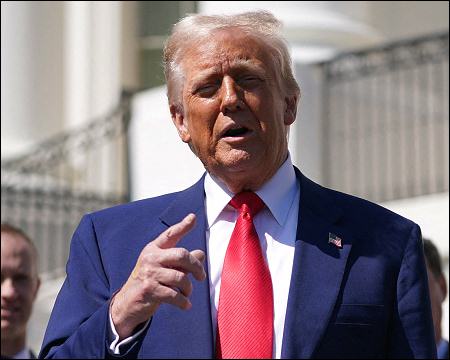
WASHINGTON,— U.S. President Donald Trump announced a temporary halt on most U.S. import tariffs Wednesday, placing a 90-day freeze on duties for more than 75 countries while increasing tariffs on Chinese products to 125%, signaling a focused turn in the country’s trade policy.
China said Wednesday it will raise tariffs on American products to 84%, effective Thursday. The announcement comes on the heels of Trump’s decision to hike tariffs on Chinese imports to 104% earlier in the week, further intensifying tensions between the world’s two largest economies.
The decision came as U.S. financial markets reacted sharply to ongoing trade tensions. The S&P 500 spiked 9.5% shortly after the news, offering a brief reprieve from weeks of volatility.
According to administration officials, the pause is intended to create room for individual trade talks while isolating China as the primary target of U.S. tariff policy. A uniform 10% tariff rate will apply to countries under the pause, a reduction from earlier figures that reached as high as 25% for some allies.
In a message posted online, Trump cited outreach from dozens of foreign governments seeking to avoid escalating tensions. “Because more than 75 countries have reached out and have not retaliated in meaningful ways, I have authorized a 90-day PAUSE,” the president said. “A substantially reduced Reciprocal Tariff of 10% is effective immediately.”
During a press briefing, Trump said the decision was influenced by bond market movements and investor concerns. “I’ve been monitoring this very closely,” he said. “People were getting anxious, and I thought it was time to ease off — not with China, but with others.”
While the president framed the decision as part of a long-considered plan, several members of his team gave differing accounts. Treasury Secretary Scott Bessent, speaking with reporters, emphasized that the change was driven by international efforts to initiate talks. “We’re going to be flexible and negotiate country by country,” Bessent said. “The market situation didn’t drive this.”
That comment was later contradicted by Trump himself, who described recent bond market shifts as a signal of public concern. “The bond market was giving us a warning,” he said, referring to rising yields and falling prices.
Commerce Secretary Howard Lutnick reiterated that talks would be conducted individually and described the new approach as “constructive.”
Notably, Canada and Mexico are excluded from the pause. Both countries remain subject to tariffs up to 25% under a separate directive aimed at stopping drug trafficking, particularly fentanyl.
The White House said negotiations would begin immediately. Press Secretary Karoline Leavitt called the move “strategic,” saying media coverage had misunderstood the administration’s intent. “The world is turning to us — not China — for leadership and access to our markets,” she said.
The head of the World Trade Organization, Ngozi Okonjo-Iweala, warned that continued hostilities between Washington and Beijing risk fracturing global trade systems and harming economic recovery worldwide.
Markets had been uneasy in the days leading up to the announcement. Bond prices had slipped and the yield on the 10-year Treasury note touched 4.45% before easing following the tariff freeze.
Despite the pause, Trump made clear that negotiations are only beginning. “We expect progress, but we’re not done yet,” he told reporters.
(With files from AP | Reuters)
Copyright © 2025 iKurd.net. All rights reserved
Related posts:
 US top court voids Trump’s global tariffs
 Trump signs new global trade tariffs
 Trump imposes tariffs on Mexico, Canada, and China
 China raises retaliatory tariffs on U.S. goods to 84% amid trade war
 Trump’s Tariffs Aren’t a Panacea for the Ailing U.S. Economy
 Trump and China’s Xi meet face-to-face to ease trade tensions
 Business with ISIS – Updated
 KRG, Genel Energy, Tony Hayward and oil deals in Kurdistan
 The Resurrection (Ba’ath) Party – Before the Iran-Iraq War
 Is the BRICS Currency Trustworthy or Just Sophistry?