

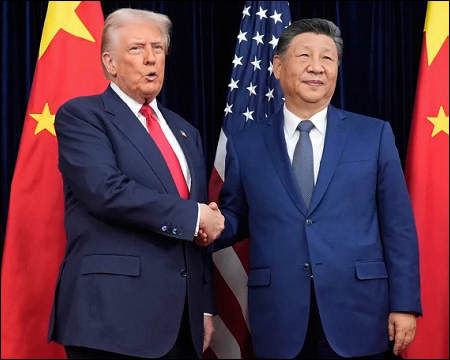
BUSAN, South Korea,— U.S. President Donald Trump met Chinese President Xi Jinping on Thursday in the southern port city of Busan, closing out Trump’s five-day tour across Asia.
The long-awaited face-to-face meeting offered the two leaders a chance to cool tensions and discuss ways to stabilize trade relations after months of escalating disputes between Washington and Beijing.
The talks, held at a South Korean air base, were the first direct encounter between the two since 2019.
Trump told reporters before sitting down with Xi that he was optimistic about reaching a “very successful” outcome but acknowledged that Xi was a “very tough negotiator.”
As the leaders shook hands before the cameras, Xi appeared composed, telling Trump through a translator that it was normal for the world’s two largest economies to experience friction from time to time.
Xi said negotiators from both sides had reached a “fundamental consensus” earlier in the week on key concerns.
“I am ready to continue working with President Trump to build a solid foundation for China-U.S. relations,” Xi said, according to remarks reported by Chinese media.
The meeting came as investors watched closely for signs of progress in the trade standoff that has rattled global markets. China’s yuan climbed to near a one-year high against the dollar as expectations grew for an easing in tensions.
Major stock indexes in New York, Tokyo and elsewhere have recently reached record levels amid speculation of an agreement.
The discussion in Busan coincided with the closing sessions of the Asia-Pacific Economic Cooperation (APEC) summit.
Trump’s team has described the meeting as a potential turning point following reports that negotiators from both countries reached preliminary understandings in Kuala Lumpur earlier in the week.
However, analysts noted that lasting peace in trade relations remains uncertain as both governments continue to compete in areas of economics and security.
Earlier this month, Beijing announced plans to tighten export controls on rare-earth minerals vital for electronics and defense production, prompting Washington to threaten new 100% tariffs on Chinese imports.
Trump also indicated potential restrictions on exports of U.S. software to China, steps that could disrupt global supply chains.
Before his arrival, Trump posted on his Truth Social account that “the G2 will be convening shortly,” referring to the two global powers.
In another post, he said the United States would accelerate nuclear weapons testing in response to China’s expanding arsenal, though he declined to comment further when questioned by reporters in Busan.
Following urgent negotiations over the weekend, U.S. Treasury Secretary Scott Bessent said Washington expects China to delay its rare-earth export limits for one year and to resume large-scale purchases of American soybeans, key to Midwest farmers. “We’ve established a substantial framework for cooperation,” Bessent told reporters, citing what he described as encouraging signals from Beijing.
According to Reuters, China had already purchased its first cargo of U.S. soybeans in several months earlier this week, suggesting renewed momentum toward compromise. U.S. officials said the White House hopes Thursday’s meeting will be the first of several between Trump and Xi in the coming year, potentially including reciprocal state visits.
Trump has pressed for quick results. He said Wednesday that he is prepared to reduce U.S. tariffs on Chinese goods in exchange for concrete steps from Beijing to curb the flow of fentanyl precursor chemicals, which U.S. authorities say contribute to the ongoing opioid crisis.
Trump also said he may finalize a separate agreement with Xi on TikTok, the social media platform facing a potential U.S. ban unless Chinese owners divest its American operations.
Existing trade deals between Washington and Beijing, which had lowered retaliatory tariffs to roughly 55% for the United States and 10% for China, are set to expire on November 10.
Those agreements had also revived shipments of rare-earth magnets essential for manufacturing. Bessent confirmed that China had pledged cooperation on controlling fentanyl chemicals but gave no details on possible U.S. concessions.
Beijing has sought to lift certain tariffs, relax export restrictions on U.S. technologies, and remove port fees imposed on Chinese vessels, which Washington said were meant to address China’s dominance in shipping and logistics.
Trump’s broader Asia tour included signing new resource cooperation pacts with Japan and Southeast Asian nations aimed at reducing reliance on Chinese minerals.
Regional tensions over Taiwan have shadowed the talks. Chinese state media reported that H-6K bombers had recently flown near the island in “confrontation drills.”
U.S. Secretary of State Marco Rubio said Washington’s commitments to Taiwan’s defense remain unchanged under U.S. law and dismissed speculation that Trump might make concessions on the issue.
(With files from Reuters)
Copyright © 2025 iKurd.net. All rights reserved
Related posts:
 US top court voids Trump’s global tariffs
 Trump signs new global trade tariffs
 The New Great Game: An Impending Danger with Serious Global Implications
 China raises retaliatory tariffs on U.S. goods to 84% amid trade war
 The Resurrection (Ba’ath) Party – Before the Iran-Iraq War
 Saddam Hussein was a Friend to the West
 Trump imposes tariffs on Mexico, Canada, and China
 Business with ISIS – Updated
 Trump’s Tariffs Aren’t a Panacea for the Ailing U.S. Economy
 Trump pauses tariffs for 90 days, raises China tariff rate to 125%