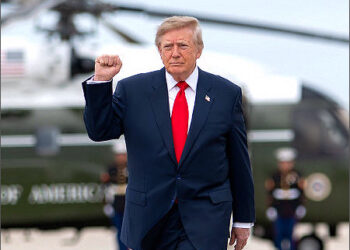



WASHINGTON,— The U.S. Supreme Court on Friday struck down a broad set of tariffs imposed by President Donald Trump under a law designed for national emergencies, delivering a major setback to the Republican leader and raising new questions about U.S. trade policy and the global economy.
In a 6 to 3 decision, the court ruled that Trump exceeded his authority when he used the 1977 International Emergency Economic Powers Act, known as IEEPA, to justify sweeping tariffs on imports from nearly every U.S. trading partner. Chief Justice John Roberts wrote the majority opinion.
The ruling upheld a lower court decision that found the president’s actions went beyond what Congress authorized under IEEPA.
The justices said the law allows the president to regulate certain economic transactions during national emergencies but does not grant the power to impose tariffs.
Chief Justice Roberts wrote that the court’s role was limited to determining whether IEEPA’s authority to “regulate … importation” included the ability to impose tariffs, and concluded that it did not, citing the law.
The U.S. Constitution gives Congress, not the president, the authority to issue taxes and tariffs.
Trump reacted at the White House, calling the ruling “terrible” and “totally defective.” He criticized members of the court who ruled against him.
“I’m ashamed of certain members of the court, absolutely ashamed, for not having the courage to do what’s right for our country,” Trump said.
He added that he has “other alternatives” to pursue tariffs and announced a 10 percent global tariff under a different legal authority, in addition to tariffs already being charged.
Tariffs have been central to Trump’s economic and foreign policy approach. After beginning his second term in January 2025, he expanded trade measures that triggered a global trade dispute, strained ties with trading partners, affected financial markets and increased economic uncertainty.

Trump has said the tariffs are vital for U.S. economic security. On Friday, he said foreign countries that he believes have taken advantage of the United States were celebrating the court’s decision.
The Supreme Court, which has a 6 to 3 conservative majority, had previously allowed Trump to use broad presidential powers in other areas. Friday’s ruling marked the biggest setback he has faced since returning to office.
Joining Roberts in the majority were conservative Justices Neil Gorsuch and Amy Coney Barrett, both appointed by Trump during his first term, along with liberal Justices Sonia Sotomayor, Elena Kagan and Ketanji Brown Jackson.
Roberts cited a prior Supreme Court ruling stating that a president must point to clear congressional authorization to justify extraordinary use of tariff powers. “He cannot,” Roberts wrote.
Justice Brett Kavanaugh dissented, joined by conservative Justices Clarence Thomas and Samuel Alito. Kavanaugh wrote that the ruling does not necessarily prevent Trump from imposing similar tariffs under other statutory authorities.
“In essence, the court today concludes that the president checked the wrong statutory box by relying on IEEPA rather than another statute to impose these tariffs,” Kavanaugh wrote. He added that the decision is not likely to greatly restrict presidential tariff authority going forward.
Trump has imposed some additional tariffs under other laws that were not at issue in this ruling. Government data from October to mid December show those measures represent about one third of the revenue from Trump imposed tariffs.
Trump declared a national emergency over the U.S. goods trade deficit, which stood at $1.2 trillion, to justify action under IEEPA. That deficit rose again in 2025 to a record $1.24 trillion.
Part of the court’s majority said Trump’s interpretation of the law would intrude on Congress’s powers and violate the major questions doctrine.
That doctrine requires actions of vast economic and political significance by the executive branch to be clearly authorized by Congress. The court has used the doctrine in past rulings involving former Democratic President Joe Biden.
Roberts wrote that accepting the administration’s view would expand presidential authority over tariff policy. He said it would replace longstanding executive legislative collaboration over trade policy with unchecked presidential policymaking.
Roberts also noted that no president has invoked IEEPA to impose tariffs of this magnitude and scope.
The case was brought by businesses affected by the tariffs and 12 U.S. states, most governed by Democrats. The liberal justices did not join the section of the opinion involving the major questions doctrine.
Economists had forecast that Trump’s tariffs could generate trillions of dollars over the next decade. The administration has not provided tariff collection data since December 14.
Economists at the Penn Wharton Budget Model estimated that more than $175 billion had been collected under IEEPA based tariffs.
The ruling did not address whether the government must refund tariffs already collected. Trump said refund disputes could take years to resolve in court.
It was not immediately clear when IEEPA tariff collections at ports of entry would stop or how any refund process might work.
(With files from Reuters)
Copyright © 2026 iKurd.net. All rights reserved.
Trump’s Tariffs Aren’t a Panacea for the Ailing U.S. Economy
Related posts:
 Trump signs new global trade tariffs
 Trump imposes tariffs on Mexico, Canada, and China
 The Resurrection (Ba’ath) Party – Before the Iran-Iraq War
 Trump pauses tariffs for 90 days, raises China tariff rate to 125%
 Business with ISIS – Updated
 Trump’s Tariffs Aren’t a Panacea for the Ailing U.S. Economy
 Iraqi Kurdistan – “Sold Out!” – Part II
 American Democracy is on Trial!
 Saddam Hussein was a Friend to the West
 China raises retaliatory tariffs on U.S. goods to 84% amid trade war