


Nemat Sharif | Exclusive to iKurd.net
Reviewed by: Nemat Sharif
Author: Sabri Silaivanayi
Book: 496 pages
Language: Kurdish Kurmanji
First Edition, Duhok, Kurdistan Region, 2016
“The Kurdish Mind” is a truly unique book, if not the first of its kind in the contemporary Kurdish library, especially in the Northern Kurmanji dialect. Two characteristics distinguish this book: the first is its subject (philosophy), which is rarely addressed by writers and readers alike, and is almost exclusively confined to academic circles. This in itself limits the number of readers and those interested in it, despite the fact that it is a vital subject that comes at the forefront of topics that push not only thought but also the language that expresses it forward.
For this reason, the philosopher needs a language with a degree of development, different from the language of narrative and poetic literature, to be able to communicate his ideas to his readers. This is also what another Kurdish thinker, Mohsen Osman, points out in his introduction to this valuable book.
The second is to gradually move from the generalities of philosophy and its European roots, deriving what is compatible with Kurdish thought and comparing them in a way that clarifies the position of the Kurdish mind and reveals the weak points and their causes through adequate comparison and explanation in a smooth and engaging manner for the academic and non-academic alike.
Perhaps this review and others will encourage others, especially non-academics, to read and contemplate its profound ideas, and how much it is need today in the circumstances that bring us to the threshold of great changes if we make good use of it to catch up with other nations.
The book is divided into 18 chapters with a valuable introduction. A review like this cannot fully encompass all its content. These are quick notes to highlight some important ideas. We encourage reading the entire book to appreciate its contents as a shining beacon of Kurdish thought and culture at this juncture in the history of the Kurdish people. Unfortunately, there is no English or Arabic translations of this book.
In the first chapter, the author traces the roots of Western philosophies and their main schools, as if he were writing the first chapter for philosophy students, ‘Philosophy 101’, written to familiarize readers in general with what is to come.
In the second chapter, he moves to the intellectual background of the Middle East through the religious and philosophical heritage. Then, he deduces some important concepts used to clarify the nature of Middle Eastern regimes. He also addresses some of the features of the Kurdistan Regional Government (KRG), including the concept of criticism and its absence.
He says, “The absence of criticism does not create dialogue and discussion, and the absence of dialogue leads to the emergence of some violent means and consequently the emergence of violence. The emergence of a character who sees only two colors, black and white, and among people sees only himself and those who oppose him, and does not see a friend. And this represents the spirit of the Middle Eastern identity that becomes a prisoner of rigid beliefs under the influence and pressure of religion and culture, and this in turn forms a basis for creating A fundamentalist and extremist personality.” (p. 87)
From there, he touches on the concept of psychological complexes, defining them as a psychological state whose source is unknown, but which is built on ideas, positions, and previous events, all of which constitute a driving force for a person to take some strange or contradictory positions.
Among its characteristics is that it does not depend on facts, but rather on names and people, and its belief in them more than its belief in principles, such as believing in a party leader more than its principles. It transfers its problems to the outside by projecting them onto others. He believes that psychologists can treat it, but he overlooks the fact that those in positions of power do not undergo psychological treatment and do not accept it at all because it is considered part of the inferiority complex that Easterners feel regarding mental health and psychological treatment, which, unlike their great interest in physical health, Easterners consider it a personality defect.
On page 93, he applies these two ideas to Kurdish society, saying, “Criticism as a philosophical concept, and as a language and performance can serve society, but Kurdish society, with its morals and upbringing, can manage, perhaps in disguise, these concepts. It is not strange to say that it did not “A concept or component remains unless it falls under the control of authority.” Here, it seems as if the author is excluding Kurdish society from the rule he set for himself (criticism and its function in society), perhaps to avoid other issues.
Here he falls in the ‘management’ of criticism, or what may be called ‘the polite society.’ Alienation (as a result of psychological complexes) comes into play and he attributes this to the fact that a personal, incorrect experience with truth and its essence drives one to estrangement from reality. Thus, the error begins with the misreading and mismanagement of events. As a consequence, and in the absence of scholars and intellectuals in Kurdish society (perhaps he means the greater Kurdish society, not just in Iraq), people turn to clerics.
Therefore, we see the common refrain being, “The imam said,” or “Ask the sheikh or mullah.” He undoubtedly compares the current state of Kurdish society to the pre-Renaissance period in Europe and the conflict between religion and reason (or science). (p. 108) He concludes by saying, “Behavior and events lead religion to a historical and materialistic concept, and then the function of religion becomes questionable. The wrong analysis of religious texts has become a means for the ignorant to believe that one religion is better than another. This is a wrong assessment and a danger to tolerance… Perhaps the problem is not with religion, but some clerics are unable to discover the meanings and viewpoints in religious texts, to ultimately arrive at the true meaning of the text.”
Softening the tone is perhaps to avoid exclusion and clash with clerics as well as society, which still clings to the reins of religion. This compromise is not only to avoid clashing, perhaps it is the nature of reformers. This is at odds with many Western philosophers who have declared their bias towards reason and science over religion and its mystical aspects. Some indeed sacrificed their lives for the sake of change.
This is not a call for such strict behavior, but only to highlight the choices every person and society make at any time. In his analysis, he concludes that “linking the problems of authority to heaven is not in the interest of the people, but in the interest of the authority itself. Truth and accountability in this world are different in the afterlife. Thus, reason refers to the afterlife for the authority, saying, why does it not say… And I ask: Which is in the interest of the people, for the authority to go to hell or to court?” (page 115).

In the chapter on Reason and Identity, the author traces Kurdish identity from the time of the Sumerians and the spread of the Kurds from the Zagros Mountains to the present day, including the genocidal wars they have been subjected to. He concludes by saying, “Despite the [dividing] countries’ use of all means and methods, political and military, against the Kurds, to the point of Anfal (1) and genocide, now they have nothing left but politics and engagement.
Therefore, it is logical that they will not rule out at any time requesting negotiations with the Kurds, and it is best for the Kurds to prepare for that.” Isn’t this happening in northern Kurdistan now! (pp. 150-160). On page 181, he says, “As long as we have not been able to liberate ourselves over the years, we must have a serious reading of our struggle, our means, and our methods, otherwise we will remain backward forever.”
He explains, “For us, the state is a historical process, and it is a right, and a right needs an owner just as much as the owner of the right needs his right. A state built on the law of reason is best, but rational law is also only administered by philosophers and scientists, as Plato and Socrates say.” (p. 226) From this we understand that the state must be built on the basis of the law established by scholars and thinkers, and the authorities must govern in accordance with it.
Once again, the author pauses before reaching a judgment on the KRG. However, we can infer his opinion to some extent when he speaks about Qazi Mohammad’s reliance on tribal leaders and clerics and his failure to enact necessary laws. Does this apply to the current situation, in addition to the corruption and reliance on tribal leaders, some of whom cooperated with the former regime of Iraq?
Among the effects of occupation, the author points to the cultural, intellectual and linguistic effects that left their mark on the Kurdish personality, as happened with the Algerian people under the French occupation, despite its limitations compared to the occupation of Kurdistan, especially in northern Kurdistan.
He says: “The influence of the occupiers of Kurdistan on us reached such an extent that even if we were liberated from them and established our own state, we would not be able to detach from them because of their presence within us through their language and thought. Their thought and language represent two pillars in building the Kurdish personality, and if there is no national strategy, it is not unlikely that they will remain for a long time.” (p. 239) From this standpoint, perhaps the Kurdish person does not feel completely free like other peoples of the world for reasons that control his self and his subconscious mind, and among these reasons: the division of Kurdistan and the long period of occupation until the trait of ‘surrender’ became entrenched in us, or what is called learned helplessness (2) (i.e., a lack of self-efficacy) in clinical psychology.
The tribal social system, which imposed obedience to the tribal leader, as well as the religious ideology used by clerics to enforce their obedience by linking it to heaven (3). Among the manifestations associated with acquired helplessness are pathological manifestations such as depression and domestic violence.
Despite the Kurdish people’s reputation for their harsh mountainous nature and their love of freedom and independence, despite the social and political constraints that bind them, some say about each other that the Kurd fights his neighbor but helps a stranger, a metaphor for tribal conflicts and, in the present era, for party conflicts.
The author devotes two chapters to reason and religion, discussing at length the ideas of renewal and reform in the Middle East and the influence of Europe on Middle Eastern societies, emphasizing religious institutions such as Al-Azhar. He then concludes that “no part of Kurdish society can develop a distinct and independent mind and philosophy because it leaves its fate to the traditional mind” (p. 308).
He continues his research by saying, “Dealing with dialectics is sufficient to ensure that everyone gets what they deserve, but in return, the individual does not reach complete conviction… Before the Renaissance in Europe, religion was related to politics, and the Church had become a source of political will, but now in the Middle East, religion is not only related to politics, but religion has become politics” (p. 310).
We deduce from this that the author, despite his inclination toward materialistic philosophies, is not completely convinced by them, just as is the case with his lack of belief in radical change. He takes the path of reform to achieve his goal of bringing about social change.
This perhaps explains his statement on page 333, “Society does not allow the individual to use his individual mind, but dictates that he uses the traditional mind. Therefore, the individual tries to harmonize with it because he believes that harmony is better than alienation, especially intellectual alienation, and this in itself is a disease from which a large part of Kurdish society groans.”
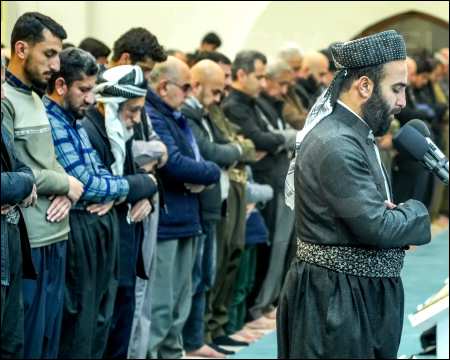
In the next two chapters, the author discusses in some detail the concepts of nature and matter and stimulating the mind to understand them, saying, “For example, only after the congregational prayer ends at that time, and each worshiper goes his own way, and this is natural, but it is unnatural for each element (spirit, mind, thought, soul) to detach to go its own way and for each worshiper to go his own way (disconnection of selves equals disconnection of elements).
The inner unity of the Kurdish individual has not yet been achieved for him to be able to believe in it objectively. Presence or non-presence in a time, place, and occasion (prayer, meeting, or appointment, etc.) is only the meeting of the body (matter). When two meet, they are physically close, but in thought, each one is in another place.” (p. 346)
On page 357, the author discusses the concepts of divine command and divine will and links them, similar to what Dr. Sadiq Jalal al-Azm did in his book, Critique of Religious Thought (4), in the chapter on the tragedy of Lucifer, and he expands the concept of Lucifer to include, for example, a dictator or someone similar to him in inhuman behavior.
For example: Dictators use religion as a pretext for domination, as ISIS did, and they use clerics for this, as was the case in Europe before the Renaissance and is still prevalent in the Middle East. If we say that it is God’s will, this exonerates the dictator from his crimes on the Day of Judgment, and his defense is that he was performing a divine mission.
In this case, it is similar to the case of Lucifer, according to Dr. Sadiq Al-Azm, who points out that all verses of the Quran that curse Satan are limited to, for example, “until the Day of Judgment, or to the Day of Judgment…” In other words, his divine mission ends with the coming of the Day of Judgment, and he returns to God’s mercy, innocent because he was acting according to His will and desire.
His refusal to prostrate to Adam was nothing but disobedience to a divine command, not a departure from God’s will. This is impossible because it goes against God’s beautiful attributes, including the attributes of justice and power (meaning strength and dominance) over the universe. God Almighty cannot be unjust, and there are no limits to His power and might. But if neither the devil nor the dictator is performing a divine mission, then the entire pretext falls apart.
The last two chapters on culture, writing, reason, and politics are the important chapters, and anyone interested in culture and politics and their role in Kurdish society should read them carefully, although I recommend reading the entire book. On page 371, the author says, “The loss of privacy and the lack of identity are the reasons why the Kurdish writers have not yet made a healthy presence in institutional structures (perhaps referring to professional organizations or government forums),”since writing has a vital and direct relationship with society.
He continues on page 373, “We need readers because we see ourselves in them. But if he also needed us and our writings, and saw himself in them, he would not have withdrawn so easily from the world of reading as a reaction or self-defense, nor would he have been defeated by writing.” Here we cannot but agree with the author about the role of Kurdish intellectuals and writers after the 1991 uprising.
After more than thirty years, the Kurdish intellectuals and writers have not only been unable to assume a leading role in educating the masses and mobilizing them for the requirements of this phase, but their role has noticeably diminished in terms of interacting with society, educating and mobilizing it for the next phase.
Without mentioning names, there are those who neigh with their poems, reap the profits of their writings, but ignore the suffering of their people. They are, as the Arab proverb says, ‘As deaf in a rowdy procession’. They condemn themselves to death while still alive. “…the responsible elite, the one with principles and morals, can, with their strength (science and knowledge), determine some directions for their people and draw a road-map for them.” (p. 390).
On pages 407 and 410 he says, “The individual is not free to resort to supernatural forces or culture. In most cases, he resorts to active forces, and so far, supernatural forces are the active forces in the East. Therefore, culture has not become an independent force and is perhaps in the beginning of its formation… In the past twenty-five years, in my opinion, culture has been dead asleep, unaware of what the winds of time will bring, and in conjunction with the political and social changes that have taken place in the Middle East, we have not heard the voice of our culture to know that it is ready.”
The author begins the chapter on reason and politics with a frankness not seen in other chapters. He declares that as a people we have not read our history enough because any people who understand their history must learn from their mistakes, or at least not repeat them.
He continues, “…It is regrettable that our politicians have not been able to keep up with the politics of the contemporary international community. They practice politics with the mentality of power and not with the power of reason, which has no relation to thought, philosophy, or science… If we had a correct political thought, we would be able to understand politics correctly. Politics as thought, philosophy, and science has not yet been consolidated. This does not diminish our value as human beings, but it affects our relations as a region and a people with politics and political players. History proves that we have not become a political player at a political level. We are still a political card.” (Page 416)
The author continues to list the schools of thought, including the Islamic one, on managing the reins of government and its goals, and then compares them to the practices of Kurdish politicians, both inside and outside the Region.
To conclude this quick review is best with the author’s own words: “…the goal of politics is stability, growth, development, and serving the people. But in our world, people are always wary and fearful that a politician will come along and cause them problems because the goal is different… Politics is not the same as party affiliation. A person can belong to a party, but that doesn’t mean he is a politician. This has confounded the practical Kurdish mind. This is also the case with the issue of culture, as if every intellectual is a writer or journalist! It is clear that knowledge is one thing and pretending to know it is another. It is time to move away from pretending to know all fields, especially politics, and to learn diligently so that we don’t get behind any further as we are already behind.”
Before concluding, I must make a few quick technical observations: The author skillfully organizes his main ideas by numbering the main paragraphs of each idea, and then uses footnotes to identify the philosophers and thinkers whose ideas he drew upon in his research.
This contributes to the organization of the content for easy reading and . As for the rest, I think it’s up to the publishing house, including editors, technicians, artists, and others. What particularly caught my attention was the book’s lack of indexes, as they are important, especially for readers, researchers, and others, to help them refer to names, ideas they wish to review, especially in a book of this length, including tables of contents, media, and others.
We hope that we shed some light on this valuable effort in serving the Kurdish library and the Kurdish people, and in encouraging more conscious young people to read this valuable book.
Notes:
(1) Anfal operations: Iraqi military campaign led by Saddam Hussein’s cousin against Kurdish civilians to depopulated major strategic areas of Kurdistan. It lasted from February to September of 1988. The Ba’athist regime committed atrocities killing an estimated 180 thousand Kurdish civilians. The campaign’s name was taken from the title of the eighth chapter of the Qur’an (al-anfal).
(2) Learned helplessness is related to the concept of self-efficacy, the individual’s belief in their innate ability to achieve goals. Learned helplessness theory is the view that clinical depression and related mental illnesses may result from a real or perceived lack of control over the outcome of a situation.
(3) In psychoanalysis (Freudian), the flow of self-energy, driving liberation and perhaps even anarchy, is domesticated, as society requires, by a component called the “ego.” In Islamic terminology, this corresponds to the spirit, which defines what the human soul considers to be evil.
(4) Azm, Sadiq Jalal Al-, Dr, Criticism of Religious Thought, Second Edition 1970, Al-Tali’ah House, Beirut, Lebanon. Dr. Al-Azm, (1934 – 2016), a Syrian professor, was tried in Lebanon where he taught at the time because of his writings.
Nemat Sharif, a political analyst, a contributing writer and columnist for iKurd.net.
The opinions are those of the writer and do not necessarily represent the views of iKurd.net or its editors.
Copyright © 2025 iKurd.net. All rights reserved
Related posts:
 The Kurdish Diplomacy: Historical, Political, and Legal Explanation – Book Review
 The Resurrection (Ba’ath) Party – Before the Iran-Iraq War
 Ocalan’s Secular Lens on a “Democratic Islam”
 The Double Cross of Iraq And The Discordant Death of WMD Inspector, Dr David Kelly – The 17th Anniversary
 The Syrian Al-Jazeera Province: An Ethnic, Social and Political Study – Book
 The Truth About The Saddam Hussein Affair
 The Mustashar and the Jash – A View from the Position of ‘Iraqi National Unity’ on the ‘Descendants of Treason’
 The Shabaks Between a Rock and a Hard Place – Book review
 The PKK’s Personality Cult: Changing Influences – Part II
 Iraqi Kurdistan – “Sold Out!” – Part II