

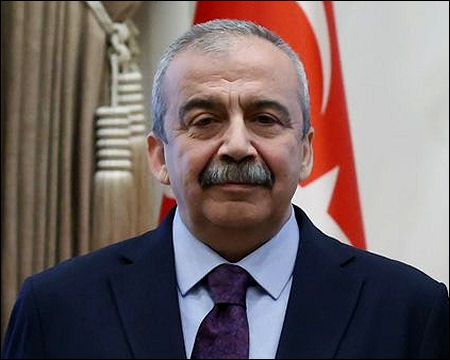
ISTANBUL,— Sırrı Süreyya Önder, a Turkish-Kurdish parliamentarian and one of the most recognizable figures involved in early peace efforts between the Turkish state and the Kurdistan Workers’ Party PKK, died on Saturday in Istanbul. He was 62.
The cause was multiple organ failure, according to a statement issued by Florence Nightingale Hospital, where Önder had been under intensive care for 18 days following a heart attack. He died at 4:10 p.m. local time.
Önder was a senior member of the Peoples’ Equality and Democracy Party, known by its Turkish acronym DEM, and was serving as a deputy speaker of the Turkish Parliament at the time of his death.
A prominent voice for dialogue during one of Turkey’s most sensitive political chapters, he became widely known for his role in outreach efforts to the leadership of the PKK, a group long designated a “terrorist” organization by Turkey and several Western governments.
“The path of peace that he championed, even in the face of risk and repression, is a legacy that must be preserved,” the DEM Party said in a statement confirming his death.
Born on July 7, 1962, in the southeastern province of Adiyaman, Önder spent much of his life at the intersection of politics and culture. He was not only a lawmaker aligned with pro-Kurdish movements but also a filmmaker, screenwriter and columnist.
His political ascent came amid a period of cautious optimism. As part of a team informally known as the Imralı delegation — named for the island prison where PKK leader Abdullah Öcalan is held — Önder helped broker communication between Turkish authorities and the PKK leadership during preliminary negotiations aimed at ending decades of conflict. That conflict has resulted in more than 40,000 deaths since the 1980s.
In February 2025, the DEM Party released a letter from Öcalan, in which he urged the PKK to disarm and disband.
The letter was interpreted as a significant gesture toward reconciliation. In response, the PKK declared a unilateral ceasefire and announced plans for a congress to discuss its future course, while also demanding Öcalan’s release to participate in the process.
Reactions to Önder’s death came from across Turkey’s political divide.

Devlet Bahçeli, the leader of the far-right Nationalist Movement Party, described him as a man who “brought together art and political struggle” and called his legacy one of “dignity and sensibility.” He added that a future free of terrorism would be a “tribute to his memory.”
Özgür Özel, chairman of the opposition Republican People’s Party, reflected on Önder’s time in prison, saying he had “endured injustice in pursuit of peace.”
Önder had previously served time in prison following the 1980 military coup. In 2018, he was convicted alongside Selahattin Demirtaş on charges of spreading terrorist propaganda. Both were later released after a court found their freedom of expression had been violated.
Funeral arrangements had not been announced as of Saturday evening.
(With files from Agencies)
Copyright © 2025 iKurd.net. All rights reserved
Related posts:
 Turkey: The Psychological War Against the Kurds Through the PKK – Part I
 The PKK’s Personality Cult: Changing Influences – Part II
 Business with ISIS – Updated
 The Resurrection (Ba’ath) Party – Before the Iran-Iraq War
 What makes a good NATO ally? The Case of Turkey
 Distorting the Kurdish Question in Turkey
 There is no hope in Ocalan’s unilateral peace initiative
 Can Apo Save The Kurds?
 Can Abdullah Ocalan be a better leader than Mustafa Barzani?
 Turkey: Nato’s Islamic State Member