

The end of the PKK and its effect on the SDF/ Decentralized the Syrian system is not a division
Serwan Zangana | Exclusive to iKurd.net
It was a joyful ceremony for some Kurdish leaders as the Kurdistan Workers’ Party (PKK) began its disarmament process with the first group of 30 guerrillas on July 11, in Dukan, Sulaimani, surrendering their weapons and duty belts, dumping and burning them in a big cauldron.
And it was beyond joy for the Turkish politicians, indeed, in their definition it was an achievement and a victory over terrorism as the Turkish President, Recep Tayyip Erdogan said that the 47-year-long scourge of PKK terrorism is ending.
The (PKK) leader, Abdullah Ocalan’s peace project with Turkey is similar to one-sided love, in which one side is affectionate and the other side has a different purpose and aims for a different goal. Erdogan has always opposed Kurdish autonomy in Turkey as he believes that the Kurds are a part of the Turkish nation. “Today the doors of a great Turkey, a strong Turkey, a Turkish century have been opened wide,” Erdogan said.

The (PKK) leaders are idealistically approaching Turkey and embracing Erdogan hoping for engagement in the political process in Turkey. It is another sweet dream that the Kurds are surrendering to in order to ignore the nightmare of the reality of the Turks. However, ending the (PKK) is empowering Erdogan and changing the definition of Kurdish rights, not only in Turkey but also in Syria.
Obviously, the U.S. is shifting direction in Syria and changing its language with the Kurds subsequent to the (PKK)’s disarmament and the U.S. relationship with the new Syrian government. In fact, the armed struggle of the (PKK) in the region had an impact, regardless of its degree, on Turkey and the U.S. And now with the (PKK)’s last breath, Turkey is taking a deeper breath and the U.S. is changing a card to play a different game with the Kurds.
Ending the armed struggle of the (PKK) will definitely invigorate Turkey politically, and perhaps, economically; since the conflict began in 1984, according to the Turkish Minister of Treasury and Finance, Mehmet Şimşek, it has cost the country an estimated $1.8 trillion.
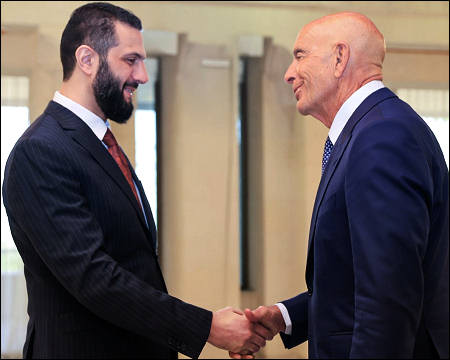
Moreover, the U.S.’s true color can clearly be seen as its foreign policy began to produce another drama in the region. Apparently, Winston Churchill’s famous quote will always apply to the life of politics as he said, “We have no lasting friends, no losing enemies, only lasting interests.” The U.S. is embracing the new Syrian government and kissing its old enemy, Ahmed al Sharraa, and leaving the Kurds behind. It is not a deja vu, it is the ugly face of U.S. foreign policy.
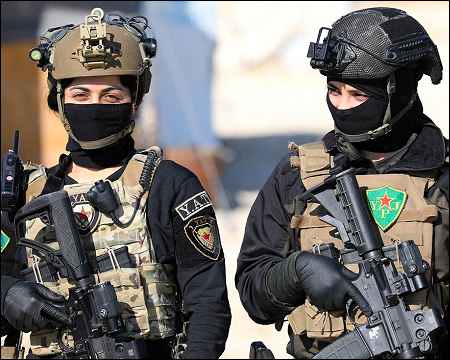
Obviously, the U.S. ambassador to Turkey and envoy for Syria, Tom Barrack, clearly said that the Syrian Democratic Forces (SDF) are “YPG, a derivative of the PKK,” which means that the U.S. at any time can officially designate the group as a terrorist organization the same way as it did with the (PKK). Barrack bluntly said that the U.S. will not support the “free Kurdistan” in Syria.
The question is: Can U.S. foreign policy be designated as one of the most unethical policies in the world?
Barrack did not hesitate to say that regardless of the Syrian Kurds’ fight alongside the U.S. against the Islamic State (ISIS), and the sacrifices the Kurdish fighters made, “We don’t owe them the ability to have their own independent government within a government.”
The Trump administration is weighing its interests in the region and evaluating the profits based on give and take, and as of now, Al Sharaa is the best option for the U.S. Evidently, for Trump, it is about an extreme business for the U.S. and his personal gain, and his strategy is based on financial profits.
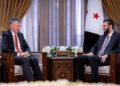
Also, the Syrian government is striving to reconnect with the U.S. and build a bridge between the two. That is why the idea of building Trump Tower in Syria has risen to show Trump that he is welcomed in the country. This will be an important step for Trump to establish businesses and access Syrian natural resources to add more to his capital gain. Obviously, now, Ahmed al Sharaa can offer more businesses than Mazloum Abdi to the Trump Administration.

Apparently, Barrack, as a typical U.S. politician, reversed his quote about the (SDF) as a derivative of the (PKK), “It’s not unthinkable that whoever the constituency is for the YPG or the SDF has distanced themselves from the PKK. So, I don’t think it’s a derivative. It’s another organization.” He said afterward.
However, Barrack is gradually distancing the U.S. from the (SDF) and leaving the group in the middle of the intersection to decide which direction to take.
Seemingly, the U.S.’s support for (SDF) is on the verge of ending since the Syrian government is being a new ally. But Barrack believes that the Syrian military is incapable of defending the country, and thus, he suggested incorporating the (SDF).
The U.S. relationship with Turkey can be observed throughout history as both are sharing interests. Turkey has always been involved in the region and attempted to influence the neighboring countries, and the U.S. has continued to create chaos and conflicts in order for its presence to be needed, and neither one has been concerned about the consequences of their catastrophic actions as the result of their policies in the region. Therefore, both the U.S. and Turkey will either directly or indirectly be involved in Syria, and the U.S. military presence will continue.
Unsurprisingly, as part of the Trump administration, Barrack praised the Turkish government for its role in the ongoing conflicts of Ukraine-Russia and Israel-Hamas. “I have to say, I’m extremely proud of the role that Turkey has played in all of these instances,” Barrack said.
However, Turkey has harshly opposed Israel in the past. As in March, 2025, in an address, Erdogan said, “We see and know what is happening in Palestine, and may God Almighty, with reverence to his name, make Zionist Israel destroyed and devastated.”
The U.S. foreign policy has always been generating crises in the Middle East, and with no alternative to the U.S., the region is remaining under the mercy of such policy. Obviously, the Trump administration has brought a new storm to the Middle East, which could be observed since day one of Trump’s presidency. But after all, the ambiguity of Trump’s administration in general impedes the predictability about the next step in the relationship with the U.S.
The (SDF) is coming under new pressure as the U.S. is raising a yellow card and setting up a time limit for the group to agree on issues and integrate with the new Syrian government. “I think issues that will arise are they’re going to have disagreement with the Syrian government, they’re going to have disagreement with the Turkish government,” Barrack said.
This means that if the (SDF) does not agree on the offering from those governments, the U.S. will not be involved. However, Barrack believes that there will be an agreement. But the question is: If all sides agree, will the (SDF) achieve its goal, or will it compromise?
The (SDF)’s main goal is the decentralization of the Syrian system to entitle the Kurds to live in an autonomous region, but the Syrian government, Turkey, and the U.S. are opposing such a system, believing this would create a division in Syria, which is totally far from the fact.
Serwan Zangana, a contributing writer for iKurd.net, lives in Virginia, U.S. He serves as a correction officer.
The views expressed are solely those of the author and do not necessarily reflect the opinions of iKurd.net or its editorial team.
Copyright © 2025 iKurd.net. All rights reserved
Related posts:
 Business with ISIS – Updated
 What makes a good NATO ally? The Case of Turkey
 Turkey: The Psychological War Against the Kurds Through the PKK – Part I
 Turkey: Nato’s Islamic State Member
 Interview with Kurdish hostage, Huseyin Baybasin
 Syria: A ‘Caliphate’ by Any Other Name — Would Smell the Same
 Betrayal by the Rogue State of America – The Bull in the China Shop
 “ISLAMBUL”
 Martyrs for Millionaires: The Black-Market Politics behind the Theft of Syria’s Oil
 The PKK’s Personality Cult: Changing Influences – Part II