

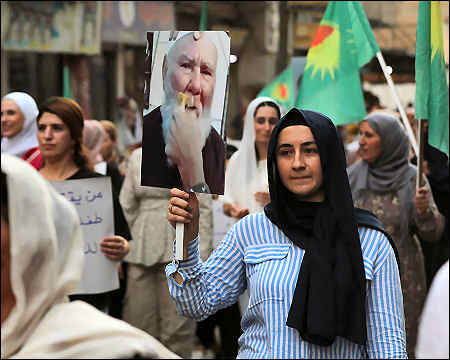
DAMASCUS,— Syria’s electoral commission announced Saturday that plans to select a transitional parliament next month have been delayed in three provinces, including Druze-majority Sweida and two Kurdish-majority provinces in Syrian Kurdistan, because of security concerns.
The decision affects Druze Sweida in the south, along with Raqa and Hasaka in Syrian Kurdistan (Rojava), according to the state-run SANA news agency.
Syria is set to hold its first parliamentary elections under the new Islamist-led administration in September.
Organizing committee member Nawar Najmeh said the move comes “until appropriate conditions and a safe environment are in place.”
The transitional legislature was originally scheduled to be formed between Sept. 15 and 20. Under the plan, two-thirds of the 210 members will be selected by local councils, while Syria’s interim president, Ahmed al-Sharaa — also known as Abu Mohammed al-Golani — will appoint the remainder.
Syria has been under interim rule since December, when forces ousted longtime leader Bashar al-Assad.
The new authorities dissolved the old parliament and adopted a temporary constitution meant to guide a five-year transition.
Critics argue the charter centralizes power in Sharaa’s hands and does little to reflect the country’s ethnic and religious diversity.
Najmeh said the delay is linked to “security challenges” in those provinces and aims to ensure fair representation.
Seats for Sweida, Raqa, and Hasaka will be reserved for later appointment, he added. The selection process will proceed only in areas under government control.
The transitional body will serve a renewable 30-month mandate.
Sweida has seen a wave of unrest in recent months. Deadly sectarian clashes erupted there in July, and access to the province remains difficult amid ongoing tensions.
Talks to merge Kurdish institutions with the central government under a deal reached on March 10 have stalled over disagreements.
The Kurdish-led autonomous administration, formally established in 2018, promotes a model of self-governance based on direct democracy, gender equality, and secularism.
On Aug. 18, hundreds of demonstrators waving Druze and Israeli flags rallied in Sweida city and nearby towns, calling for self-determination for Syria’s Druze community. Activists described it as the largest protest since last month’s clashes.
In March 2025, Syria formed a new transitional government without Kurdish representation.

Hundreds of delegates from Syria’s ethnic and religious communities urged the creation of a decentralized state and the drafting of a new constitution guaranteeing pluralism, at a conference held on August 8, 2025, in Syrian Kurdistan.
The one-day meeting took place in Hasaka, a city under the control of the Kurdish-led Autonomous Administration in Rojava Kurdistan.
Organizers said roughly 400 representatives of minority groups, including Kurds, Christians, Alawites, and Druze, attended the gathering.
Participants said the move was aimed at safeguarding the rights of Syria’s diverse communities after years of conflict and political upheaval.
In a closing statement, delegates condemned recent attacks by pro-government armed groups against minorities, describing the incidents as crimes against humanity.
The conference called for a political system that ensures cultural and religious rights for all Syrians.
Delegates called for a federal or decentralized structure as a basis for long-term stability.
(With files from AFP | Agencies)
Copyright © 2025 iKurd.net. All rights reserved
Related posts:
 Syria withdraws forces from Druze city of Sweida after Israeli strikes
 The Resurrection (Ba’ath) Party – Before the Iran-Iraq War
 Druze in Syria’s Sweida besieged months after clashes, Israeli Druze leader says
 Druze, Syrian govt militias clash amid ceasefire violation claims
 Israel strikes Syrian government forces in Druze city of Sweida
 Business with ISIS – Updated
 Syria’s Sharaa urges Bedouins to uphold ceasefire with Druze
 Syria: Revisiting The Caesar Torture Victim Photographs
 Syria: The Hijacking of the Arab Spring: From ISIS to Hayat Tahrir al-Sham
 Druze leader urges int’l probe into Syria’s deadly Sweida clashes