


How the Barzanis Used Pirate Names to Hide $100M
Kurdish Pirates of the Caribbean in America
NEW YORK,— The Barzani family is synonymous with political power in Iraqi Kurdistan. Now, a leaked cache of documents reviewed by the Organized Crime and Corruption Reporting Project (OCCRP) and shared with partners shows how five of Massoud Barzani’s sons, all either senior officials or close to power, quietly expanded their wealth far beyond Erbil.
According to OCCRP, the brothers spent at least $100 million in the United States on luxury homes, commercial properties and high-end goods, using offshore companies and funds that appear tied to Kurdish conglomerates with government contracts.
The records, covering nearly two decades, reveal how the Barzanis built a financial empire in America while leading a region still struggling with corruption, economic crises and public frustration over inequality.
Buying Properties Coast to Coast
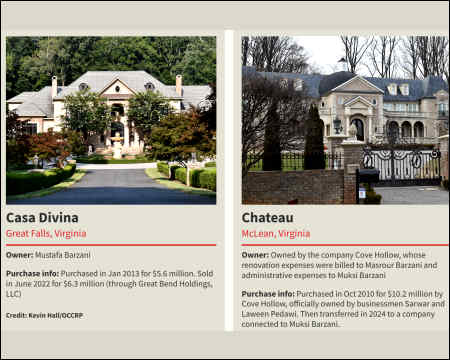
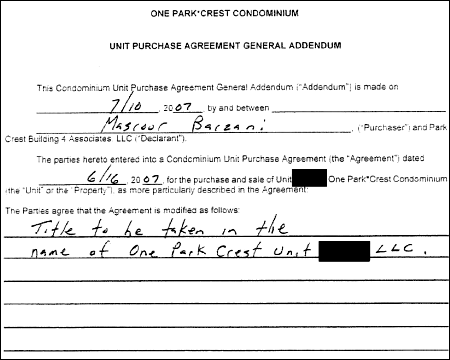
The leaked documents detail how the Barzanis acquired 31 properties across the United States between 2005 and 2019, worth more than $100 million. The holdings included a six-bedroom mansion in the Washington, D.C., suburbs, multiple apartments near the capital, and commercial buildings in Florida, Texas and California that hosted chain restaurants and shops.
The acquisitions were managed through U.S. companies registered in Delaware and Virginia, often owned by offshore firms in the British Virgin Islands. Each of these offshore entities carried names drawn from the Pirates of the Caribbean film franchise, with one company titled after “Jack Sparrow” and another after “Edward Teague.”
At least 13 of the American properties have since been sold, while 18 remain under companies still active on public registries.
How the Money Moved
OCCRP found that at least $28 million of the family’s spending came from two conglomerates with operations in Iraqi Kurdistan.
More than $10 million was traced to Golden Eagle Global, a firm involved in construction, advertising and military supply contracts. Leaked documents suggest the company was secretly controlled by Mustafa Barzani (also known as Babo Barzani), the youngest brother.
Another $18 million originated from Ster Group, a conglomerate described in the documents as being under the influence of Masrour Barzani, who is now prime minister of the region.
Beyond those transfers, ledgers showed additional family spending on high-value purchases such as a Ferrari Spider, a piano costing nearly $100,000, Arabian horses, jewelry and handbags. Payments also covered American Express “black card” balances, nanny services, and private school expenses.
Offshore Structures for Secrecy
Lawyers working for the Barzanis designed a layered corporate structure to keep their names off U.S. public records. In 2007, after concerns that property records listed family names, legal advisers created a web of companies in the British Virgin Islands. Those offshore firms then owned Delaware or Virginia companies, which in turn held property deeds.
Internal memos show that this system was intended to maintain confidentiality and avoid scrutiny under “politically exposed person” rules, which require extra checks for relatives of senior officials.
Role of Golden Eagle Global
Golden Eagle Global, known in Kurdistan for construction and advertising contracts, also supplied vehicles, helmets and boots to Kurdish security forces and handled contracts with the U.S. military.
Leaked corporate agreements list associates acting as “nominees” for Mustafa Barzani (Babo Barzani), pledging to follow his instructions as the actual owner. Company bylaws named him chairman, and internal emails from U.S. lawyers referred to Golden Eagle as the “family business.”
A related entity, Golden Eagle Global Inc., registered in Delaware, was originally described as a subsidiary of the Kurdish firm. Leaked documents show that in 2021 its shares were transferred to Mustafa Barzani and an associate for nominal sums. Another company, GEGI Management LLC in Washington, D.C., was created solely to receive Barzani family funds and pay U.S. property expenses.
According to a 2020 internal memo, this account routinely paid costs ranging from luxury shopping to hospital bills. In 2023, for example, it covered a $41,000 fee to a nanny placement agency.
Ster Group Transfers

The second major funding source was Ster Group, a Kurdish conglomerate that expanded rapidly after 2003. Once known for distributing Coca-Cola products and building Erbil’s first skyscraper, Ster also entered telecommunications, oil and other sectors.
According to leaked correspondence, Ster Group or its owners transferred more than $18 million for Barzani family purchases. Wire receipts documented $7.2 million, while letters from the family’s U.S. law firm referenced an additional $11.1 million.
In 2008, Ster was described in emails as “Masrour Barzani’s overseas company.” Draft letters suggested that Ster and U.S. firms buying property on his behalf were “under common control.”
Ster also provided funds for luxury purchases, including a Ferrari for Mustafa and Lalique crystal objects.
Conflicts of Interest
Analysts who reviewed the documents said the findings highlight concerns about conflicts of interest. Iraqi law requires officials to disclose assets and business ties, but enforcement is weak.
“The financial flows appear to blur the line between public duties and private wealth,” said Jodi Vittori, a professor at Georgetown University.
Former U.S. official Stuart Bowen said the spending stood in stark contrast to the lives of ordinary Kurds, whose average monthly income is little more than $500.
Family Ties and Political Power
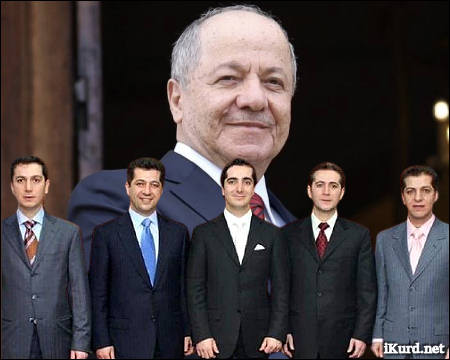
The Barzani family has dominated politics in Iraqi Kurdistan for decades. Patriarch Massoud Barzani led the region as president until 2017 and continues to head the Kurdistan Democratic Party. His sons hold or have held senior posts:
-
Masrour, 56, became Kurdistan prime minister in 2019 and was formerly head of intelligence.
-
Waysi, 50, has advised the region’s Security Council.
-
Mansour, 52, commanded special forces.
-
Mustafa, 44, has been active in regional administration.
-
Muksi, 53, lives mainly in the United States and made the largest property acquisitions, worth nearly $60 million.
The leaked records show that all five brothers held U.S. residency rights through citizenship, green cards or visas.
Properties in Washington and Beyond
The Barzanis concentrated many acquisitions in and around Washington, D.C., particularly in McLean, Virginia, near CIA headquarters. Several homes were gated and guarded.
One of the most prominent was Casa Divina, a mansion on five acres in Great Falls, Virginia. Purchased in 2013 for $5.6 million by a company tied to Mustafa Barzani, the home featured a cinema, classical columns and luxury furnishings. He sold it in 2022 for $6.25 million.
Other investments included commercial buildings in Miami Beach, Detroit, and multiple fast-food franchises.
Lawyers’ Responses
Lawyers for Prime Minister Masrour Barzani said he “vehemently rejects” any wrongdoing and pointed to anti-corruption initiatives he launched. They said there is nothing unlawful about owning property abroad and that wealthy individuals often rely on corporate structures for privacy and security.
Attorneys for Ster Group’s former owners said the transfers represented legitimate currency exchanges and were legal. They denied acting as fronts for the Barzanis.
Repeated requests for comment to the other Barzani brothers, as well as to Golden Eagle, Ster Group, and related advisers, went unanswered.
Political Context
The Barzanis’ dominance in Iraqi Kurdistan dates back to Massoud Barzani’s father, a tribal leader who fought Baghdad for decades. After the 1991 Gulf War, Kurdish authorities gained autonomy under international protection. Following the 2003 U.S. invasion, the region deepened its ties with Washington, receiving military and financial support.
Today, the family maintains close relations with American policymakers. Masrour Barzani visited Washington in 2025 to announce new energy deals. Members of Congress, including Michigan Senator Elissa Slotkin, emphasized the Kurdish role in fighting the Islamic State.
A Network Still Intact
While some of the Barzanis’ U.S. properties have been sold, leaked documents show that at least 18 remain under companies created through their offshore network.
In total, OCCRP calculates that the family spent at least $100 million in the United States on real estate and luxury items between 2005 and 2019. The disclosures raise unresolved questions about conflicts of interest, transparency, and the intersection of politics and private wealth in Iraqi Kurdistan.
Kurdish Region’s Reputation for Corruption

Iraqi Kurdistan is widely regarded as one of the most corrupt regions in Iraq. According to watchdog organizations, Kurdish lawmakers, and leaked financial records, billions of dollars from oil revenues are unaccounted for.
Local and international analysts say the absence of effective oversight and control mechanisms has turned the region into an environment that facilitates illegal financial activities by ruling elites. Observers note that wealth accumulation often appears to benefit a small circle of leaders rather than the broader population.
The Barzani family, which has dominated regional politics for decades, is frequently described by critics as a “Kurdish oligarchy.” Reports and watchdog analyses suggest that members of the clan have used their positions to amass substantial fortunes, particularly from the oil sector, while ordinary citizens see little benefit.
Massoud Barzani remains, according to analysts, the most influential figure behind the scenes, guiding the family’s political and economic decisions. His son, Masrour Barzani, serves as the region’s prime minister, while his nephew, Nechirvan Barzani, holds the presidency. Together, the family continues to exercise substantial control over the Kurdistan Regional Government and its economic resources.
The $100 million revealed by OCCRP represents only a fraction of the estimated wealth the Barzani family has accumulated over the years, much of it derived from oil revenues and public funds, critics say, highlighting the extent of systemic corruption in the region.
To read the full report reported by Zack Kopplin, Government Accountability Project, and Kevin G. Hall from OCCRP, please visit the OCCRP.
The Organized Crime and Corruption Reporting Project (OCCRP) is a United States non-governmental organization that fosters investigative journalism.[1] It was founded in 2006 and specializes in organized crime and corruption.
Copyright © 2025 iKurd.net. All rights reserved
Yasser Barzani appears in Monaco with high-end Lamborghini amid Kurdistan’s salary crisis
Related posts:
 Iraqi Kurdistan: The Emperors’ New Clothes
 Business with ISIS – Updated
 Iraqi Kurdistan – “Sold Out!” – Part II
 The Mustashar and the Jash – A View from the Position of ‘Iraqi National Unity’ on the ‘Descendants of Treason’
 Iraqi Kurdistan – “Sold Out!” – Part III
 Iraqi Kurdistan has better individuals than Massoud Barzani to lead
 Masrour Barzani tried buying U.S. zero-click spyware, faces lawsuit: report
 The Resurrection (Ba’ath) Party – Before the Iran-Iraq War
 Biggest media and political lies in Iraqi Kurdistan in 2025
 Massoud Barzani between corruption, political crisis, and psychology behind his actions