

CAIRO,— Egypt has opened the long-awaited Grand Egyptian Museum, a massive new complex near the Giza Pyramids designed to showcase the nation’s ancient treasures and reinforce its role as a global tourism hub.
The inauguration on Saturday came with a display of pharaonic imagery and a high-tech drone show that illuminated the sky with depictions of ancient deities and pyramids.
The event marked the culmination of a project that has been in progress for nearly twenty years, delayed by political and economic turmoil.
President Abdel Fattah el-Sissi, who presided over the ceremony attended by world leaders and royal families from Europe, the Middle East, and Asia, described the museum as a new chapter in cultural dialogue.
He told guests the site should serve as “a platform for knowledge and a symbol of humanity’s shared heritage.”
Construction of the Grand Egyptian Museum, or GEM, began in 2005 during the presidency of Hosni Mubarak.
The project, valued at around $1 billion, was repeatedly postponed after the 2011 uprising and subsequent unrest. Work resumed under el-Sissi’s administration as part of a broader drive to modernize infrastructure and revive tourism, a key source of foreign currency.
Located two kilometers from the Giza Pyramids, the vast facility spans over 24,000 square meters of exhibition space.
Officials say it will display about 50,000 artifacts, including the complete collection of objects found in the tomb of King Tutankhamun — presented together for the first time since their discovery in 1922.
The new building, with a glass façade echoing the geometry of nearby pyramids, replaces the century-old Egyptian Museum in downtown Cairo, which had become overcrowded and outdated.
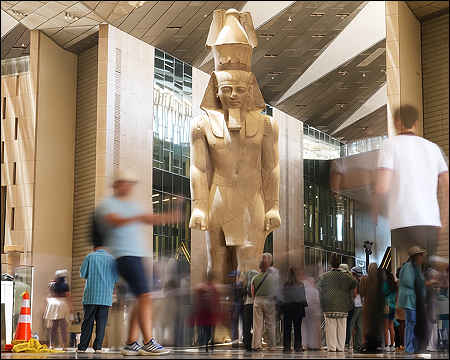
Visitors enter the museum through a large atrium dominated by a granite statue of Ramses the Great, who ruled from 1279 to 1213 B.C. Twelve main galleries trace Egypt’s civilization from prehistoric times through the Greco-Roman period, organized by historical themes.
Two newly opened halls are devoted to the treasures of King Tutankhamun, the boy pharaoh who reigned in the 14th century B.C. The display features his golden throne, funerary beds, chariots, and the iconic gold-and-lapis burial mask that has become a symbol of ancient Egypt.
Zahi Hawass, Egypt’s best-known archaeologist and former antiquities minister, called the Tutankhamun collection “the heart of the museum,” saying it would attract millions of visitors.
Saturday night’s ceremony featured orchestral music, performances inspired by ancient rituals, and hundreds of drones forming images of gods such as Isis and Osiris.
Leaders from more than 70 nations attended, including royal representatives from Belgium, Spain, Denmark, Jordan, and Japan.
Officials compared the international gathering to the 1869 opening of the Suez Canal, which drew European royalty to Egypt more than a century ago.
Tourism Minister Sherif Fathy said the GEM could attract up to 5 million visitors annually, potentially placing it among the world’s most visited museums. In comparison, the Louvre in Paris recorded 8.7 million visitors in 2024.
Authorities hope the museum’s opening will drive economic recovery by extending visitor stays and increasing spending.
The government has also improved transport links, including new highways and the nearby Sphinx International Airport, roughly 40 minutes from central Cairo.
According to official data, Egypt received a record 15.7 million tourists in 2024, contributing about 8 percent of its gross domestic product. Fathy said the country expects 18 million visitors this year and hopes to reach 30 million by 2032.
Tourism expert Walid el-Batouty said the museum would generate broad economic benefits. “Every dollar spent by a tourist — in a hotel, in a taxi, even for a bottle of water — strengthens the economy,” he said.
With the Grand Egyptian Museum now open, Egypt aims to position its ancient past at the center of its modern future.
(With files from AP)
Copyright © 2025 iKurd.net. All rights reserved
Related posts:
 The Resurrection (Ba’ath) Party – Before the Iran-Iraq War
 Indian ambassador says Delhi-Cairo ties are strategic: interview
 Between Kurdistan and Egypt, lessons and examples
 From Ancient Sumer to Kurdistan of Iraq
 The Armed Radical Muslims: Two Options and One Solution
 Iraq: Revenge and Corruption
 Iraqi Kurdistan can house 100,000 tourists per night, tourism board reports
 Iraqi Kurdistan – “Sold Out!” – Part II
 Iraq – The Cynical Swindle
 Spiritual Revival of the Forgotten Traditions of NuRoj