

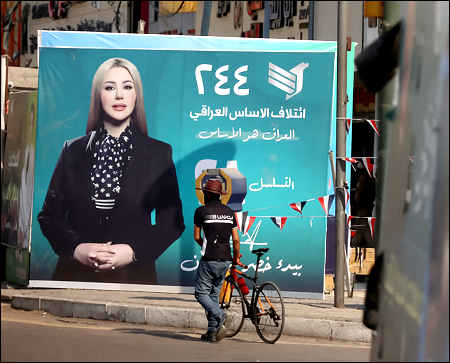
BAGHDAD,— Frustrated with Iraq’s political establishment, 25-year-old Anwar Ibrahim is stepping into the political arena. He is one of many young Iraqis running for parliament next week, hoping to challenge an entrenched class that has dominated the country’s politics since the fall of Saddam Hussein in 2003.
“I believe young people and technocrats should have the opportunity to help manage the state and end the domination of certain political parties,” Ibrahim told Reuters.
The pro-democracy activist says the system has long excluded his generation, leaving them to inherit a country plagued by corruption and economic stagnation.
Many Iraqis remain doubtful that the November 11 parliamentary vote will bring real change. The same political blocs have controlled state institutions and oil revenues for two decades.
But the surge of youthful candidates appearing in significant numbers for only the second time since 2005, signals that a generation once sidelined may now be asserting itself.
An official with the Iraqi High Electoral Commission (IHEC) told Reuters that nearly 40 percent of registered candidates are under 40 years old, and about 15 percent are under 35.
“This shows there is growing interest among Iraq’s youth to participate in shaping the country’s future,” the official said. “It reflects a desire for renewal and a stronger voice from a generation that has long felt excluded.”
Most of these candidates are in their late 20s to mid-30s, representing both Iraq’s Shiite majority and Sunni minority. In contrast, the current parliament has an average age of about 55.
In the 2021 elections, only 24 percent of candidates were under 30, according to IHEC data.
This wave of younger contenders could motivate some citizens to vote for the first time, drawn by the promise of change and disillusioned by years of sectarian politics. Despite regular elections, Iraq continues to face widespread unemployment, weak services, and persistent corruption.
Young Iraqis Divided Over Voting
But not all young Iraqis share the enthusiasm. Some have lost hope in the system altogether.
Ali Abd al-Hussain, a 28-year-old musician from Baghdad, said he destroyed his voter registration card.
“Those we elected before came to us wearing simple clothes, saying they wanted to bring change,” he said. “After we voted, the change came, but only for them. They now wear expensive suits and ride in luxury cars with tinted windows. I will not vote again.”
Instead of forming new political movements, many young Iraqis have joined established blocs, hoping to influence them from within. It is an ambitious approach in a system where political patronage dominates public life.
“Networks tied to parties control jobs, contracts, and security appointments, ensuring loyalty and limiting opportunities for outsiders,” told Reuters Baghdad-based constitutional expert Kadhum al-Bahadli. “Breaking this cycle would require not only political will but also a deep shift in how economic and security power is distributed.”
A System Hard to Change
Analysts say this was not the future envisioned when Iraqis pulled down Saddam’s statue in Baghdad in 2003. U.S. officials then believed Iraq would move toward democracy and fair distribution of its oil wealth.
Instead, the country descended into sectarian conflict, an insurgency loyal to Saddam, and the rise of extremist groups such as al-Qaida and later Islamic State.
Since then, power has shifted from Saddam’s Sunni minority to the Shiite majority, represented by civilian leaders and militias aligned with Iran.
Youth Candidates Push for Reform
Today, young candidates like Ibrahim say they want to rewrite the electoral law, create an independent elections commission, and reduce the influence of Iran-backed militias. But they know change will not come easily.
Some candidates believe the balance of power could shift following the recent conflict between Israel and Iran, which briefly drew in the United States last June. Ibrahim said the confrontation may weaken the militias tied to Tehran, opening a small window for reformists.
Others, however, fear violent pushback. “We are worried about attempts to prevent change,” said Hussein al-Ghurabi, another young candidate. “Parties that have armed wings may use their weapons to block any real transformation.”
Iraq’s younger generation has already shown its willingness to confront the system. In October 2019, mass protests erupted over corruption, unemployment, and poor services. Security forces cracked down violently, killing 149 demonstrators.
A government inquiry later found that over 70 percent of those killed were shot in the head or chest.
“If we succeed, this election will be a step toward a new Iraq,” al-Ghurabi said. “If we fail, democracy here will remain only words on paper.”
(With files from Reuters)
Copyright © 2025 iKurd.net. All rights reserved.
Related posts:
 The Resurrection (Ba’ath) Party – Before the Iran-Iraq War
 Saddam Hussein was a Friend to the West
 Iraq: Revenge and Corruption
 The Truth About The Saddam Hussein Affair
 Saddam Hussein’s Enemies: Paving the Road to the Invasion of Iraq
 Saddam Hussein…The Hell That is Iraq!?
 The Mustashar and the Jash – A View from the Position of ‘Iraqi National Unity’ on the ‘Descendants of Treason’
 The Suffocation of Iraq Kurdistan
 The 19th Anniversary of the U.S. Invasion of Iraq, 20 March 2022
 Iraq in the Shadow of Khomeinism – Part III: Iraq is NOT Iran!