

BAGHDAD,— Iraq will hold parliamentary elections on November 11 as Iran, weakened across the Middle East, seeks to protect its political foothold in Baghdad, analysts said.
Tehran’s regional standing has eroded over the past two years after its allied movements, including Hamas in Gaza, Hezbollah in Lebanon and the Houthis in Yemen, were hit by major Israeli military operations.
In June, Israel launched airstrikes inside Iran for the first time, joined briefly by the United States. Syria’s former President Bashar al-Assad, one of Tehran’s closest partners, was ousted last year.
With its influence shrinking elsewhere, Iran is focusing on maintaining leverage in Iraq, where it has built extensive political, religious and military ties since the 2003 U.S.-led invasion that overthrew Saddam Hussein.
“Iran’s influence continues as long as its allies are the ones making decisions,” said Ihsan al-Shammari, a political analyst in Baghdad.
Iran-backed factions and Shiite parties remain deeply embedded in Iraq’s power structure. The current Iraqi prime minister, Mohammed Shia al-Sudani, came to office through the Coordination Framework, a coalition of Iran-aligned parties that dominates parliament.
Iraq continues to walk a careful line between Tehran and Washington. The rivalry has often turned violent.
Pro-Iranian Shiite militias attacked U.S. targets in Iraq during the early stages of the Gaza conflict, prompting U.S. retaliatory strikes.
When direct fighting later broke out between Iran and Israel, those Iraqi groups largely stayed on the sidelines.
Munqith Dagher, who heads the polling organization IIACSS, said Iran’s capacity to dictate terms has diminished but added that “Tehran will still seek to shape Iraq’s political process.”
The vote will be Iraq’s sixth national election since 2003. Turnout is expected to be low, with many Iraqis disillusioned by years of unstable governments.
A Chatham House report said participation could fall to its lowest level in two decades, describing elections as “a symbolic act with limited effect on real change.”
Moqtada Sadr, the powerful Shiite cleric whose movement won the most seats in 2021 before pulling out of parliament, has said he will boycott the November poll.
He described it as “a corrupt and sectarian exercise.” His absence leaves the Coordination Framework in a strong position to retain control.
More than 21 million voters are eligible to elect 329 lawmakers. The parliament will then choose a president and a prime minister, following Iraq’s customary power-sharing arrangement in which the premiership goes to a Shiite, the presidency to a Kurd and the parliamentary speaker to a Sunni.
The United States continues to play an active role in Iraq’s politics and economy. “Washington wants to curb Tehran’s grip by backing leaders more open to U.S. partnerships,” said Ibrahim al-Sumaidaie, a former adviser to Sudani.
U.S. sanctions have targeted Iraqis accused of helping Iran bypass financial restrictions, while American companies have expanded contracts in oil, energy and health care.
“Regardless of the election’s outcome, the United States expects the next government to move against Iranian influence,” said Tamer Badawi of Britain’s RUSI defense institute.
He said Washington does not want Iran using Iraq as a route to trade oil or obtain foreign currency.
Roughly 2,500 U.S. troops remain stationed in Iraq, along with 900 more in Syria, as part of the coalition against Islamic State.
In a recent statement on X, U.S. special envoy Mark Savaya emphasized the goal of “a fully sovereign Iraq, free from external interference,” adding that no armed factions should operate outside the state’s authority.
Iraq’s autonomous Kurdistan Region will also take part in the national vote, where competition between the Barzani’s Kurdistan Democratic Party and the Talabani’s Patriotic Union of Kurdistan remains intense.
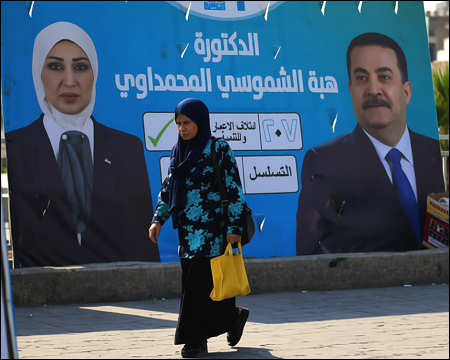
Electoral rules set aside 25 percent of seats for women and nine for minority groups. Around 7,700 candidates are running across the country, nearly a third of them female, in a nation of about 46 million people.
(With files from AP)
Copyright © 2025 iKurd.net. All rights reserved.
Related posts:
 The Resurrection (Ba’ath) Party – Before the Iran-Iraq War
 Iraq: Revenge and Corruption
 Saddam Hussein was a Friend to the West
 The Suffocation of Iraq Kurdistan
 Iraq in the Shadow of Khomeinism – Part III: Iraq is NOT Iran!
 Saddam Hussein’s Enemies: Paving the Road to the Invasion of Iraq
 Iraqi Kurdistan – “Sold Out!” – Part II
 The Truth About The Saddam Hussein Affair
 The Assassination of Abdurrahman Ghassemlou: No Friends but the Mullahs?
 LOSING IRAQ — to Iran