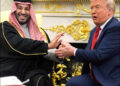


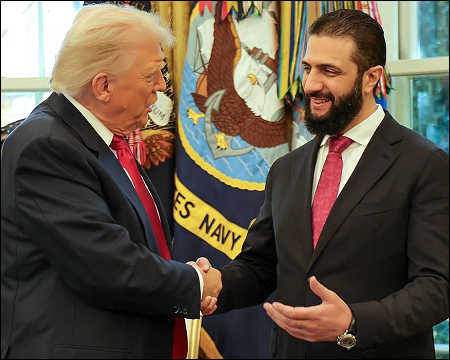
WASHINGTON,— U.S. President Donald Trump met Monday at the White House with Syrian Interim President Ahmad al-Sharaa, a former al-Qaeda commander, in a historic encounter marking a major shift in Washington’s Middle East policy and Syria’s return to the international stage.
Ahmad al-Sharaa, also known as Abu Mohammed al-Golani, built his career inside some of the world’s most violent jihadist networks.
He served with al-Qaida and ISIS before establishing the al-Nusra Front, a Syrian offshoot of al-Qaida later repackaged as Hayat Tahrir al-Sham (HTS).
Though he now presents himself as a statesman, his past links to terrorism and extremist ideology continue to shadow his rule and raise doubts about his claimed transformation.
Al-Sharaa’s arrival at the White House just before noon marked the first visit by a Syrian leader since the nation’s independence in 1946. The meeting was kept closed to the press and lasted roughly two hours.
Officials said discussions centered on reconstruction, investment, and Syria’s formal entry into the United States-led Global Coalition to Defeat the Islamic State group.
According to a senior administration official, Syria became the coalition’s 90th member during the visit.
The United States also agreed to reopen the Syrian Embassy in Washington to coordinate on counterterrorism and security matters. The official spoke on condition of anonymity, saying a joint statement would be issued later in the week.
President Trump, speaking afterward to reporters, praised the visiting leader and described the meeting as “positive and forward-looking.”
“We’ll do everything we can to make Syria successful because that’s part of the Middle East,” Trump said. “I have confidence he’ll be able to do the job.” The president added that he expected to meet al-Sharaa again soon.
Al-Sharaa, appearing later on Fox News, said the two discussed long-term investment opportunities. “We spoke about transforming Syria from a place viewed as a security threat to a partner for regional stability and U.S. economic interests,” he said, mentioning projects in gas exploration and infrastructure.
Syria’s Foreign Ministry released a statement calling the discussions “friendly and constructive.” The ministry said Trump had expressed readiness to support Syria’s recovery and reconstruction following years of conflict.
It added that U.S. Secretary of State Marco Rubio met separately with Syrian Foreign Minister Asaad al-Shibani and Turkish Foreign Minister Hakan Fidan, who were both in Washington.
The officials agreed to continue efforts to implement an earlier deal integrating the Kurdish-led Syrian Democratic Forces, the de facto army of autonomous administration in Syrian Kurdistan (Rojava) into the national army.
It was not immediately clear what specific measures were reached, though both sides said progress had been made. The ministry also mentioned that Washington had reaffirmed support for talks toward a potential security arrangement between Syria and Israel, though no details were provided on Damascus’s response.
The White House meeting capped a dramatic turnaround for Syria and for al-Sharaa, who only last year led rebel forces that ousted longtime president Bashar Assad. Al-Sharaa took office in January after the December 8 uprising and has since sought to reposition his country as a U.S. partner rather than an adversary.
Before his visit, the United Nations Security Council voted to lift sanctions on Syrian officials, a move the U.S. ambassador to the U.N., Mike Waltz, described as “a sign that Syria is entering a new chapter.”
The U.S. government had already removed al-Sharaa’s name from its terrorist sanctions list earlier this year.
Al-Sharaa, once known for his involvement with al-Qaida’s Syrian branch, had a ten-million-dollar U.S. bounty on his head before breaking with the group in 2016.
Trump met him for the first time in Saudi Arabia in May. At the time, Trump described him as “a strong, determined fighter who wants peace.”
The Syrian president arrived in Washington quietly, entering the White House through West Executive Avenue rather than the ceremonial West Wing driveway typically used for state arrivals. A small crowd of supporters gathered nearby, waving Syrian flags and chanting his name as his convoy departed about two hours later.
A major focus of al-Sharaa’s trip was sanctions relief. The Caesar Act sanctions, imposed in 2019 over human rights violations by the Assad government, remain the most significant barrier to rebuilding Syria’s economy. Although the Trump administration has suspended enforcement for six months, only Congress can repeal the act.
Two competing proposals have emerged in Congress. Senator Jeanne Shaheen, a Democrat from New Hampshire, supports a permanent repeal without conditions. Senator Lindsey Graham, a Republican from South Carolina, has proposed ending sanctions but subject to review every six months.
Critics argue that conditional repeal would discourage foreign investment because companies fear the risk of renewed penalties.
Mouaz Moustafa, director of the Syrian Emergency Task Force, said that as long as sanctions hang over Syria, private investors will stay away. “It acts like a shadow that freezes progress,” he said in a statement Monday.
The U.S. Treasury Department later announced that the current sanctions waiver would be extended another 180 days, effectively maintaining the status quo while Congress debates next steps.
Analysts in Washington described the meeting as an important symbolic moment. Syria’s participation in the anti-Islamic State coalition marks a significant geopolitical shift, especially after years of isolation during the Assad era. Yet questions remain about the durability of the new relationship and the political future of al-Sharaa’s transitional government.
A senior administration official, speaking to reporters under background rules, said Washington views Syria’s cooperation as “an opportunity for a stable, counterterrorism-focused partnership.”
The official added that the U.S. hopes to support reforms in Damascus and encourage economic stability in Kurdish regions such as Hasaka and Qamishlo in Syrian Kurdistan.
As al-Sharaa left the White House, his motorcade briefly stopped near the gates. He stepped out to greet cheering supporters before departing. For now, both governments appear eager to present the meeting as a fresh start after decades of confrontation.
(With files from Reuters | AP | Agencies)
Copyright © 2025 iKurd.net. All rights reserved.
Related posts:
 The Resurrection (Ba’ath) Party – Before the Iran-Iraq War
 Business with ISIS – Updated
 Saddam Hussein was a Friend to the West
 Stealing Syria
 Syria: Revisiting The Caesar Torture Victim Photographs
 Syria: A ‘Caliphate’ by Any Other Name — Would Smell the Same
 The Islamic State of Syria? (Al Dawla al-Islamiya fi al-Sham)
 Sabotaging Syria
 Syria: The Truth Lies Buried beneath an Edifice of Lies
 Syria: The Hijacking of the Arab Spring: From ISIS to Hayat Tahrir al-Sham