

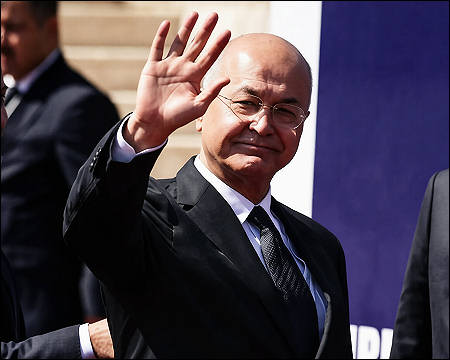
GENEVA,— Former Iraqi President Barham Salih has been appointed as the next United Nations High Commissioner for Refugees, marking a notable shift away from the long-standing practice of appointing leaders from major European donor countries, according to a letter circulated by the office of the U.N. Secretary General.
U.N. Secretary General Antonio Guterres confirmed the appointment in a letter dated December 11, stating that Salih would be proposed to the U.N. General Assembly for approval.
The term is set for five years beginning January 1, pending the customary endorsement process by UNHCR’s governing committee, diplomats in Geneva said.
Salih, who is 65, served as president of Iraq from 2018 until 2022. He is expected to replace Italy’s Filippo Grandi, who is stepping down at the end of December after completing a decade as head of the U.N. refugee agency. UNHCR is headquartered in Geneva and operates in more than 130 countries.
According to U.N. officials, Guterres described the approval process as a routine procedure and emphasized the need for continuity at the agency during a period of significant operational and financial strain.
Salih enters the role at a time of mounting challenges for UNHCR. The agency has been affected by sharp reductions in international aid, similar to other U.N. bodies, and has reduced its workforce by nearly 5,000 staff members this year.
That figure represents more than one quarter of its global employees, according to internal agency figures shared with member states.
UNHCR is also facing record levels of global displacement. The agency estimates that more than 117 million people worldwide have been forced from their homes, either within their own countries or across borders.
Funding has declined by approximately 35 percent so far this year, leaving major gaps in assistance programs, according to agency briefings.
The United States, traditionally the largest contributor to UNHCR, has significantly reduced foreign aid allocations under President Donald Trump. Washington had previously provided more than 40 percent of the agency’s annual budget.
The pullback, combined with reductions by other donor nations, has created what outgoing High Commissioner Grandi described as bleak financial projections.
At a press briefing in Geneva, UNHCR spokesman Ewan Watson said that the right to seek asylum, established by international agreements in 1951, is increasingly under pressure. He noted that millions of displaced people now face reduced access to protection, food, shelter, and essential services due to funding shortages.
Salih is a veteran Kurdish politician with decades of experience in Iraqi and regional politics. He has held several senior posts in Baghdad and in the Kurdistan region following the 2003 U.S.-led invasion that removed Saddam Hussein from power.
He was a senior figure in the Patriotic Union of Kurdistan, Iraq’s second-largest Kurdish political party, and took part in the interim authority established after the invasion.
Salih served as one of Iraq’s deputy prime ministers from 2006 to 2009, and later as prime minister of the Kurdistan region from 2009 to 2012.
Fluent in English, Arabic, and Kurdish, Salih served four years as Iraq’s president, a largely ceremonial role that has traditionally been held by a Kurd since 2005.
He is also affiliated with Harvard University as a senior fellow at the Middle East Initiative and the Belfer Center for Science and International Affairs.
According to the Belfer Center, Salih holds a civil engineering degree from the University of Cardiff and a doctorate in statistics and computer applications in engineering from the University of Liverpool.
UNHCR is currently hosting its biennial Global Refugee Forum Progress Review in Geneva, drawing more than 1,800 participants. T
he meeting is focused on evaluating commitments and identifying responses to long-term displacement challenges, U.N. officials said.
(With files from AFP | Reuters)
Copyright © 2025 iKurd.net. All rights reserved.
Can Barham Salih succeed in repatriating Iraqi Kurdistan’s embezzled money?
Related posts:
 Iraqi Kurdistan – “Sold Out!” – Part II
 Iraq – The Cynical Swindle
 Saddam Hussein’s Enemies: Paving the Road to the Invasion of Iraq
 The Resurrection (Ba’ath) Party – Before the Iran-Iraq War
 Saddam Hussein was a Friend to the West
 Iraq: Revenge and Corruption
 Iraq: A State of Surveillance – Databases, Tracking And Corruption
 Business with ISIS – Updated
 The Truth About The Saddam Hussein Affair
 The Misleaders: Corrupt, Filthy Rich, and Proud of it