

TRIPOLI,— Saif al-Islam Gaddafi, the most prominent son of Libya’s late ruler Muammar Gaddafi, was killed on Tuesday during an armed attack on his home, his office said, ending a life that swung between political influence, captivity, exile, and a failed presidential bid.
His office said four unidentified gunmen forced their way into his residence and shot him in a “direct confrontation.” No group immediately claimed responsibility, and the attackers remained unidentified.
Libya’s attorney general confirmed that forensic investigators examined his body and determined he died from gunshot wounds. Officials said they were working to identify those responsible.
Although he held no official role at the time, Saif al-Islam, 53, had long been considered one of Libya’s most powerful figures, second only to his father, who ruled for more than 40 years.
During Muammar Gaddafi’s rule, Saif al-Islam helped shape policy and led sensitive diplomatic missions. He negotiated Libya’s decision to abandon its weapons of mass destruction program and arranged compensation for families of victims of the 1988 Lockerbie bombing of Pan Am Flight 103.
He presented himself as a reformer, advocating for a constitution and human rights. Educated at the London School of Economics and fluent in English, he was once seen by Western governments as a modern, acceptable face of Libya.
That image ended in 2011, when a rebellion erupted against his father’s rule. Saif al-Islam sided with his family and played a key role in the government’s violent crackdown on rebels, whom he called “rats.”
Speaking to Reuters during the uprising, he said, “We fight here in Libya, we die here in Libya,” warning of rivers of blood and promising the government would resist to the last man, woman, and bullet.
In a televised speech, he predicted Libya would be destroyed and would need decades to agree on governance.
After rebels seized Tripoli, he tried to flee to Niger disguised as a Bedouin tribesman. The Abu Bakr Sadik Brigade militia captured him on a desert road and flew him to Zintan about a month after his father was killed.
An audio recording captured him saying, “I’m staying here. They’ll empty their guns into me the second I go out there.” Reuters reported he had been betrayed by a Libyan nomad.
He spent six years detained in Zintan, a sharp contrast to his earlier life of luxury, which included pet tigers, falcon hunting, and mingling with British high society.
Human Rights Watch met him in detention. Hanan Salah, the group’s Libya director, told Reuters that he did not claim mistreatment but was kept mostly in solitary confinement.
He was missing a tooth, received no visitors, but had access to satellite television and books.
In 2015, a Tripoli court sentenced him to death by firing squad for war crimes. The International Criminal Court in The Hague also issued an arrest warrant for murder and persecution.
He was released in 2017 under an amnesty law and went underground to avoid assassination. From 2016 onward, he was allowed contact with people inside and outside Libya, according to Libyan analyst Mustafa Fetouri, who said Saif al-Islam received visitors weekly, debated politics, and sometimes accepted books and gifts.
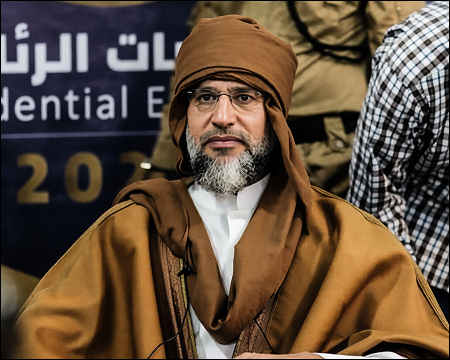
Saif al-Islam made a public return in 2021 when he appeared in the southern city of Sabha wearing traditional Libyan dress to register as a presidential candidate. Many believed he hoped to appeal to nostalgia for stability before the 2011 uprising.
His candidacy faced opposition from those who suffered under his father and from armed groups that emerged from the rebellion.
Election talks stalled, and his disqualification over his 2015 conviction, coupled with armed fighters blocking a court appeal, contributed to the collapse of the election process.
In a 2021 interview with The New York Times Magazine, he described his political comeback as a gradual process: “You need to come back slowly, slowly. Like a striptease. You need to play with their minds a little.”
Jalel Harchaoui, a contributor to Britain’s Royal United Services Institute, told Reuters that Saif al-Islam struggled to communicate publicly after his release but remained symbolically powerful, a key factor in preventing the 2021 elections.
Harchaoui added that Saif al-Islam’s death would likely anger pro-Gaddafi supporters while removing one major obstacle to holding future elections in Libya.
Hannibal Gaddafi, the youngest son of Libya’s former leader Muammar Gaddafi, was released in November 2025 after spending almost a decade in detention in Lebanon without ever facing trial.
(With files from Reuters)
Copyright © 2026 iKurd.net. All rights reserved.
Related posts:
 Lebanon lifts travel ban on Hannibal Gaddafi, lowers bail
 Sabotaging Syria
 The Resurrection (Ba’ath) Party – Before the Iran-Iraq War
 Lebanon releases Gaddafi’s son Hannibal after decade in detention
 Khalifa Haftar Getting Stronger
 Khalifa Haftar Hard to Replace in Libya
 Iraq in the Shadow of Khomeinism – Part III: Iraq is NOT Iran!
 Libya’s Haftar a Dominant Player
 Sirte-Jufra Will be a Flashpoint in Libya Conflict
 Time to Remember Omar Al-Mukhtar