

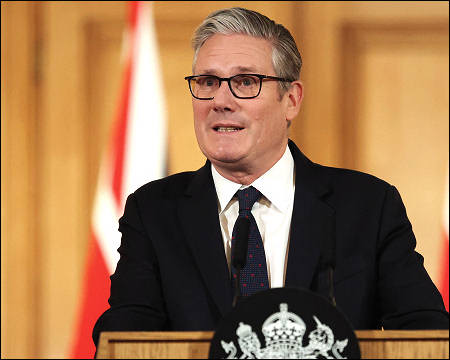
LONDON,— British Prime Minister Keir Starmer announced on Monday that he will step down, saying he intends to oversee an orderly transition to a successor no later than September in an effort to prevent political disruption, Reuters reported.
The move sets Britain on course to have its seventh leader in the decade since the Brexit vote.
Speaking in Downing Street outside his office and official London residence, Starmer said he had reflected on his position and concluded that he should no longer lead the governing Labour Party into the next general election, which is scheduled for 2029.
His decision followed weeks in which he insisted he would resist any attempt to remove him. Over the weekend, however, he considered his future at his country residence as backing within Labour continued to weaken.
Starmer said he would ask the Labour Party’s organizing committee to establish a timetable for selecting a new leader. Under the proposed schedule, nominations will begin on July 9 and close by the middle of July. If a contest is required, a replacement will be chosen by September.
He made no reference to Andy Burnham, who is widely expected to succeed him.
“The question my party is asking now is whether I am best placed to lead us into the next general election. I have heard the answer from my parliamentary party to that question and I accept that answer with good grace,” Starmer said.
The prime minister reviewed the accomplishments of his administration during two years in office before becoming emotional while thanking his family. Starmer, who has often faced criticism for appearing robotic, struggled to maintain his composure as he spoke.
“When I leave the biggest job in the country I will spend more time on the most important job, being the best husband I can to my fantastic wife Vic who has been a rock by my side through good times and bad, and being the best dad I can to my beautiful children who are my pride and my joy,” he said.
Pressure on Starmer had been mounting for several months. His departure means that whoever takes over will become Britain’s seventh prime minister since voters chose to leave the European Union 10 years ago this week.
The rapid turnover of leaders, the highest Britain has experienced in nearly 200 years, highlights ongoing difficulties faced by governments attempting to maintain public support amid concerns over living standards, public services and illegal immigration.
Challenges to Starmer’s leadership intensified on Friday after Burnham, the mayor of Greater Manchester, won a parliamentary election and returned to Westminster.
He defeated a candidate from Nigel Farage’s Reform UK party, which has led national opinion polls for more than a year.
The result encouraged Labour lawmakers who believe Burnham’s communication skills and long political experience could help revive a party that has lost support while Starmer’s approval ratings have fallen to record lows for a British leader.
Financial markets showed little reaction immediately after the announcement. The pound and British government bonds remained steady as investors had largely anticipated Starmer’s resignation.
Despite expectations of a smooth transfer of power, uncertainty remains. Additional candidates entering the leadership race could create a divisive contest and hinder the government’s ability to function effectively.
Sky News reported on Monday, citing an ally of former health minister Wes Streeting, that Streeting still intends to compete for the leadership.
Burnham, expected to arrive in London on Monday to take up his newly won seat representing Makerfield in northwestern England, has not yet presented a detailed policy platform.
Beyond calls for fundamental change and lower living costs, he has not outlined positions on foreign policy, economic issues or defense.
Investors interviewed by Reuters were divided over whether Burnham would prioritize reassuring financial markets.
(With files from Reuters)
Copyright © 2026 iKurd.net. All rights reserved.
Related posts:
 The Resurrection (Ba’ath) Party – Before the Iran-Iraq War
 Labour party wins UK general election in historic victory
 The Double Cross of Iraq And The Discordant Death of WMD Inspector, Dr David Kelly – The 17th Anniversary
 Nadhim Zahawi: Who Really is The New UK Chancellor?
 Iraq’s Internal Enemies: Shi’a rivalries and the fallout from the US-led invasion
 Saddam Hussein’s Enemies: Paving the Road to the Invasion of Iraq
 Iraq’s Sudani meets Britain’s King Charles III, PM Starmer in London
 Business with ISIS – Updated
 Iraqi Kurdistan – “Sold Out!” – Part II
 Iraq in the Shadow of Khomeinism – Part III: Iraq is NOT Iran!