

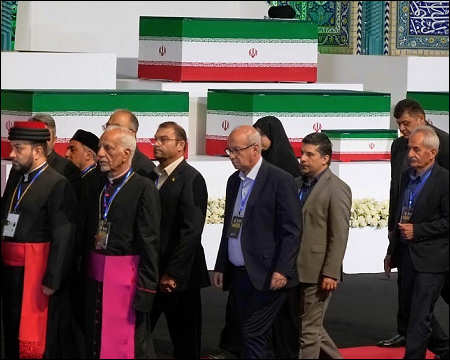
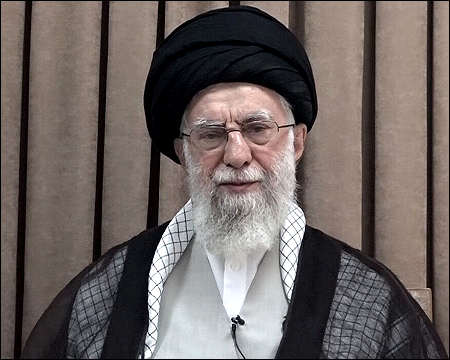
TEHRAN,— In Tehran on Friday, the body of Ayatollah Ali Khamenei lay in state inside a vast hall as clerics, officials, foreign representatives, and mourners gathered to honor Iran’s late Supreme Leader, who was killed in strikes by U.S. and Israeli forces.
The government has launched a week of large funeral processions for Khamenei, whose 37-year leadership ended in February when the first airstrike of the war struck him.
Authorities are presenting the ceremonies as a demonstration of loyalty to the Islamic Republic’s clerical system and revolutionary ideology.
Following the death, arrangements were made to move his body to Qom, Najaf, and Kerbala, important Shiite centers in Iran and Iraq, before burial scheduled for Thursday in Mashhad, near the nation’s most sacred pilgrimage site.
Late Thursday, his coffin was opened to large crowds of mourners who cried, swayed, and struck their chests in rhythm with chanting, while flowers were thrown from the bier.
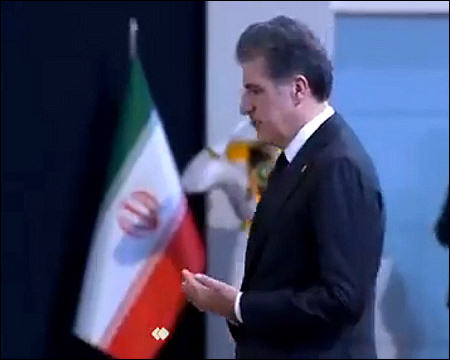
On Friday, his coffin and those of relatives killed alongside him were placed in state in a major prayer hall dedicated to Ayatollah Ruhollah Khomeini.
The events are unfolding at a sensitive moment for Iran. The clerical establishment, backed by the Islamic Revolutionary Guard Corps, is projecting strength after what it describes as surviving an existential conflict with its main adversaries.
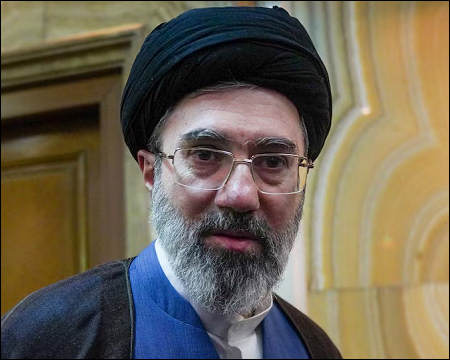
Yet nearly five decades after the 1979 revolution, internal tensions remain visible. Analysts say backing for the leadership is weak, and the newly named Supreme Leader, Mojtaba Khamenei, has not appeared publicly in recent images since being injured in the strike that killed his father.
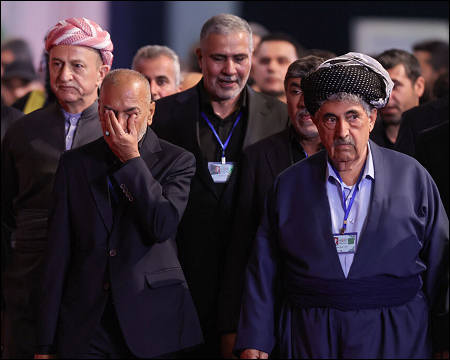
Senior Iraqi and Kurdistan officials were among those who paid tribute to the late leader during funeral ceremonies in Tehran, including Iraqi President Nizar Amedi, Parliament Speaker Haibat al-Halbousi, President of Patriotic Union of Kurdistan PUK Bafel Talabani, Kurdistan Region President Nechirvan Barzani, and other Kurdish officials.
A delegation from Iraq’s pro-Iran Shiite Popular Mobilization Forces (PMF), led by PMF Chairman Faleh al-Fayyad, also attended the funeral ceremonies in Tehran. The delegation included Chief of Staff Abdul Aziz al-Muhammadawi, along with several other PMF leaders and senior officials.
Economic pressure from years of sanctions has severely strained Iran’s financial system, while recurring nationwide protests have been suppressed by security forces with increasing severity, including deadly incidents in January that killed thousands of demonstrators.
Despite these conditions, authorities have focused this week on projecting unity, organizing large public ceremonies intended to attract millions of participants across the country.
Security measures in Tehran have been extensive, with police and military vehicles deployed along major roads and Basij volunteer units patrolling on motorcycles.
Officials also issued warnings to the United States and Israel against any interference during the funeral period.
When the coffins arrived on Friday, they were carried above the crowd and placed on a raised white platform within a prayer hall decorated with national and mourning flags.
A black turban, symbolizing clerical descent from the Prophet Muhammad, was placed on top alongside a checkered scarf associated with revolutionary symbolism and solidarity with Palestinians.
Delegations from Russia and China were expected, while political leaders from Iraq, Armenia, and Pakistan traveled to Tehran for the ceremonies.
Members of Hezbollah leader Hassan Nasrallah’s family and commander Imad Mughniyeh, both killed in Israeli strikes, also attended.
Iran’s president, speaker of parliament, foreign minister, and other senior officials participated in prayers, with many visibly grieving. Military generals stood in formation and saluted the coffin during the ceremony.
Under Iran’s political-religious system, Khamenei was not only head of state but also considered a representative of the hidden twelfth Imam in Shiite belief.
His death in an enemy attack has reinforced longstanding traditions of mourning and martyrdom.
Black flags have been displayed across cities, referencing Imam Hossein’s martyrdom in the seventh century.
In central Tehran, crowds gathered overnight, crying and chanting as Basij members led prayers and distributed images of the former leader.
Mobina Razaaghi, an 18-year-old student from Isfahan, said the grief could only be eased through justice and retaliation.
Also killed in the strike were his daughter, his son-in-law, and his infant granddaughter, along with the wife of his son Mojtaba.
Although Islamic custom calls for burial within 24 hours, the funeral was postponed due to wartime conditions and rescheduled following a temporary truce agreement.
Authorities have organized extensive logistics, including discounted hotels, temporary shelter in schools and mosques, and rerouted transport services to handle crowds.
A major procession is scheduled in Tehran on Monday, followed by ceremonies in Qom on Tuesday, Najaf and Kerbala on Wednesday, and burial in Mashhad on Thursday near the Imam Reza shrine.
Officials said preparations also include expanded transport arrangements and coordinated security operations across all stages of the ceremonies in Iran and Iraq, as authorities seek to manage large crowds and intercity movement throughout the week.
Additional measures are planned across multiple cities during the events this week period.
(With files from Reuters)
Copyright © 2026 iKurd.net. All rights reserved.
Related posts:
 The Assassination of Abdurrahman Ghassemlou: No Friends but the Mullahs?
 The Resurrection (Ba’ath) Party – Before the Iran-Iraq War
 The Suffocation of Iraq Kurdistan
 Iran Now Under Military Rule
 Iran – Toxic Theocracy – Part I
 Ayatollah Khamenei’s fading acceptability in Iran, Iraq and Lebanon
 Mojtaba Khamenei appointed Iran’s new supreme leader
 LOSING IRAQ — to Iran
 Iran, a Failed Country by Enemies Within
 Who Are the Persians, Part V